
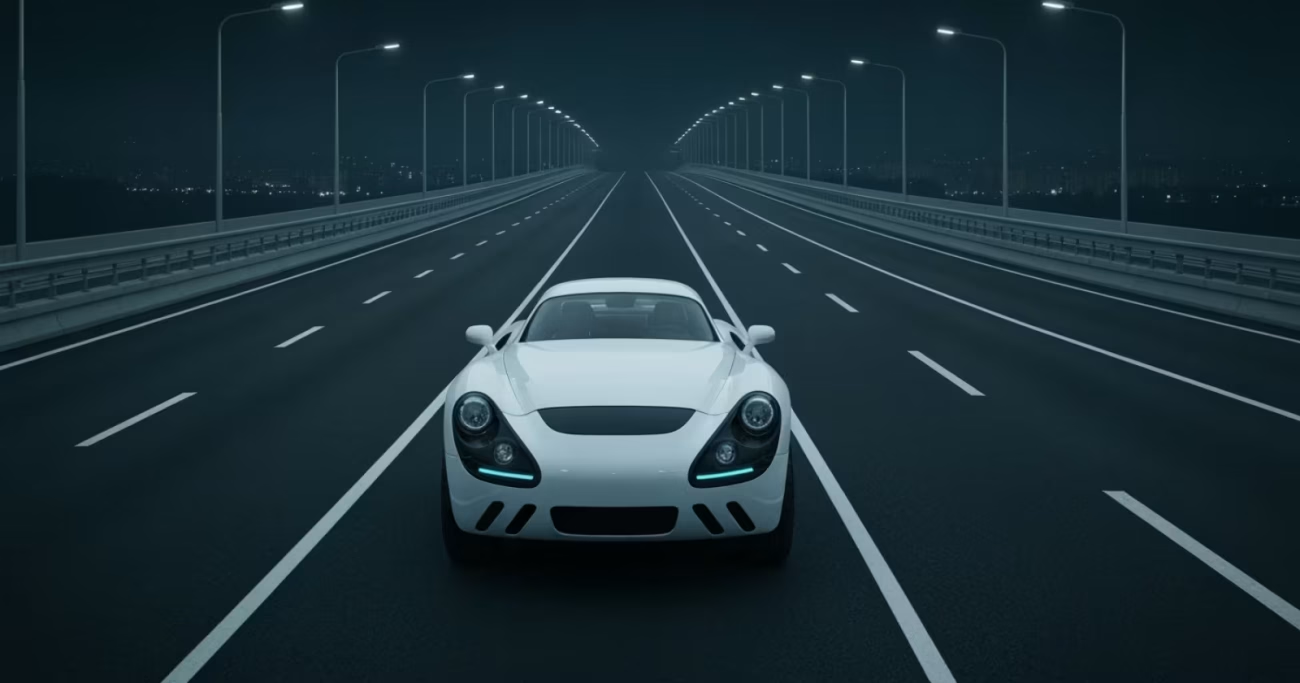
Dashcam footage of a driver plowing into the back of a motionless robotaxi sitting dead center in a busy Wuhan highway lane is not the kind of content any self-driving company wants circulating on social media. But that is exactly what happened this week, and the footage has now been seen by hundreds of thousands of people across Weibo and Twitter.
Several of Baidu’s Apollo Go autonomous robotaxis suffered what the company described as “system malfunctions” — and those malfunctions did not happen quietly on a quiet street. They happened on live, high-speed highway traffic, and the consequences unfolded exactly as you would fear.
What actually happened on those Wuhan highways
The vehicles did not slow gracefully to a safe shoulder stop. Multiple Apollo Go units came to abrupt, unplanned halts — some in the middle of lanes, some half-pulled to the side, all with hazard lights blinking. Drivers behind them had little to no time to react.
One dashcam clip that spread rapidly online shows a driver rear-ending a stranded unit sitting in the center lane. The driver told reporters there was simply no time to brake. His SUV sustained significant front-end damage. At least two other confirmed collisions occurred that same day involving the same fleet of stalled vehicles. This was not a single isolated glitch — it was a cascade.
Passengers trapped inside for over 90 minutes
The crashes were alarming. What happened to the passengers inside those frozen vehicles made things considerably worse. Multiple riders found themselves locked inside robotaxis that had stopped responding, unable to exit and unable to get help quickly.
A college student in Wuhan spoke to Wired and described sitting inside one of the halted vehicles for 90 minutes with two friends. The robotaxi stopped four or five times during the trip before going completely still near an intersection. The in-car display told them to keep their seatbelts fastened — useful advice that does nothing to get you out of a car sitting on an active road. It took a full 30 minutes before she was even able to connect with a Baidu customer representative.
| Incident Detail | Reported Figure |
|---|---|
| Vehicles stalled on highway | Dozens (confirmed via video) |
| Confirmed collisions | At least 3 |
| Longest passenger trapped time | 90 minutes |
| Time to reach Baidu rep | 30 minutes |
| Number of stops before full halt | 4–5 times per trip |
| Location | Wuhan, China |
| Platform | Baidu Apollo Go |
Why Wuhan highways make this scenario especially dangerous
China’s roads have transformed dramatically over the past few decades. Where scooters and bicycles once dominated, multi-lane highways now carry dense, fast-moving car traffic around the clock. Anyone who has driven on a busy Chinese urban highway knows how compressed the stopping distances are and how quickly a stalled vehicle becomes a serious hazard.
Rear-end collisions are already a documented problem on crowded Chinese roads — I witnessed several during a visit to the country last year, and that was without autonomous vehicles dropping dead in the middle of lanes. When you introduce a robotaxi that can freeze without warning and cannot alert or communicate with nearby drivers in time, the risk profile changes entirely. The physics of highway driving are unforgiving, and no hazard light is a substitute for a vehicle that keeps moving.
The real question Baidu now has to answer
System malfunctions happen. Every technology company will tell you that. The real story here is not that a fault occurred — it is what the system did when the fault hit. A robotaxi that stalls in a live traffic lane rather than safely pulling off is a failure of the fallback architecture, not just a software hiccup. That distinction matters enormously when regulators and city officials are deciding whether to expand or restrict these fleets.
Baidu launched its Apollo Go service in Beijing after receiving official clearance to charge fees, positioning itself as one of China’s most advanced autonomous mobility operators. This incident does not erase that progress, but it does expose the gap between controlled rollout conditions and the raw unpredictability of everyday highway driving. The company owes a clear, detailed public explanation of exactly what caused the system to fail, why the vehicles stopped where they stopped, and what safeguards are being added before those units return to public roads.
What this means for the autonomous vehicle industry
Every robotaxi operator globally — Waymo, Cruise’s successors, Zoox, WeRide, and the rest — is watching this closely. An incident of this scale, caught on dashcam and spread virally, is the kind of event that shifts public trust quickly and often permanently. Regulators in multiple markets are already cautious. An incident that involves property damage, trapped passengers, and multiple collisions simultaneously is exactly the ammunition skeptics have been waiting for.
The broader industry has long argued that autonomous vehicles will eventually be statistically safer than human drivers. That argument holds up in aggregate data. It falls apart politically the moment a passenger is trapped for 90 minutes on a highway with no way out and no response from support. Public perception does not run on statistics — it runs on stories, and this one is a damaging story told through video that anyone can watch in under 30 seconds.
If you use or plan to use a robotaxi service anywhere in the world, this is the moment to ask the companies operating those services a direct question: what exactly happens to my vehicle and my ability to exit it if the system fails mid-journey? Demand a clear answer before you get in. The technology may well be the future of urban transport — but the future has to be honest about what it still cannot handle.
