
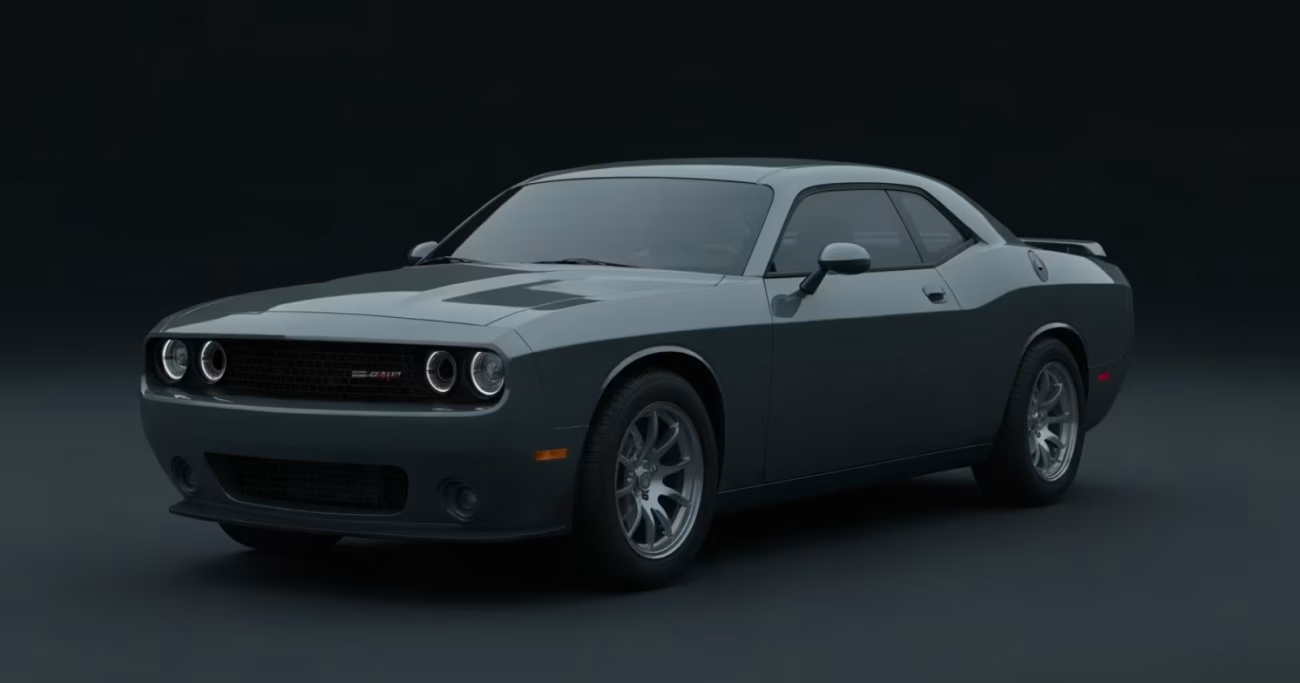
A car that stopped rolling off the production line more than two years ago just outsold Dodge’s flagship electric vehicle in the first quarter of 2026. That sentence alone should be keeping Stellantis executives awake at night.
I’ve tracked quarterly sales data long enough to know that discontinued models linger — a few stragglers here and there is normal. But what I’m seeing in Dodge’s latest numbers goes so far beyond normal that it’s become a genuine indictment of where the brand stands right now. The Challenger is still selling. The EVs meant to replace it are cratering. And the math is nearly impossible to defend.
The Challenger’s ghost is haunting dealership lots in the best possible way
Here’s what defies basic automotive logic: Dodge sold 45 Challengers in Q1 2026. Production for the big V8 coupe ended in late 2023, which means some dealers have been sitting on inventory for over two years — either strategically or simply because the cars weren’t moving at the time. Either way, buyers are still showing up for them.
A year earlier, in Q1 2026, Dodge had moved more than 900 Challengers, so there was clearly a deeper reserve pipeline than anyone expected. That well is nearly dry now, down 95 percent in twelve months. But the real story isn’t the shrinking number — it’s the fact that the number isn’t zero. Enthusiasts are actively hunting down leftover V8 coupes rather than walking into the same dealership and buying the electric future Dodge says they should want.
Three dead models combined are keeping pace with Stellantis’s live EVs
The Challenger isn’t the only zombie on Stellantis’s sales chart. The Jeep Renegade, discontinued after the 2023 model year, moved 23 units in Q1 2026. The Fiat 500X — also a 2023 casualty — actually did better than both, selling 71 units this quarter. Add them up and you’ve got 139 sales from 3 models that are officially dead.
Here’s the catch that makes Stellantis’s EV story genuinely painful: the Fiat 500e, a currently produced and actively marketed electric vehicle, sold just 68 units in the same window. A discontinued three-year-old crossover beat it. The 500e collapsed from 448 sales in Q1 2026 to 68 this year — an 85 percent drop in a single year. That’s not a rough quarter. That’s structural failure.
| Model | Status | Q1 2026 Sales | Q1 2026 Sales | YoY Change |
|---|---|---|---|---|
| Dodge Challenger | Discontinued 2023 | 900+ | 45 | −95% |
| Jeep Renegade | Discontinued 2023 | 370 | 23 | −94% |
| Fiat 500X | Discontinued 2023 | 74 | 71 | −4% |
| Fiat 500e (EV) | Currently on sale | 448 | 68 | −85% |
| Dodge Charger Daytona (EV) | Currently on sale | 1,947 | 240 | −88% |
| Jeep Wagoneer S (EV) | Currently on sale | 2,595 | 175 | −93% |
| Dodge Hornet | Discontinued | N/A | 417 | — |
Dodge’s Charger Daytona dropped 88 percent and nobody wants to say it out loud
The Charger Daytona was supposed to be the proof of concept — the car that showed muscle car culture and electrification could share the same DNA. I’ll admit I was curious when it debuted. The numbers in 2026, though, are brutal: 1,947 sales in Q1 2026 down to 240 this quarter. That is an 88 percent year-over-year collapse for a car that is actively in production and on dealer lots right now.
What Dodge isn’t saying is that these EV sales figures are worse than what you’d typically see from a model approaching the end of its lifecycle — they’re worse than models already discontinued. The Hornet, officially shelved, posted 417 sales in Q1 2026 and beat both the Daytona and the Wagoneer S without breaking a sweat. A discontinued compact crossover outrunning 2 live EVs isn’t a data anomaly. It’s a message.
Buyers are sending Stellantis a signal it cannot afford to misread
What I think we’re watching is a quiet revolt expressed entirely through purchase decisions. The enthusiasts who built their identity around Dodge’s V8 era are not converting to electric at the rate Stellantis projected. Some are chasing down the last surviving Challengers on dealer lots. Others are just waiting — or walking away entirely. Neither outcome helps Stellantis’s short-term survival plan.
The Challenger first appeared in 1970 and survived oil embargoes, emissions crackdowns, and the near-death of American muscle twice over. Its ability to outlast its own discontinuation in the sales charts is almost poetic. But Stellantis needs more than poetry right now. It needs to decide whether the Charger Daytona’s collapse is a pricing issue, a product positioning failure, or something deeper — a fundamental mismatch between what the brand promises and what it’s actually delivering. The clock on that answer is running out faster than those last Challenger inventory reserves.
If you’re an enthusiast still on the fence about nabbing one of those final Challengers before they truly disappear, now would be the time to start making calls to dealers. And if you’re watching Stellantis’s EV strategy the way I am, keep a close eye on Q2 2026 numbers — because if the trajectory doesn’t shift, the conversation stops being about one bad quarter and starts being about the brand’s entire direction.
