
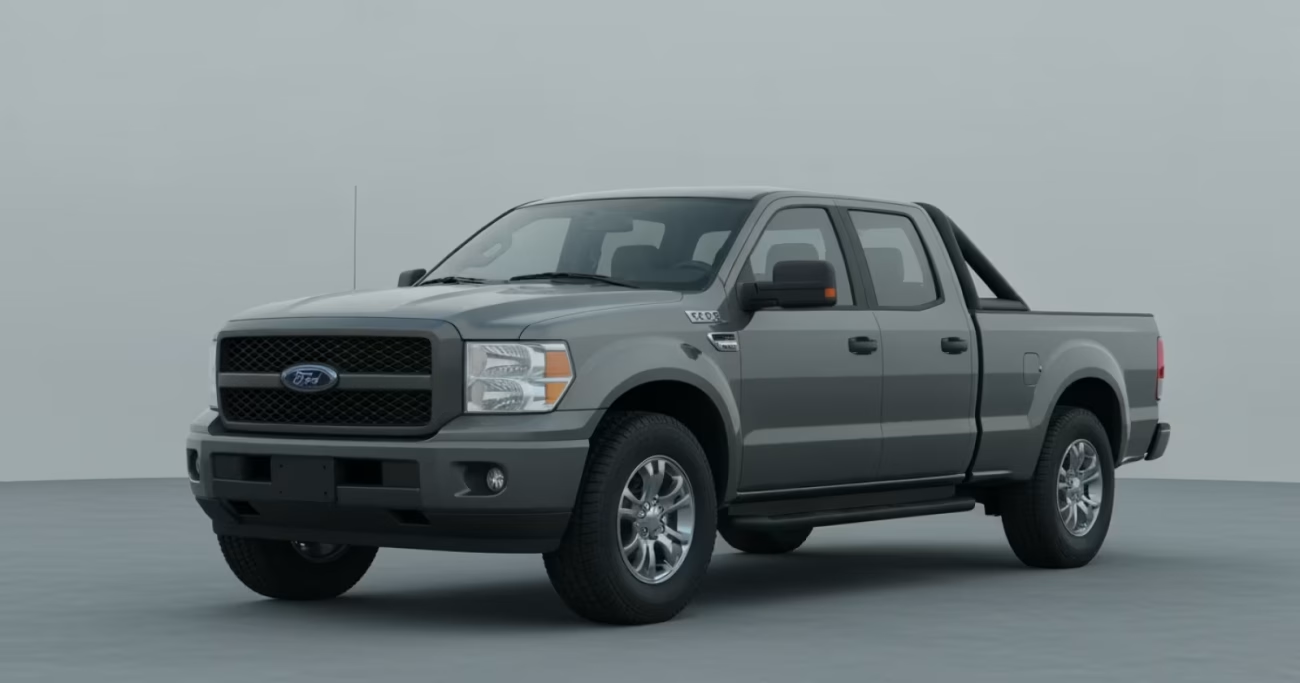
Ford built its entire empire on trucks — and in Q1 2026, that empire showed serious cracks. The numbers are in, and they tell a story Ford would rather not lead with.
Overall US sales dropped 8.8% to 457,315 units, a loss of nearly 44,000 vehicles compared to the same period last year. The damage wasn’t random. It was largely self-inflicted.
Killing the Escape and Corsair left a hole Ford can’t plug fast enough
When Ford discontinued the Escape and Lincoln killed the Corsair, the expectation was that buyers would migrate to other models in the lineup. That hasn’t happened the way anyone hoped.
In Q1 of last year, Ford sold 37,357 Escapes and Lincoln moved 6,240 Corsairs. This quarter, combined replacement-model sales totaled just 17,742 units. That’s a gap of nearly 26,000 vehicles — vanished, not transferred.
The Bronco Sport was supposed to absorb some of those Escape defectors. It did see a 5% sales increase, but that translated to only 1,658 extra customers. For a brand pulling in hundreds of thousands of units per quarter, that’s barely a rounding error.
The F-Series cracked — and that’s the number Ford should be losing sleep over
Here’s where things get genuinely alarming for the Blue Oval. The F-Series — America’s best-selling vehicle for over four decades — dropped 16% in Q1 2026, with only 159,901 trucks sold. That’s not a blip. That’s a structural warning sign.
The F-150 Lightning made it worse. With the electric pickup now axed, dealers are sitting on inventory they can’t move. Lightning sales collapsed 71.3%, exactly what you’d expect from a dead-model clearance — except the broader F-Series dragging down alongside it is the part that stings.
Even the Maverick, Ford’s affordable hybrid-friendly truck that should be perfectly positioned for cost-conscious buyers right now, slipped 10.9% to 33,861 units. The truck segment that built Ford is underperforming across nearly every nameplate.
The Mach-E and E-Transit numbers are a federal tax credit cautionary tale
The Mustang Mach-E didn’t just decline — it cratered. With the federal EV tax credit eliminated, deliveries fell 60.4% to just 4,600 vehicles in three months. That’s a dramatic illustration of how dependent EV demand was on government subsidy, not organic enthusiasm.
The E-Transit told an even starker story. Ford sold just 200 units of the electric van in Q1 2026 — a 94.7% decline. Two hundred vans in ninety days from a company that sells nearly half a million vehicles per quarter is practically a rounding error.
The real story here isn’t just poor EV performance. It’s that Ford bet heavily on electrification, absorbed significant losses on those programs, and now faces a market that walked away the moment incentives disappeared.
Explorer, Expedition, and the Mustang are the bright spots Ford is leaning on hard
Not everything went sideways. The redesigned Expedition surged 30.2%, and the Explorer matched it with a 29.7% jump. The Ranger climbed 19.2%, suggesting mid-size truck appetite is still alive. And in a genuinely surprising turn, the Mustang posted a 50.1% gain — dealers moved nearly 4,700 more pony cars than the same quarter last year.
Ford is publicly framing all of this as a “strategic shift toward high-margin SUVs,” pointing to Expedition and Explorer momentum as evidence the pivot is working. There’s some truth to that. But it doesn’t fully explain away a near-9% overall decline.
| Model / Segment | Q1 2026 Sales | Year-over-Year Change |
|---|---|---|
| F-Series (Total) | 159,901 | -16% |
| F-150 Lightning | N/A (axed) | -71.3% |
| Mustang Mach-E | 4,600 | -60.4% |
| Ford Maverick | 33,861 | -10.9% |
| Ford Expedition | N/A (record high) | +30.2% |
| Ford Explorer | N/A | +29.7% |
| Ford Mustang (ICE) | N/A | +50.1% |
| E-Transit | 200 | -94.7% |
| Ford Overall (US) | 457,315 | -8.8% |
Lincoln, for its part, held up better than the Ford brand itself — down just 0.5% overall. The Aviator surged 31.4%, and the redesigned Navigator climbed 6.5% to 4,322 units. The Nautilus slipped 11.4% but held its position as Lincoln’s best-seller. For a luxury sub-brand, that’s a respectable quarter inside a rough report.
Ford also noted that retail market share likely ticked up 0.2% to 11.6%, and that the Bronco Sport is off to a record start among off-road-oriented models. They’re not wrong — but headline market share doesn’t tell you much when overall volume is contracting at this rate.
I’d also push back on Ford’s comparison excuse. Yes, March of last year was an unusually strong month industry-wide, which makes year-over-year math harder. But a 16% F-Series decline isn’t explained by calendar quirks. That’s a demand signal worth taking seriously.
If you’re in the market for a Ford right now — especially an Expedition, Explorer, or Mustang — this is actually your moment. Dealers are incentivized to move metal, and high-volume pressure usually translates to better negotiating leverage on the showroom floor. The brand’s headaches can be your advantage.
