
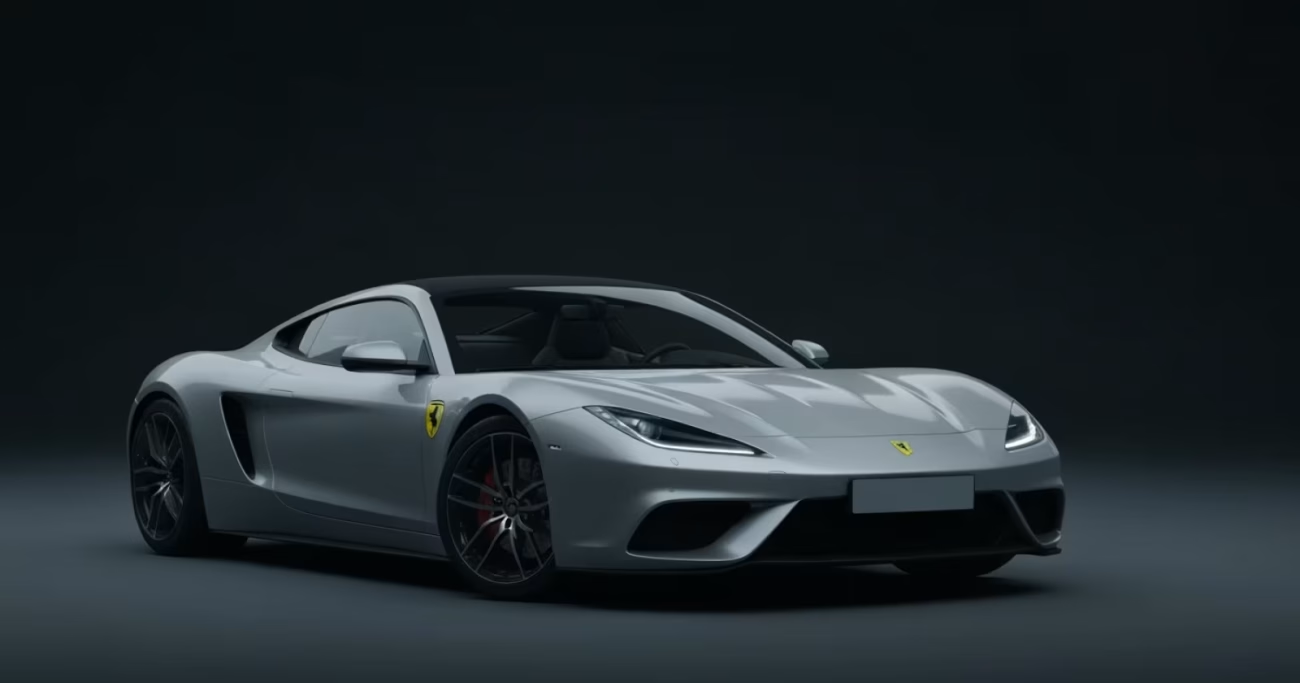
The man most responsible for making your phone a featureless glass rectangle is now designing a Ferrari interior packed with physical dials, tactile toggles, and CNC-machined switches. That’s not irony — that’s Jony Ive making the most self-aware design statement of his career.
Ferrari’s first electric vehicle, the Luce, is shaping up to be something genuinely unexpected. Not just because it’s a Ferrari without an engine roar, but because the person defining its cockpit has spent decades arguing that less is more — and is now arguing the opposite.
The man who built the buttonless phone is rethinking everything
Jony Ive spent his most famous years at Apple doing one thing exceptionally well: removing complexity from the surface and hiding it inside software. The original iPhone had one button on the front. Then zero. Every iteration stripped more physical interaction away in the name of elegance.
Now, through his design studio LoveFrom — co-founded with Marc Newson — Ive is doing the exact opposite inside the Luce. He’s advocating loudly for physical controls, and he isn’t mincing words about why. “Practically and functionally, a large touchscreen doesn’t work in a car,” he told Top Gear. “That’s incontrovertible. I find it easy and lazy.”
That’s a significant statement from someone whose work helped normalize touchscreens across an entire industry. But here’s the real story: Ive isn’t reversing his philosophy. He’s applying the same obsessive thinking to a different problem, and arriving at a different answer.
Tesla popularized screens — Ferrari is now pushing back hard
Tesla deserves credit for making the large central touchscreen a mainstream expectation. Buyers embraced it. Rivals copied it. Within a decade, virtually every new vehicle on sale was chasing that same minimalist, screen-dominated aesthetic. Physical buttons became associated with old thinking.
The catch is that car companies loved screens for a reason that had nothing to do with user experience. Screens are dramatically cheaper to manufacture than rows of individual, high-quality physical controls. A single display replaces dozens of bespoke parts. Margins improve. Complexity shrinks — at least on the assembly line.
Ferrari and Ive are rejecting that logic entirely. The Luce’s steering wheel alone is built from 19 CNC-machined parts. Each switch and toggle is described as looking like a piece of jewelry, engineered with its own distinct click and feel. This is not cost-optimization. This is deliberate theater.
Every detail was treated like a watch or a camera
Ive and Newson approached the Luce’s interior by treating every individual component as a standalone precision object. Their framing was direct: they effectively designed “hundreds of products” that happen to come together inside one car. A wiper stalk. A Manettino dial. A turn signal toggle. Each one considered from scratch.
The gauge cluster behind the wheel uses circular OLED panels from Samsung, with high-grade optical glass mounted in front of them. The design language separates input from output cleanly — the steering wheel is where the driver commands the car, the binnacle is where the car reports back. Ive described this relationship as “intimate,” and the physical execution appears to reinforce that intentionally.
What Ive isn’t saying directly, but the design makes clear, is that this approach is a rebuke of the industry’s current direction. It’s a bet that luxury car buyers — particularly Ferrari buyers — will respond to tactility, craft, and restraint more than they respond to another 15-inch display loaded with sub-menus.
Why an EV Ferrari needs this philosophy more than most
Electric Ferraris face a specific credibility problem. The combustion engine has always been the soul of the brand — the sound, the vibration, the mechanical drama. Remove it, and you have to find that emotional connection somewhere else. A sterile, screen-heavy interior would make that problem significantly worse.
Physical controls do something screens can’t in a moving vehicle: they give the driver sensory confirmation without requiring a glance. A click means something happened. A dial’s resistance communicates position. In a high-performance context, that’s not nostalgia — it’s ergonomic logic. Ive’s background in product design, watches, and precision objects turns out to be unusually well-suited to solving exactly this problem.
| Element | Detail |
|---|---|
| Vehicle | Ferrari Luce — brand’s first EV |
| Interior lead designer | Jony Ive via LoveFrom studio |
| Steering wheel construction | 19 CNC-machined parts, classic 3-spoke metal |
| Gauge cluster tech | Circular OLED panels by Samsung, high-grade optical glass |
| Control philosophy | Physical switches and toggles over touchscreen dependence |
| Design co-lead | Marc Newson, LoveFrom co-founder |
| Ive’s previous work | iPhone, Apple Watch, MacBook — all touchscreen-forward products |
The Luce arrives at a moment when the automotive interior design conversation is genuinely unsettled. Mercedes doubled down on screens with the EQS and faced significant criticism. Hyundai and Kia are exploring new directions. Even BMW has experimented with yoke steering. The industry is clearly searching for the next language of the car interior, and Ferrari — with Ive — is offering one credible answer.
I think this is the interior story of 2026. Not because Ferrari built an EV — that was inevitable — but because the person who arguably did more than anyone to push physical interfaces out of consumer products is now the loudest voice in the room arguing to bring them back. If that argument lands, and the Luce becomes as culturally referenced as the original iPhone, other manufacturers will follow. They always do.
If you care about where car interiors are heading — or you’ve quietly missed the satisfying click of a real button — the Luce is worth watching closely. Follow Ferrari’s official channels and keep LoveFrom on your radar, because this interior philosophy is almost certainly not staying exclusive to one car for long.
