
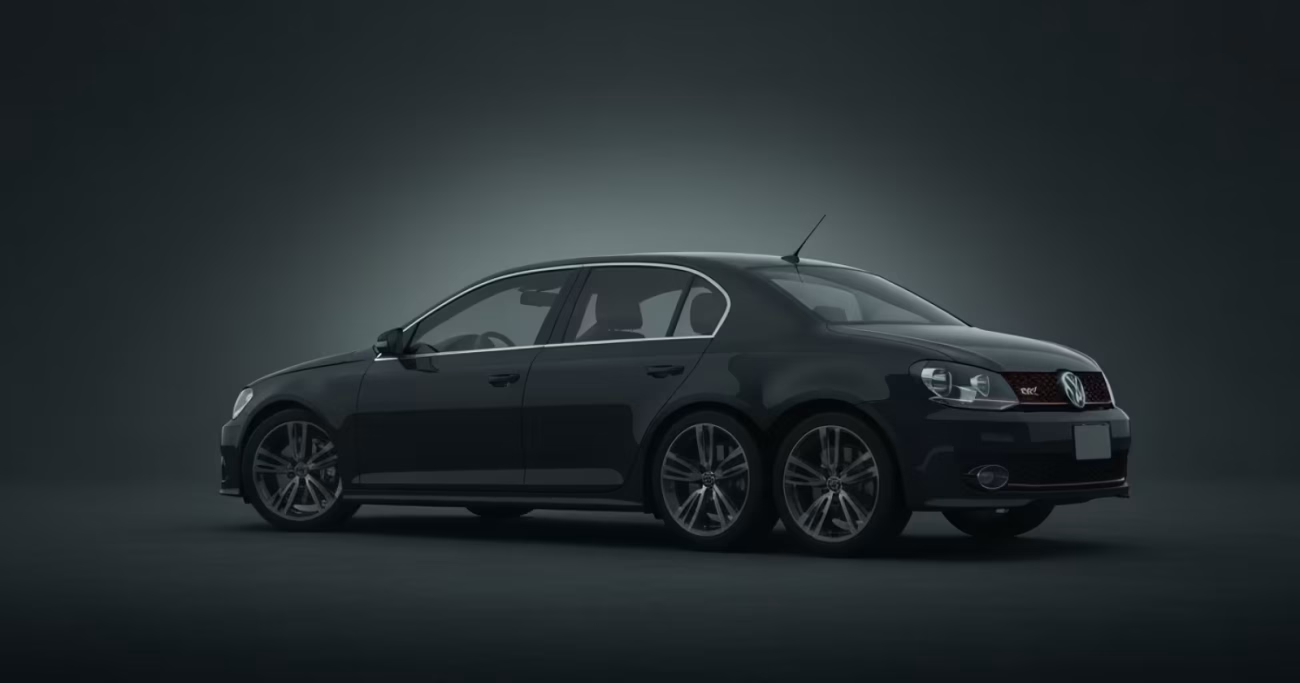
Sales dropped 30% in a single year and Volkswagen’s CEO stood at a press table and essentially said, “So what.” That kind of confidence — or stubbornness, depending on your perspective — is exactly why I still find the Golf GTI story worth paying attention to in 2026.
At a roundtable interview held during the 2026 New York International Auto Show, VW Group North America president and CEO Dr. Kjell Gruner made something very clear: the Golf GTI and Golf R aren’t going anywhere, no matter what the sales charts say. And honestly, as someone who has watched automakers gut their most beloved nameplates the moment quarterly numbers dip, that statement hits differently.
A 30% Sales Drop That Apparently Means Nothing
Here’s the real story: the Golf GTI and Golf R combined sold just 10,554 units in the US in 2026. That’s down from 15,268 the year before — a 30.2% collapse. For most vehicles carrying that kind of number, the product death clock starts ticking immediately.
But Gruner isn’t treating this like a crisis. He made the argument that volume alone is a broken metric for measuring a car’s value to a brand. “You can’t measure success and importance just by volume alone,” he said. “You also need to measure it by heartbeat.” That word — heartbeat — is doing a lot of heavy lifting here, and I think he means it literally. The GTI is the emotional core of what Volkswagen is supposed to represent.
Why VW’s “Brand Icon” Logic Actually Holds Up
It’s easy to dismiss the heartbeat talk as executive spin, but there’s a real argument underneath it. The GTI invented the hot hatch segment back in 1976. Every affordable performance hatchback you can buy today — from the Honda Civic Type R to the Toyota GR Corolla — exists because Volkswagen proved the formula worked. Killing the GTI wouldn’t just be a product decision; it would be a brand identity collapse.
Gruner was direct: “Every company needs these brand icons, these brand shapers, and for me that’s Golf GTI and Golf R.” When a CEO speaks that plainly, without corporate hedging, I tend to believe him. The GTI stays. What changes, though, is the part of this story worth watching closely.
| Spec | Detail |
|---|---|
| Base Price (2026) | $34,000 |
| Engine | 2.0L turbocharged inline-4 |
| Horsepower | 241 hp @ 5,000 RPM |
| Torque | 273 lb-ft @ 1,750 RPM |
| Transmission | 7-speed DSG auto-shift manual |
| Fuel Economy (combined) | 27 MPG |
| 2026 US Sales (GTI + Golf R) | 10,554 units (down 30.2% YoY) |
What VW Isn’t Saying About the GTI’s Future
Here’s the catch: Gruner confirmed changes are coming to the Golf family, but details were scarce. One thing he was specific about — the GTI will stay gasoline-powered. No full EV conversion on the horizon for the hot hatch. For enthusiasts who feared the GTI would eventually be folded into VW’s ID. electric lineup, that’s genuinely good news.
What won’t be coming back, at least not based on current signals, is the manual transmission. The 7-speed DSG dual-clutch gearbox is fast and competent, but it’s not the same emotional experience as rowing your own gears on a back road. VW seems committed to the DSG path, which I suspect will remain a sticking point for purists no matter how compelling the rest of the package is.
The ID. Buzz Situation Is More Complicated Than It Looks
Gruner also used the roundtable to address speculation around the ID. Buzz electric van, which is skipping the 2026 model year entirely. Dealers are currently selling down remaining 2026 stock, and the 2027 model is expected to arrive in late summer or early fall of next year — right on schedule with VW’s normal model-year changeovers. “We’re just going directly from 2026 to 2027,” Gruner said, pushing back hard on discontinuation rumors.
The honest problem with the ID. Buzz isn’t the model year gap — it’s the price. At around $60,000 to start for 234 miles of range, the math doesn’t work for most buyers. VW demonstrated with the ID.4 that it can improve range gradually; that model launched in 2022 with 275 miles and now delivers 291 in its longest-range configuration for 2026. A similar improvement trajectory for the ID. Buzz, paired with a $10,000 price reduction, would change the conversation entirely. Right now it’s a stylish, Microbus-inspired van that not enough people can justify buying.
The One Number That Should Concern VW Watchers
Thirty percent. That year-over-year sales decline is not a blip. It represents a structural challenge in selling a $34,000 front-wheel-drive hatchback in a market that has fully pivoted to crossovers and SUVs. Volkswagen knows this — it’s why the redesigned Atlas is getting so much internal attention and investment right now. The Atlas is VW’s most American product in every sense, and it’s where the real volume game is being played.
The GTI gets to exist as a brand guardian while the Atlas carries the financial weight. That’s a sustainable model if VW keeps the crossover side competitive, but it also means the GTI will likely always operate on thin margins with limited marketing support. The car survives on prestige, not profit — and that’s a precarious place to live long-term, no matter what any CEO says at a press roundtable.
If you’ve been on the fence about picking up a Golf GTI before the segment shifts further, this is your window. VW’s commitment is real for now, the 241-horsepower package at $34,000 is genuinely strong value, and the Edition 50 — the most powerful GTI ever built — is still fresh in the lineup. Get behind the wheel of one at your nearest dealer and decide for yourself whether 10,000 sales a year tells the whole story.
