
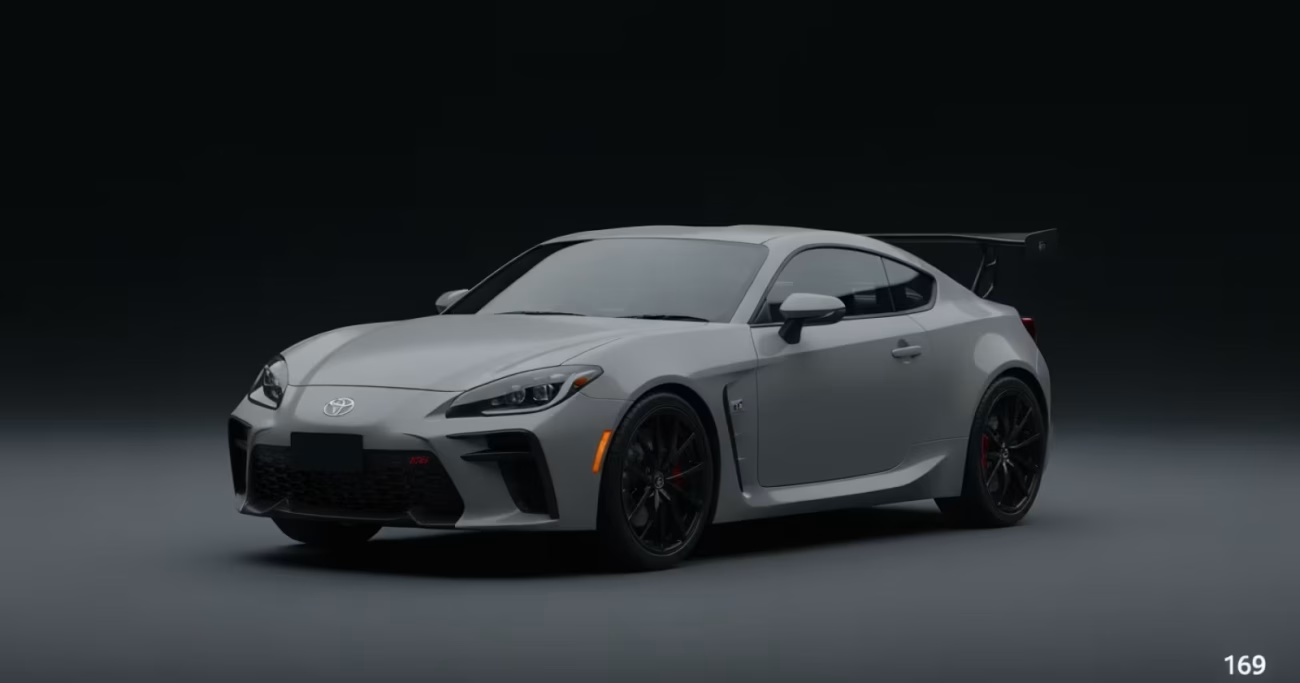
A single pipe might be the most underrated piece of engineering in any supercar built this decade. Toyota just patented a deceptively simple solution for its upcoming 641 hp twin-turbo V8, and it solves a problem most drivers would never even feel.
The 2027 Toyota GR GT is shaping up to be one of the most meticulously engineered front-engined super-coupes on the planet. A fresh filing at the United States Patent and Trademark Office reveals how Toyota plans to keep both cylinder banks breathing in perfect harmony, and the answer is almost laughably elegant.
At a glance
| Spec | Detail |
|---|---|
| Engine | 4.0-liter twin-turbocharged V8 hybrid |
| Output | ~641 hp / ~627 lb-ft |
| Layout | Front-engine, rear-wheel drive |
| Turbo config | Hot-vee twin turbochargers |
| Key patent | Intake crossover communication pipe |
| Expected launch | 2027 model year |
| Segment rival price range | $110,000 – $220,000+ |
Why a simple pipe changes everything for the GR GT
In a twin-turbo V8 with a hot-vee layout, each bank of cylinders gets its own turbocharger, intercooler, and throttle body. That setup is efficient, but it introduces a subtle problem. Momentary exhaust pulses or tiny differences in turbo spool between the left and right banks can create uneven intake pressure. Most drivers would never notice it on the street, but Toyota noticed it in the data.
The fix is what Toyota calls a “communication pipe.” It sits between the two intake manifolds, just downstream of each throttle body, and it equalizes pressure in real time. No motors. No actuators. No electronics. Just a tube with a diameter equal to or smaller than the primary intake runners, quietly balancing airflow without introducing parasitic losses. I find it remarkable that in an era of over-engineered everything, the real breakthrough here is plumbing.
What Toyota isn’t saying about the sensor network behind it
The communication pipe gets the headline, but the patent describes a much deeper system working underneath. Toyota has placed pressure sensors on the exhaust side before the turbine wheel, on the intake side before the intercooler, and again after each throttle body. That is 6 sensor points feeding the ECU continuous data about how each bank is performing relative to the other.
The real story is that this sensor array lets the engine computer make micro-adjustments in real time, trimming boost targets and throttle response so both banks deliver identical power pulses. Combined with the passive crossover pipe, the result should be near-zero turbo lag and perfectly linear throttle response. For a car targeting track days and hot laps, that kind of consistency matters more than raw peak numbers.
Here’s the catch with low-risk engineering
I want to be honest about what this patent does not promise. Toyota is not claiming the communication pipe adds significant horsepower. The 641 hp and 627 lb-ft targets were already set before this filing appeared. What the pipe does is protect those numbers across every driving condition, whether the engine is cold, heat-soaked after 20 track laps, or transitioning between partial and full throttle at 7,000 rpm.
There is a philosophy at work here that reminds me of Honda’s recent synthetic gasoline patent. Neither invention reinvents the wheel. Both take existing technology and apply it in a slightly smarter way to produce more reliable results. Stack enough of these marginal gains together and you end up with a car that feels bulletproof at the limit. That is the Japanese engineering playbook, and it works.
The Corvette and GT-R should be paying attention
The GR GT does not exist in a vacuum. Chevrolet’s C8 Corvette Z06 uses a flat-plane-crank V8 that revs to the moon but relies on natural aspiration, meaning it trades low-end torque for top-end scream. The Nissan GT-R, whenever its next generation arrives, will almost certainly stick with a twin-turbo V6 layout. Toyota is splitting the difference with a big-displacement forced-induction V8 that prioritizes balance over brute force.
What makes the GR GT’s approach dangerous for rivals is the hybrid element sitting alongside that V8. Electric torque fill at low rpm combined with a pressure-balanced twin-turbo system at high rpm means there may be no dead spot anywhere in the powerband. That is the kind of engineering that makes a car feel faster than its numbers suggest, and it is very hard to replicate without starting from scratch.
How it stacks up
| Model | Power | Engine | Forced induction | Edge |
|---|---|---|---|---|
| Toyota GR GT | ~641 hp | 4.0L V8 hybrid | Twin-turbo (hot-vee) | Balanced boost + hybrid torque fill |
| Chevrolet Corvette Z06 | 670 hp | 5.5L V8 | Naturally aspirated | Peak power, high-rev character |
| Nissan GT-R Nismo | 600 hp | 3.8L V6 | Twin-turbo | AWD traction, proven platform |
| Porsche 911 Turbo S | 640 hp | 3.7L flat-6 | Twin-turbo | All-weather usability, brand prestige |
Why this matters
- Toyota is proving patents matter more than press releases
- Hot-vee V8 balance tech could trickle down to Lexus
- Rivals without hybrid torque fill face a widening gap
The verdict
The GR GT’s communication pipe patent is not flashy, and that is exactly the point. Toyota is building a 641 hp supercar the way it builds everything else, by obsessing over the details nobody asked about until they experience the result. If this level of engineering discipline carries through to the production car in 2027, the Corvette and 911 Turbo S will have a serious problem on their hands. The most dangerous competitor in any segment is the one that refuses to leave anything on the table.
If you are shopping the front-engine super-coupe segment or just tracking what Toyota Gazoo Racing does next, keep this patent on your radar. The GR GT is shaping up to be the car that proves reliability and excitement are not mutually exclusive. Stay tuned for pricing and production details as 2027 gets closer.
