
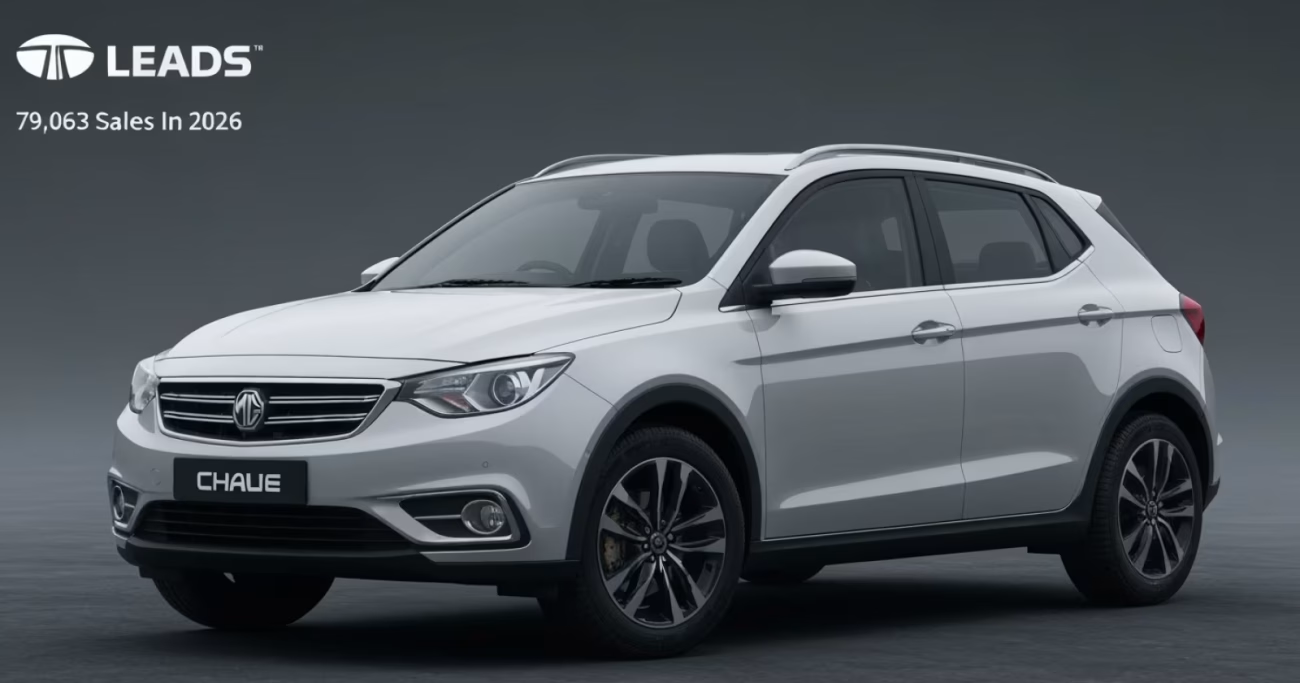
India’s electric car market just posted numbers that would have seemed impossible two years ago. With nearly 80,000 units sold in just four months, the race between Tata, Mahindra, and MG is getting fiercer than ever — and a few surprise names are quietly climbing the ranks.
I have been tracking EV sales data closely this year, and the calendar year 2026 figures paint a fascinating picture. Total electric car sales from January to April 2026 reached 79,063 units across all major manufacturers. That is not a typo. The Indian EV market is no longer a niche experiment — it is a full-blown battleground.
Tata Motors Holds The Crown — But The Gap Is Shrinking
Tata Motors remains the undisputed leader in India’s electric car segment with 31,604 units sold between January and April 2026. The brand kicked off the year with 8,410 units in January, saw a dip to 6,002 units in February, then bounced back strongly with 8,685 units in March and 8,507 units in April.
What is driving these numbers? The Tata Punch EV and Nexon EV continue to be volume pullers, but the real story is the newly launched Harrier EV. It has given Tata a credible offering in the premium electric SUV space, something the brand desperately needed to fend off Mahindra’s aggressive push.
I will say this though — Tata’s February dip was noticeable. While seasonal slowdowns are normal, the brand cannot afford to lose momentum when competitors are breathing down its neck every single month.
Mahindra’s Born Electric Lineup Is Delivering Results
Mahindra secured the second spot with 18,153 units during the same period. The brand started at 3,889 units in January, dropped to 3,219 in February, then surged to 5,651 in March and 5,394 in April. That March spike tells me the Born Electric SUV lineup — specifically the BE 6 and XEV 9e — is finding real traction with buyers.
What impresses me about Mahindra’s approach is the positioning. They are not trying to compete with Tata on price alone. The BE 6 and XEV 9e target a slightly premium audience, and the sales trajectory suggests that strategy is working. If Mahindra maintains this monthly average, they could close the gap with Tata significantly by year end.
MG Motor — The Quiet Contender At Number Three
MG Motor India posted 19,036 units in CY2026, technically edging past Mahindra in cumulative numbers thanks to strong performances from the Windsor EV and the affordable Comet EV. In April alone, MG sold 4,978 units, which is a solid showing for a brand that many still consider a challenger rather than a mainstream player.
The Windsor EV has been a smart product for MG. It sits in a sweet spot — practical enough for families, modern enough for younger buyers, and priced competitively enough to pull customers away from ICE alternatives. The Comet EV, on the other hand, serves as an entry point that gets first-time EV buyers into the ecosystem.
VinFast, Maruti, And Hyundai — The Emerging Pack
VinFast is the name I find most interesting in this list. The Vietnamese automaker has managed 2,840 units in its early months in India with the VF6 and VF7. That is not a blockbuster number, but for a brand building awareness from scratch in one of the most competitive markets on the planet, it is a respectable start. The upcoming VF MPV 7 could be a game changer if priced right.
Maruti Suzuki, the king of Indian passenger vehicles, is still finding its feet in the EV space. The eVitara is its sole electric offering right now, and it managed 2,667 units in CY2026. What is encouraging is the month-on-month growth trend. Maruti has confirmed plans for a YMC electric MPV, a sub-4 metre electric SUV, and an EV hatchback. Once that portfolio fills out, Maruti’s massive dealer network and brand trust could make it a serious volume player very quickly.
Hyundai sits at sixth position with 1,707 units. For a brand with the Ioniq 5 in its global arsenal, these numbers feel underwhelming in the Indian context. BYD is not far behind at 1,502 units, and Kia added 1,443 units. PCA rounds out the list with 111 units.
Full Brand-Wise EV Sales Breakup — January To April 2026
| Brand | Jan 2026 | Feb 2026 | Mar 2026 | Apr 2026 | CY2026 Total |
|---|---|---|---|---|---|
| Tata Motors | 8,410 | 6,002 | 8,685 | 8,507 | 31,604 |
| MG Motor India | — | — | — | 4,978 | 19,036 |
| Mahindra | 3,889 | 3,219 | 5,651 | 5,394 | 18,153 |
| VinFast | — | — | — | — | 2,840 |
| Maruti Suzuki | — | — | — | — | 2,667 |
| Hyundai | — | — | — | — | 1,707 |
| BYD | — | — | — | — | 1,502 |
| Kia | — | — | — | — | 1,443 |
| PCA | — | — | — | — | 111 |
| Total | 18,851 | 14,438 | 23,097 | 22,677 | 79,063 |
The Bigger Picture — EVs Are No Longer Optional
Here is the number that should make every automaker pay attention. EV sales in FY2026 reached approximately 1,99,923 units. That is an 83.6 percent year-on-year growth over the 1,08,873 units sold in FY2026. Nearly doubling in a single financial year is extraordinary growth by any standard.
When you zoom out further, EVs combined with CNG and hybrid vehicles crossed 13.58 lakh units in FY2026, accounting for nearly 30 percent of total passenger vehicle sales in India. The shift away from pure petrol and diesel is no longer a future prediction — it is happening right now, and the pace is accelerating.
Charging infrastructure improvements, government incentives, and genuinely competitive products have all contributed. But I think the biggest driver is simply that Indian buyers are doing the math. Lower running costs, reduced maintenance, and increasingly competitive pricing make EVs a rational choice, not just an aspirational one.
What To Watch For In The Coming Months
The second half of 2026 is going to be intense. Maruti Suzuki’s expanded EV portfolio could reshape the affordable end of the market. VinFast’s MPV 7 will test whether a new brand can crack the family vehicle segment. Mahindra’s Born Electric range is likely to see additional variants. And Tata will need to keep innovating to protect its lead as the competition closes in from every direction.
BYD is another wildcard. With 1,502 units already and a global reputation for aggressive pricing, any new India-specific launch from BYD could disrupt the mid-premium segment overnight.
If you have been sitting on the fence about going electric, these numbers should tell you something important — the market is maturing fast, choices are multiplying, and prices are only getting more competitive. Whether you are eyeing a Tata Punch EV for city commutes or a Mahindra BE 6 for weekend highway runs, now is a genuinely good time to start comparing options and visiting your nearest showroom. The EV wave in India is not coming — it is already here.
