
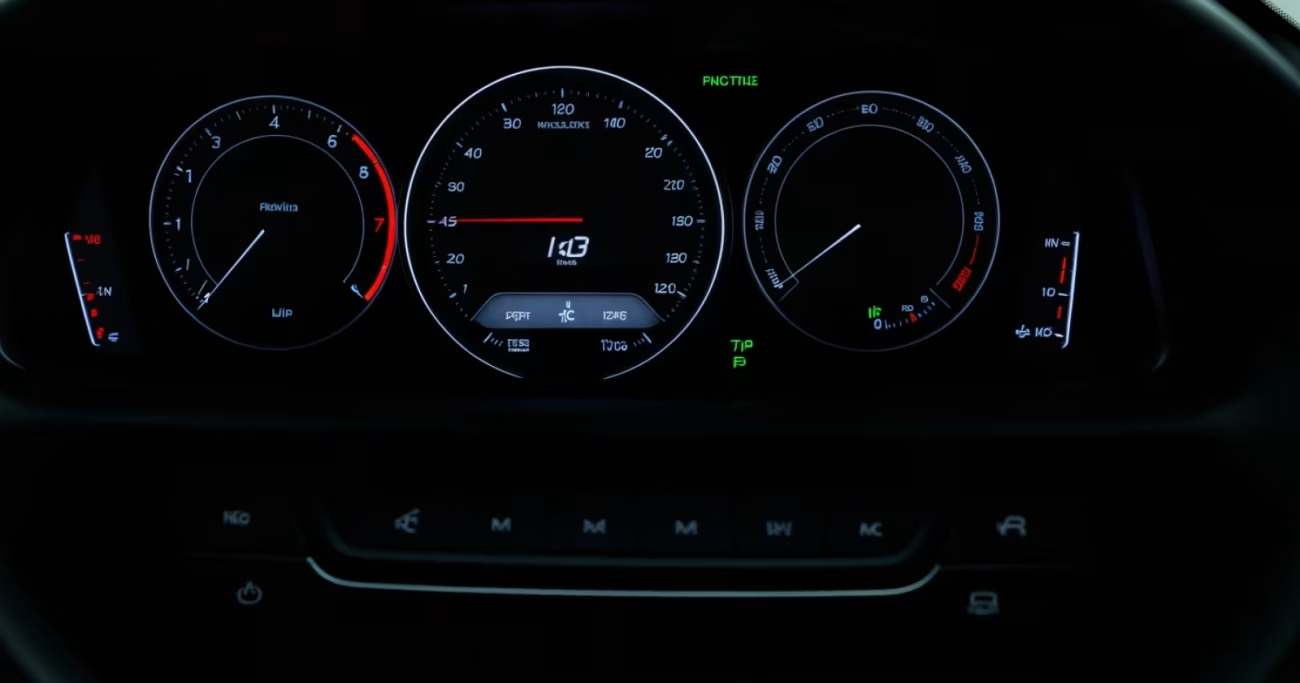
Every time you start your car and glance at those glowing numbers and icons ahead of you, you are looking at one of the most sophisticated pieces of technology in your vehicle. That panel is not just showing you numbers — it is essentially running a live health report on your entire machine, updated 60 times every single second.
I have always been curious about what actually happens inside that cluster, and honestly, the engineering behind it is far more impressive than most of us realise. Let me break it down in a way that actually makes sense for everyday Indian drivers.
From Cables and Needles to Full Digital Screens
Old dashboards were brilliantly simple. A physical cable ran from your gearbox to a mechanical speedometer needle. If that cable snapped, the needle dropped to zero — full stop. That was the entire system.
The shift started in 1976 when the Aston Martin Lagonda became the world’s first car to feature a fully digital LED dashboard. It was expensive and unreliable, but it planted the seed. By the 1980s, cars like the Chevrolet Corvette were experimenting with LCD screens. Then in the 1990s and 2000s, the CAN bus system arrived — essentially a high-speed internal internet for your car that lets every electronic component talk to every other component over a single network. Today, vehicles like the Mahindra XUV700 and Tata Nexon EV run full virtual cockpits — high-definition screens showing 3D maps, drive modes, and real-time energy flows.
Step One: Sensors Are the Car’s Sense Organs
Everything begins with sensors. These small devices are scattered throughout your vehicle, each measuring one specific physical condition. The wheel speed sensor fires a series of electrical pulses as your tyre rotates. More pulses per second equals higher speed — simple and devastatingly accurate.
Inside your fuel tank, a float bobs up and down with the fuel level. That float is connected to a variable resistor. As the fuel drops, the electrical resistance changes, and that change is read as a percentage of tank capacity. Temperature sensors use thermistor materials that alter their conductivity based on heat — perfect for monitoring coolant and engine oil temperatures in the intense heat of Indian summers.
Step Two: The ECU Makes Sense of the Chaos
Raw sensor data is messy. Imagine your fuel gauge spiking every time you hit a pothole on the Delhi–Meerut Expressway because petrol is sloshing around in the tank. That would be maddening. This is where the Engine Control Unit — the ECU — does its most important invisible work.
The ECU acts as the car’s brain, constantly filtering and averaging data from dozens of sensors. It smooths out the noise, applies the right calibration formulas, and packages the clean result into a digital message. That message then travels across the CAN bus network to the dashboard in milliseconds.
Step Three: The Dashboard Renders What You See
Once that digital message reaches the instrument cluster, a small onboard GPU — exactly like the processor inside your smartphone — interprets it and draws what you see on screen. It decides how far the virtual needle sweeps, what number appears in the speed readout, and whether a warning icon needs to illuminate. This entire rendering process happens up to 60 times per second, which is why modern gauges feel completely instant and lag-free.
What Exactly Is Inside a Modern Cluster
| Gauge / Feature | What It Measures | Sensor Used |
|---|---|---|
| Speedometer | Vehicle travel speed (km/h) | Wheel speed sensor (ABS ring) |
| Tachometer | Engine RPM | Crankshaft position sensor |
| Fuel Gauge | Tank fuel level (%) | Float + variable resistor |
| Temperature Gauge | Engine coolant heat | Coolant temperature sensor |
| Battery / Energy Gauge | EV battery state of charge | Battery Management System (BMS) |
| Warning Telltales | Seatbelt, airbag, engine faults | Multiple ECU inputs |
| Odometer | Total distance travelled | Non-volatile memory chip |
Why Electronic Gauges Are Dramatically Better
The accuracy improvement alone is staggering. Mechanical gauges stretch, wear, and drift over time. Electronic systems have no moving parts to degrade, so they stay precise for the entire lifespan of the vehicle. They also react faster — electricity moves near the speed of light, so a sudden spike in engine RPM shows on screen almost before you consciously notice it with your foot.
Modern clusters also let you personalise what you see. Many Indian cars now let you switch between a sporty RPM-focused layout, an economy driving mode display, or a full navigation view — all from the steering controls. That level of flexibility was unimaginable with a mechanical needle and a glass dial.
Software, Security, and OTA Updates
Here is the part that surprises most people: your dashboard runs software, and that software can be updated wirelessly. Over-the-Air (OTA) updates allow manufacturers to push improvements, fix display bugs, or add entirely new gauge screens while your car sits in your apartment parking. Tata and MG have already rolled out OTA updates for Indian models in 2026.
But connected cars also face a new threat: cybersecurity. A hacker theoretically manipulating your speed display or disabling warning lights is not science fiction anymore. Car manufacturers now embed hardware-level encryption and digital verification into the cluster to prevent unauthorised changes. This is especially critical as Indian roads become more connected through V2X infrastructure.
The EV Revolution Is Rewriting the Dashboard
Electric vehicles like the Tata Nexon EV and MG ZS EV have essentially replaced the traditional gauge set. The tachometer becomes less relevant. Instead, real-time power flow diagrams, regenerative braking intensity meters, and range-per-km efficiency graphs dominate the screen. The battery management system feeds live data into the cluster continuously, giving you a far richer picture of energy use than a petrol driver ever had with a simple fuel needle.
As fully digital, AI-assisted dashboards become standard even in budget Indian cars, the gap between what you see and what your car actually knows is shrinking to zero.
If you have been ignoring all those screens and icons on your dashboard, I genuinely encourage you to explore your car’s cluster menu this weekend. You will likely find features you never knew existed — drive efficiency scores, real-time tyre pressure readouts, or even personalised display themes. Drop a comment below telling me which car you drive and what surprised you most about its instrument cluster. Let us start a conversation.
