
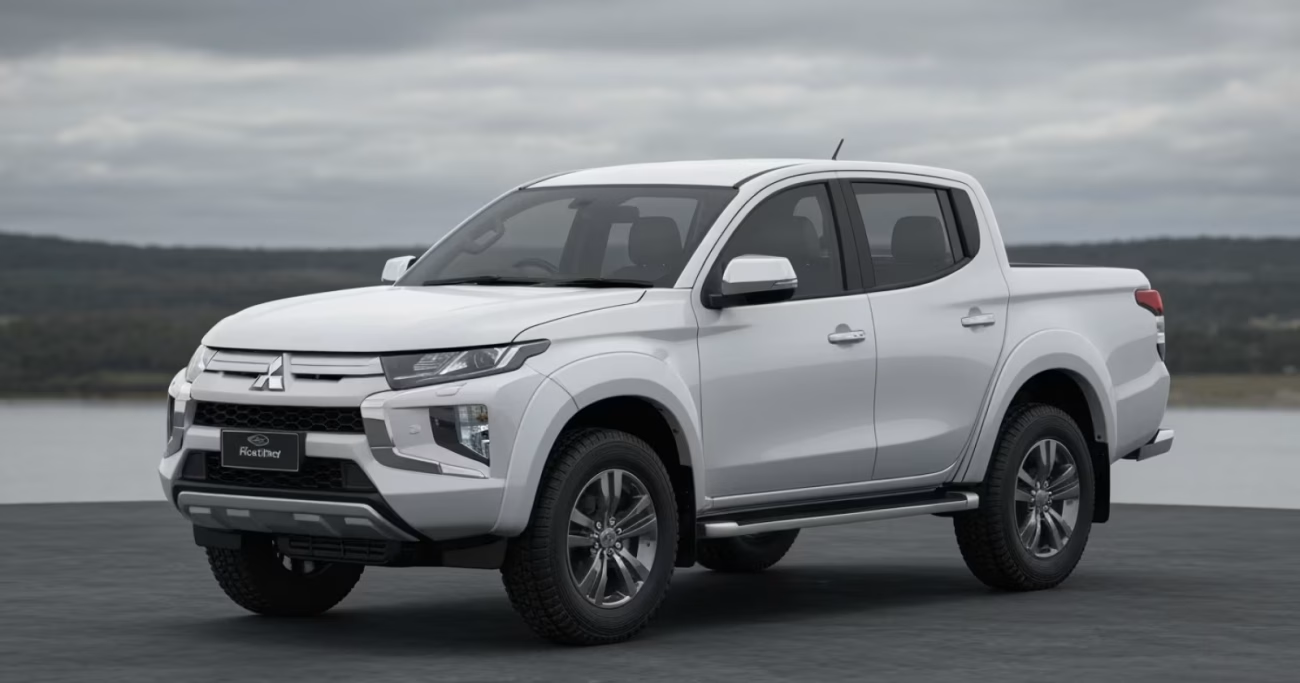
A pickup truck nobody in America has heard of might be about to shake up one of the most competitive off-road segments on the planet. Mitsubishi is quietly considering a move that could put 400 horsepower and serious long-travel suspension hardware directly in Ford’s crosshairs.
The brand’s Australian arm just revealed the Triton Raider — a new off-road trim — and when its product strategy chief started talking about what sits above it in the lineup, things got very interesting very fast.
The Triton Raider Is Just the Opening Act
The Triton Raider lands at around AU$75,000 — roughly $53,000 USD — and comes with a lifted suspension, Bridgestone all-terrain tires, wider-offset wheels, and underbody skid plate protection. It’s a solid Stage 1 off-road build straight from the factory. But here’s the catch: Mitsubishi Australia’s General Manager of Product Strategy, Bruce Hampel, openly admitted that positioning leaves a gap at the very top of the range.
That gap is where things get genuinely exciting. Hampel’s comments at the Triton Raider debut suggest a flagship variant — think Ralliart badging — is being seriously considered. Something that doesn’t just nudge the Ranger Raptor, but goes directly at it with comparable long-travel suspension, remote-reservoir shock absorbers, and extensive underbody armor.
| Model | Est. Power | Price (AUD) | Key Feature | Edge |
|---|---|---|---|---|
| Mitsubishi Triton Ralliart (rumored) | ~400 hp | ~AU$90,000 | Twin-turbo V6, long-travel suspension | Ralliart motorsport pedigree |
| Ford Ranger Raptor (AU) | ~400 hp | AU$90,000+ | Fox shocks, Baja Mode | Established off-road benchmark |
| Toyota Hilux GR Sport | ~224 hp | ~AU$75,000 | TRD suspension, skid plates | Toyota reliability reputation |
| Nissan Navara Pro-4X Warrior | ~187 hp | ~AU$72,000 | Warrior by Premcar kit | Value for money |
Why a Twin-Turbo V6 Shared With the Nissan Z Changes This Conversation
The real story here is the engine. Because the Triton shares its platform and powertrains with the Nissan Navara, a flagship Triton Ralliart could theoretically borrow the twin-turbocharged 3.0-liter V6 already found in the Nissan Z — where it produces between 400 and 420 horsepower. That’s not a stretch. That’s an engineering shortcut Mitsubishi already has access to.
For context, the Ford Ranger Raptor in Australia produces around 400 horsepower from its own twin-turbo V6. If Mitsubishi can match that output while undercutting on price — and still bring the long-travel hardware the Raptor is famous for — Ford has a real problem on its hands. The platform is already proven. The engine exists. The only question is whether Mitsubishi has the will to pull the trigger.
Ralliart’s Racing Credentials Are More Than Just a Sticker
What Mitsubishi isn’t saying loudly enough is that the Ralliart name carries genuine racing weight. The company’s in-house Ralliart team has been running a race-prepped Triton in the Asia Cross-Country Rally since 2023, consistently finishing on the podium. This isn’t a marketing badge. It’s an active motorsport program building real-world data on exactly the kind of abuse a flagship Triton would need to handle.
Mitsubishi’s history also includes the Pajero Evolution — a legitimate homologation special built to win the Dakar Rally — and a long string of WRC-era rally victories. That heritage doesn’t disappear. A Triton Ralliart would have something the Ranger Raptor doesn’t: a story rooted in decades of desert racing and dirt glory. That matters to enthusiasts who buy these trucks as an identity statement, not just a tool.
What This Means for North America — and Why It’s Complicated
Mitsubishi’s American lineup is, to put it plainly, struggling. The Outlander and its PHEV variant are doing the heavy lifting while the rest of the range ages out of relevance. A Triton Ralliart would be a compelling answer — but getting it here is far from guaranteed. Mitsubishi has never successfully sold a pickup in the US at volume. The Mighty Max of the 1980s and the Dakota-rebadged Raider of the 2010s were both sales disappointments.
The more immediate North American play is the returning Montero — reportedly built on the Nissan Armada platform — which should land with genuine full-size SUV capability. But if Mitsubishi really wants to rebuild showroom traffic and brand credibility in 2026, a high-powered off-road truck with Ralliart badges and a race-proven reputation would do more for its image than almost anything else. The question isn’t whether it could work. It’s whether Mitsubishi is willing to bet on itself to make it happen.
If you’ve been sleeping on Mitsubishi as a serious off-road brand, now is a good time to pay closer attention. Follow the Triton Ralliart story closely — because if this truck moves from rumor to reality, the conversation around performance pickup trucks is going to get a lot more interesting.
