
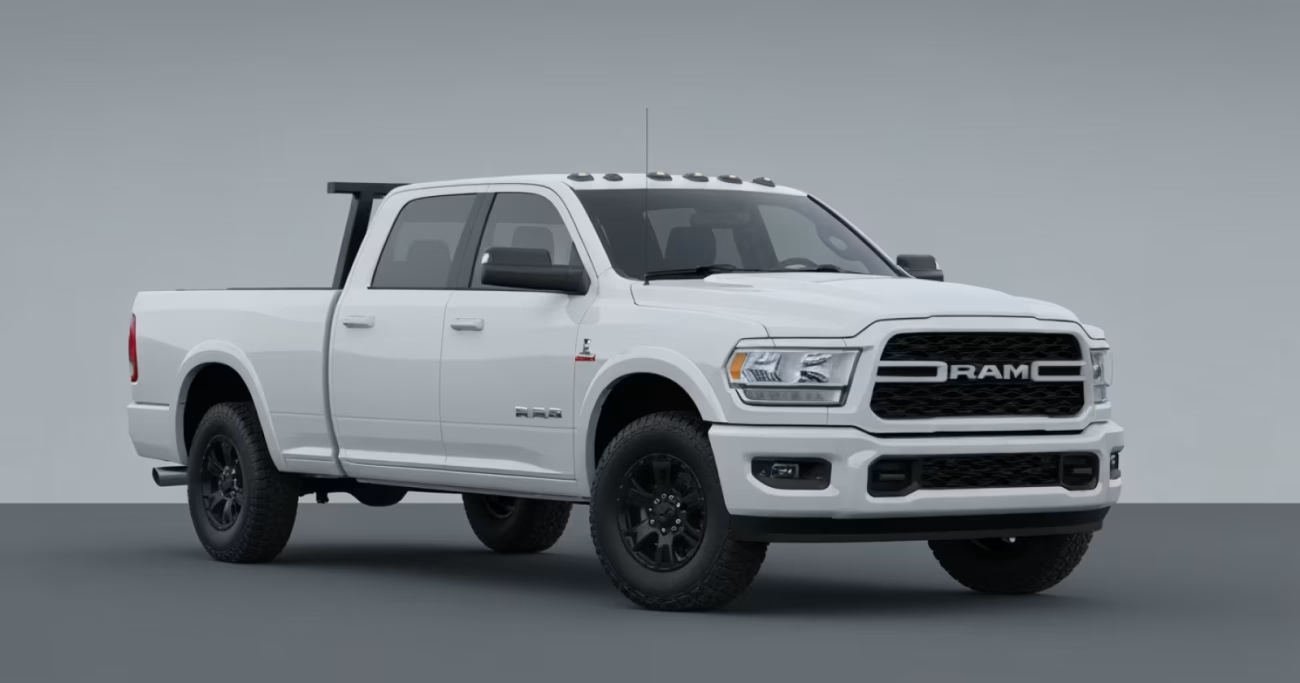
Nobody expected Ram to take a heavy-duty work truck and push it through one of the most grueling police certification tests in the country. Yet here we are in 2026, and the Ram 2500 has just become the first and only pursuit-rated heavy-duty pickup truck on the planet.
I’ve been following the police vehicle market for years, and this move genuinely caught me off guard. Ram didn’t take the easy route and build this around the lighter 1500 platform — they went straight to the 2500, and the results are worth paying serious attention to.
What pursuit-rated actually means — and why it’s so hard to earn
The term “pursuit-rated” isn’t marketing language. It’s a specific certification tied to the Michigan State Police’s rigorous testing protocol, and passing it is no small achievement for any vehicle, let alone a heavy-duty pickup.
To earn the rating, a vehicle must hit specific acceleration benchmarks, complete 20 consecutive panic stops from 60 mph within defined braking distances, and lap the department’s test course for a minimum of 32 consecutive laps without any mechanical failure. The Ram 2500 Emergency Service Response Vehicle didn’t just pass — it completed 40 laps with zero issues, clearing the bar by a margin that should make Ford and Chevy engineers uncomfortable.
The 2500’s specs tell a story Ford’s F-150 Police Responder can’t match
Under the hood sits Ram’s naturally aspirated 6.4-liter HEMI V8, producing 405 horsepower and 429 lb-ft of torque. Paired with an 8-speed automatic and standard four-wheel drive, this truck hits 60 mph in 8.41 seconds and tops out at 103 mph — a speed it reaches in under half a mile. That top speed is currently limited by tire specifications, not the engine itself.
Ram also upgraded the electrical system significantly, fitting dual alternators with a combined 400 amps of capacity, up from a single 220-amp unit. The 18-inch wheels replace the standard 17-inch setup, and a 4.10:1 limited-slip rear differential keeps power planted under hard acceleration. Here’s the catch — the Cummins diesel that’s available on the standard Special Service Vehicle isn’t an option here. For pursuit work, Ram went gas-only, and that’s a deliberate choice built around reliability and heat management during high-speed operation.
| Spec | Ram 2500 ESRV | Ford F-150 Police Responder | Chevy Silverado 1500 PPV |
|---|---|---|---|
| Engine | 6.4L HEMI V8 | 3.5L EcoBoost V6 | 5.3L V8 |
| Horsepower | 405 hp | 400 hp | 355 hp |
| Torque | 429 lb-ft | 500 lb-ft | 383 lb-ft |
| 0-60 mph | 8.41 sec | ~6.5 sec (est.) | ~7.2 sec (est.) |
| Top Speed | 103 mph | 100 mph | 107 mph |
| Duty Class | Heavy-duty (HD) | Light-duty | Light-duty |
| Alternator Output | 400A dual | ~250A single | ~220A single |
Why Stellantis going all-in on police vehicles right now makes perfect sense
The real story here isn’t just one truck. Stellantis is building a wall around the law enforcement market in 2026, and the Ram 2500 is only the latest brick. The brand already holds pursuit ratings on the Dodge Durango, and its CEO has publicly confirmed they’re “actively talking” with police departments about bringing a new Dodge Charger into the patrol car lineup. That conversation is happening with at least 420 horsepower on the table.
What Stellantis isn’t saying loudly enough is how strategically brilliant this timing is. Many departments across the country are still running aging first-generation Charger sedans, and those vehicles are aging out fast. Stellantis is positioning itself to own the transition — sedan replacement, SUV patrol, and now heavy-duty pursuit — all under one umbrella. Ford and GM each hold one pursuit-rated pickup. Stellantis, if the Charger gets certified, could soon hold pursuit ratings across three completely different vehicle segments simultaneously.
The one catch nobody is talking about in the police fleet world
An 8.41-second 0-60 time is honest work for a heavy-duty truck, but it’s noticeably slower than every light-duty pursuit-rated competitor on the market. Departments chasing suspects in dense urban environments run different math than those patrolling wide-open rural highways, and the 2500’s weight will always be a factor in tight maneuvering scenarios.
The truck’s real value proposition isn’t pure speed — it’s durability and capability under load. Departments that need to carry heavy equipment, tow tactical assets, or operate in off-road conditions where a light-duty truck would get stuck have never had a pursuit-rated option before. Ram just opened a door that no manufacturer had even knocked on. That’s not a minor product update — that’s a category that didn’t exist before 2026.
Why this matters
- First pursuit-rated heavy-duty pickup redefines what police fleets can carry
- Stellantis now covers more law enforcement segments than any single competitor
- Aging Charger fleets nationwide create a massive replacement opportunity for Ram and Dodge
The verdict: The Ram 2500 Emergency Service Response Vehicle isn’t trying to outrun a Ford F-150 Police Responder in a straight line — it’s solving a completely different problem for departments that need heavy-duty capability with the legal clearance to pursue. Stellantis is playing the long game here, and between the 2500, Durango, and a likely Charger certification on the horizon, they’re building the most diversified police vehicle portfolio in the industry. If you’re a fleet manager, a law enforcement equipment buyer, or simply someone who watches how manufacturers compete for government contracts, this is the most interesting automotive story of 2026 so far. Ram didn’t just build a police truck — they built a category.
If you work in fleet procurement or follow the law enforcement vehicle space, now is the time to request spec sheets directly from Ram’s commercial division. The 2027 model year availability window opens sooner than most buyers expect, and departments that move early will have the most leverage in fleet pricing negotiations.
