
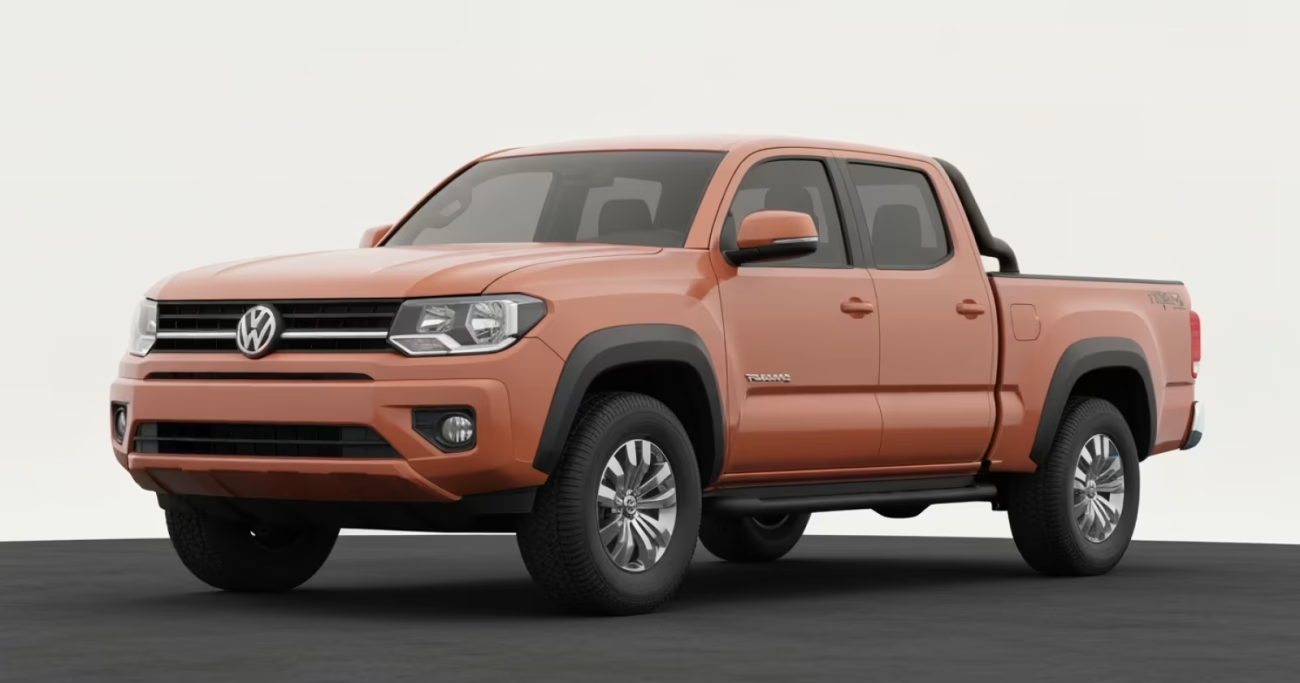
Pickup trucks account for 30 percent of every new vehicle sold in the United States, and Volkswagen’s top American executive just admitted the brand has been running the numbers on that figure very carefully. I’ve been watching the truck segment long enough to know that when a CEO stops saying “no” and switches to “I wouldn’t rule it out at all,” the wheels are already turning somewhere in a product planning room.
| Model | Type | Engine | Power | Tow Capacity |
|---|---|---|---|---|
| VW Amarok (Global) | Body-on-frame midsize | Turbo 2.3L I4 | 300 hp / 333 lb-ft | TBD for US |
| Ford Ranger (US) | Body-on-frame midsize | Turbo 2.3L I4 | 270 hp / 310 lb-ft | 7,500 lbs |
| Toyota Tacoma | Body-on-frame midsize | Turbo 2.4L I4 | 278 hp / 317 lb-ft | 6,500 lbs |
| VW Atlas (2027 platform) | Unibody SUV base | Turbo 2.0L I4 | 269 hp / 273 lb-ft | 5,000 lbs |
| Honda Ridgeline | Unibody | 3.5L V6 | 280 hp / 262 lb-ft | 5,000 lbs |
| Ford Maverick | Unibody compact | Turbo 2.0L I4 | 250 hp / 277 lb-ft | 4,000 lbs |
Why VW’s CEO Just Put The Tacoma And Colorado On Notice
Dr. Kjell Gruner, president and CEO of Volkswagen Group of America, made a statement during a closed-door journalist roundtable in 2026 that I don’t think the industry has fully absorbed yet. He confirmed VW is actively evaluating the pickup segment, pointing directly at the numbers. “Of course, if the market has that size, you can’t just ignore it,” Gruner said. That’s not executive hedging — that’s a man who has already seen the spreadsheet.
The two formats on VW’s radar are a traditional body-on-frame midsize truck to square off against the Toyota Tacoma and Chevrolet Colorado, or a unibody compact pickup in the style of the Ford Maverick and Hyundai Santa Cruz. No final path has been chosen. Gruner was transparent about that, telling journalists: “We are having these discussions internally, but we have not made any decisions.” Still, naming two specific segments isn’t browsing — it’s shortlisting.
The Amarok Already Exists And Ford Helped Build It
Here’s what most American truck shoppers don’t know: Volkswagen already sells a legitimate body-on-frame pickup truck in Europe and Australia called the Amarok, and it was co-developed with Ford through an existing commercial-vehicle partnership. VW isn’t staring at a blank whiteboard if it decides to pursue the midsize route. The architecture is real, it’s been tested in global markets, and it was engineered alongside the same truck that currently dominates US midsize sales.
The real story is in the power numbers. The Amarok’s turbocharged 2.3-liter four-cylinder gasoline engine produces 300 horsepower and 333 pound-feet of torque. The same basic engine in the American Ranger produces only 270 hp and 310 lb-ft. If VW adapted an Amarok-derived truck for US roads, it would arrive with a factory power advantage over its closest platform sibling. I’d expect Ford’s marketing team to start paying close attention the moment VW files a single regulatory document with the EPA.
The Atlas Route Could Flip The Unibody Segment Upside Down
If VW takes the softer path and pursues unibody construction instead, the redesigned 2027 Atlas platform is the most logical starting point. That platform already supports 5,000 pounds of towing capacity, matching the Honda Ridgeline exactly. A truck built on that architecture would be immediately credible in the lifestyle-pickup conversation — the one currently being held between the Santa Cruz, the Maverick, and buyers who want a truck that doesn’t feel like a truck.
VW’s own concept history hints at what this could look like. The Tarok concept debuted years before the Taos subcompact SUV arrived, showing a compact unibody pickup with genuinely strong proportions. That concept never reached production, but it proves VW has already thought seriously about this form factor. A modern interpretation built on the Atlas platform, finished with 2026-era VW design language, could land in a segment where real visual identity is still surprisingly rare.
A Commercial Van Push Could Arrive At The Exact Same Time
What gives this story additional weight is that Gruner wasn’t narrowly focused on trucks. He also confirmed that VW is evaluating bringing its commercial van lineup to the United States, which would put it in direct competition with the Mercedes-Benz Sprinter — the current king of the aspirational cargo van space. The ID. Buzz cargo variant already sells in Europe, and the US electric van market has a gap that no one has fully claimed yet.
There’s cultural gravity behind a VW van push that no other brand can replicate. The original Type 2 Bus defined an era of American road culture, and the Mercedes boxes have filled that void ever since. If VW arrives in the US market with both a pickup and a commercial van in the same strategic push, the scale of that campaign would be the brand’s most ambitious American chapter in decades. I’m watching both product lines — they appear to be moving in tandem.
Why this matters
- Trucks are 30% of US sales — any brand ignoring that math is leaving billions behind
- The Amarok-Ranger platform link cuts VW’s development cost and timeline significantly
- A simultaneous truck and van launch would mark VW’s largest US product expansion in decades
The verdict: Volkswagen entering the American pickup market is no longer a fantasy — it’s a confirmed board-level conversation acknowledged by the company’s own US chief. The Amarok’s platform is proven, the Atlas can already tow, and the midsize and compact truck segments are more competitive and more open than they’ve been in years. If VW executes this correctly, the Tacoma and Ranger won’t just face a new rival — they’ll face a well-funded, platform-ready European brand that has been quietly studying their playbook for years. This is a story I’ll be tracking closely until the first official product reveal lands.
If you’re currently shopping a midsize or compact truck, I’d strongly encourage keeping Volkswagen on your research list right now. Watch for regulatory filings, concept previews, and any VW investor presentations mentioning North American truck strategy — those will be the first real signals that a launch timeline is forming. Getting ahead of this before the hype cycle starts is exactly how smart buyers avoid getting caught off guard at the dealership.
