
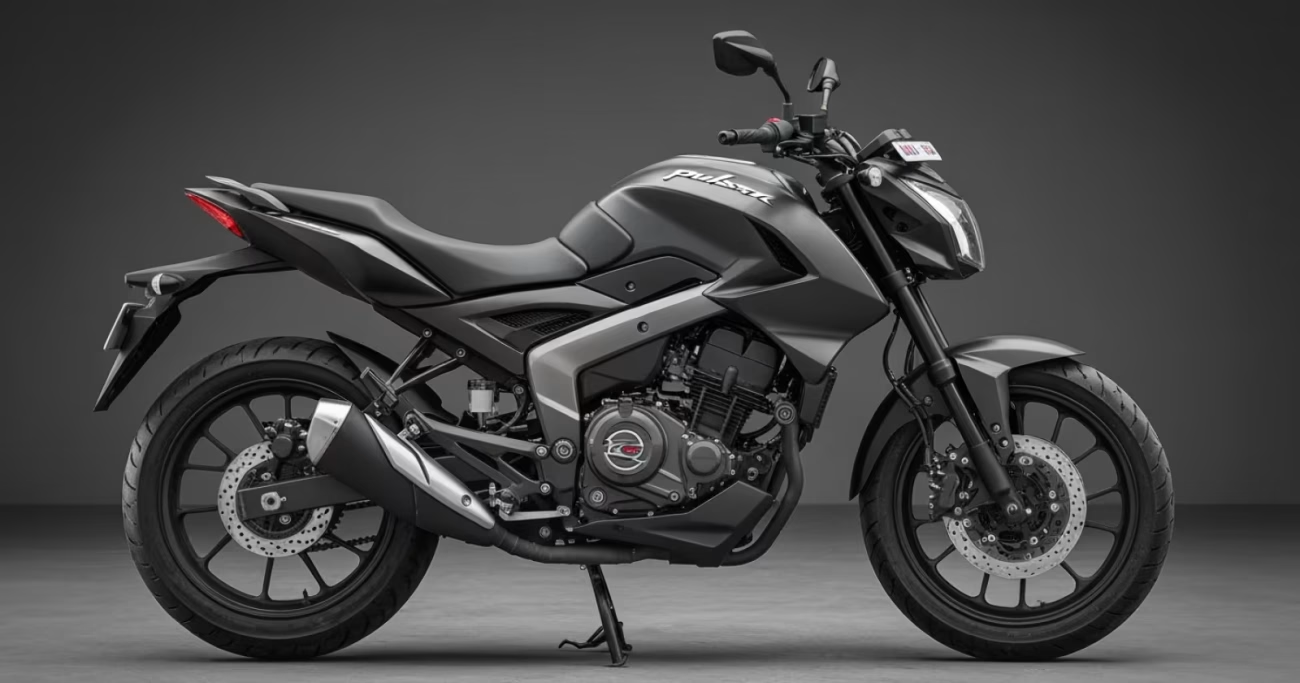
Bajaj just pulled off one of the smartest moves I have seen in the Indian motorcycle market this year. By shaving displacement down to 349cc and slipping under a lower GST bracket, the company has handed buyers a saving of nearly ₹24,500 on its flagship naked streetfighter — and the performance numbers barely budge. Let me walk you through everything that matters here.
The GST Masterstroke Behind the Price Drop
I want to start with the money, because that is what makes this story genuinely interesting. The updated Pulsar NS400Z is now priced at ₹1,80,092 ex-showroom Delhi. The older 373cc powered model sat at roughly ₹1.94 lakh. That is a straight ex-showroom reduction of about ₹14,000, but the real savings go deeper.
Because the engine now displaces 349cc, the motorcycle falls into the sub-350cc category. That category attracts 18 percent GST instead of the 28 percent rate that applies to motorcycles above 350cc. This single regulatory shift cascades into lower insurance premiums and reduced registration charges across most Indian states. Bajaj claims the total cost-of-ownership saving adds up to ₹24,500 when you factor in all three — price, insurance and RTO.
I find this fascinating because it is not a discount or a festive offer. It is a structural repositioning. Bajaj has essentially re-engineered the bike’s tax classification while keeping the riding experience almost identical. That is a level of strategic thinking you do not see every day from an Indian OEM.
349cc Engine — What Changes and What Stays
The heart of the new NS400Z is a revised 349cc liquid-cooled single-cylinder engine. The older unit displaced 373cc. Despite losing 24cc, Bajaj has managed to retain a peak power output of 40.6 PS. That is a seriously competitive number for a motorcycle now officially classified in the sub-350cc segment.
Bajaj quotes a power-to-weight ratio of 247 PS per tonne. For context, that puts the NS400Z comfortably ahead of most rivals in the 300-350cc naked category in terms of sheer thrust-per-kilo. I have not seen official torque figures for the updated engine yet, but I expect the mid-range delivery to remain punchy enough for both city filtering and highway overtakes.
The liquid-cooling setup stays, which means thermal management on long rides through Indian summers should not be a concern. The engine continues to be paired with a six-speed gearbox, and yes, the quickshifter carries over. That alone is a feature most competitors in this price range simply do not offer.
Feature List That Punches Above Its Price
Here is where the NS400Z continues to embarrass motorcycles costing significantly more. The feature sheet is loaded, and nothing has been stripped out in the transition to the 349cc platform. I want to lay out the key specifications clearly so you can compare this against anything else in the segment.
| Specification | Bajaj Pulsar NS400Z (2026) |
|---|---|
| Engine Displacement | 349cc, Liquid-Cooled, Single-Cylinder |
| Peak Power | 40.6 PS |
| Power-to-Weight Ratio | 247 PS/tonne |
| Riding Modes | 4 Modes |
| Quickshifter | Yes (Standard) |
| Traction Control | Yes |
| ABS | Dual-Channel |
| Tyres | Radial |
| Instrument Cluster | Bluetooth-Enabled TFT |
| Ex-Showroom Price (Delhi) | ₹1,80,092 |
| Estimated Savings Over Older Model | Up to ₹24,500 |
Four riding modes on a motorcycle under ₹1.80 lakh is remarkable. Traction control at this price point is not something the TVS Apache RTR 310 or the Honda CB300F can match in the same breath. Dual-channel ABS with radial tyres means the braking hardware is genuinely premium. And the Bluetooth-enabled cluster keeps you connected on the go without needing to glance at your phone.
Who Should Be Worried — Apache, Duke and the Rest
I think TVS has the most to think about right now. The Apache RTR 310 is a brilliant motorcycle, but it sits at a higher price point and does not offer a quickshifter or four riding modes as standard. The NS400Z now undercuts it on price while matching or exceeding it on features. That is a tough position for any rival.
KTM’s Duke 390 remains the enthusiast benchmark in this space, but it plays in a completely different price league. At well over ₹3 lakh on-road in most cities, the Duke asks for nearly double what the NS400Z costs. For a rider who wants genuine performance electronics and a capable engine without stretching the budget, the Bajaj suddenly looks like the rational choice.
The Honda CB300F and the Yamaha MT-03 (where available) also compete loosely in this zone, but neither offers the same density of features per rupee. Bajaj has essentially created a value gap that competitors will need to respond to — either by adding features or by cutting prices themselves.
What Sarang Kanade Said About the Strategy
Sarang Kanade, President of the Motorcycles Business Unit at Bajaj Auto, framed this launch around accessibility. His statement made it clear that the goal is to democratise performance motorcycling in India. The phrase he used — “making high-performance motorcycling more attainable” — tells me Bajaj sees a large pool of buyers who want flagship-level tech but have been held back by the on-road price crossing the ₹2 lakh mark.
By bringing the on-road cost down meaningfully, Bajaj is targeting riders who might have otherwise settled for a 200cc or 250cc motorcycle. The NS400Z now sits in a sweet spot where it offers genuine 350cc-class performance with sub-350cc taxation. That is a compelling pitch for young professionals in Indian metro cities who ride daily and want something exciting for weekend highway runs.
Real-World Implications for Indian Riders
I ride in Indian traffic regularly, and I can tell you that the difference between 349cc and 373cc is not something you will notice at a traffic signal or on the Mumbai-Pune Expressway. What you will notice is the extra ₹24,500 still sitting in your bank account. That money covers a good riding jacket, a decent helmet, or about six months of fuel.
The four riding modes also matter more than people realise in Indian conditions. A rain mode for monsoon commutes, a sport mode for empty highway stretches, and a city mode for crawling through Bangalore traffic — these are practical tools, not gimmicks. Combined with traction control, the NS400Z is genuinely safer to ride hard on Indian roads where surface quality changes every few hundred metres.
Insurance renewal will also be lighter year after year because the sub-350cc classification brings down the base premium. Over a five-year ownership period, the cumulative savings could be substantial. Bajaj has thought this through from a total cost perspective, not just the sticker price.
Should You Head to the Showroom
If you have been eyeing a performance naked in the ₹1.5 to ₹2 lakh range, I genuinely think the updated Pulsar NS400Z deserves a test ride before you sign any other booking form. The combination of 40.6 PS, a quickshifter, four riding modes, traction control and dual-channel ABS at ₹1.80 lakh ex-showroom is hard to argue against on paper. Go visit your nearest Bajaj dealership, throw a leg over it, and see if the riding position and engine character work for you. I have a feeling most of you will come back impressed.
