
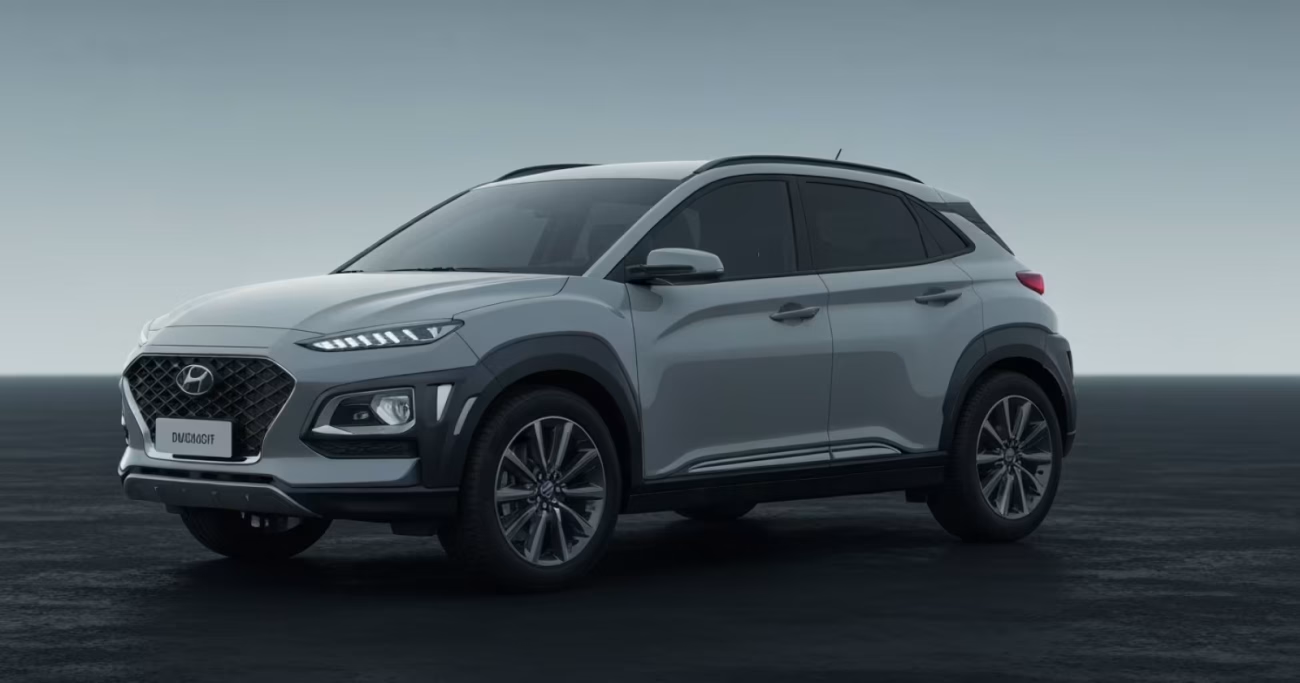
Hyundai may have just tipped its hand years ahead of schedule. A camouflaged prototype spotted on US roads looks almost nothing like the current Kona and almost everything like the wild Crater concept from 2026. If this is real, the compact crossover segment is about to get a serious shakeup.
Why the Crater connection changes everything for Kona
When Hyundai rolled out the Crater concept, most people filed it under “cool but never happening.” That assumption now looks wrong. Spy photographers have captured a next-generation Kona prototype that borrows heavily from the Crater’s angular, aggressive design language. The roofline is crisp and slash-cut, the greenhouse pillars are razor-sharp, and the soft curves of the current model are essentially gone.
The real story here is timing. Hyundai redesigned the Kona for model year 2024, which normally means a full replacement wouldn’t land until 2029 or 2030. Instead, sources suggest Hyundai may skip the traditional mid-cycle facelift entirely and fast-track this new generation. That’s an aggressive move for a brand that typically follows a predictable product cadence.
What Hyundai kept from the concept and what got cut
I have to be honest about the compromises. The Crater concept’s coach-opening doors are gone. So are the massively flared fenders that gave the concept its muscular stance. Neither loss is surprising on a vehicle that needs to hit an affordable price point, but it still stings a little for anyone who fell in love with the show car.
What survived matters more. The overall proportions carry that boxy, purpose-built attitude. The angles across the hood, nose, and pillars are noticeably sharper than anything in Hyundai’s current lineup. And then there are the wheels, which might be the most fascinating detail in these spy shots. A star pattern sits inside a wider ring, making the connection between inner and outer sections look impossibly thin. The structural support is hidden, giving the wheels a delicate, futuristic appearance that I haven’t seen on any production crossover.
| Spec | Detail |
|---|---|
| Design basis | Hyundai Crater concept (2026) |
| Body style | Compact crossover / subcompact SUV |
| Expected reveal | Late 2027 |
| Production start | 2028 (estimated) |
| Key design shift | Angular, slash-cut lines replacing curves |
| Confirmed trims rumored | Kona N performance, Kona XRT off-road |
| Part of Hyundai’s plan | 36 new or updated models by 2030 in North America |
The Tucson connection nobody is talking about
Here’s something worth paying attention to. The new Kona prototype looks strikingly similar to spy shots of the next-generation Tucson that have also been circulating. The 2 models already share design DNA in their current forms, but these redesigns appear to bring them even closer together. Under heavy camouflage, it’s hard to know exactly where Hyundai will draw the line between them.
That’s a strategic question as much as a design one. If the Kona and Tucson look too similar, buyers might just default to the larger, more expensive option. Hyundai needs enough visual separation to justify both models in the showroom. I suspect the production Kona will lean harder into the rugged, off-road-inspired aesthetic from the Crater concept while the Tucson stays more refined. But until the camo comes off, that’s an educated guess.
Hyundai’s 36-model blitz makes this more than a redesign
This prototype doesn’t exist in a vacuum. Hyundai has publicly committed to launching 36 new or updated models in North America by 2030. The Kona could account for 2 of those slots on its own if both a minor facelift and this full redesign reach production. That’s an unusual level of investment in a single nameplate, and it signals how seriously Hyundai takes the compact crossover segment.
The return of a Kona N performance variant looks likely. Hyundai leadership has confirmed that more performance and off-road trim grades are coming across the lineup. A Kona XRT with genuine off-road capability would be a natural fit given the Crater-inspired styling. For a vehicle that starts under $30,000 in its current generation, offering both a hot hatch personality and a trail-ready variant would give Hyundai coverage that rivals like the Chevrolet Trax, Kia Seltos, and Toyota Corolla Cross simply don’t match.
How it stacks up
| Model | Starting MSRP (current gen) | Design direction | Performance variant | Edge |
|---|---|---|---|---|
| Hyundai Kona (next-gen) | ~$30,000 (est.) | Angular, Crater-inspired | Kona N expected | Boldest redesign in class |
| Kia Seltos | ~$30,000 | Evolutionary refresh | None | Practical interior space |
| Toyota Corolla Cross | ~$24,000 | Conservative, smooth | None | Lowest entry price |
| Chevrolet Trax | ~$23,000 | Clean, modern | None | Value leader |
Why this matters
- Hyundai is accelerating product cycles faster than any competitor
- Concept-to-production design pipelines are getting shorter industry-wide
- Affordable crossovers are finally getting bold, risk-taking design
The verdict
Hyundai is doing something most automakers won’t: taking a concept car that excited people and actually putting it into production at an accessible price point. The next-gen Kona won’t be a carbon copy of the Crater, but it’s clearly drawing from the same well. If Hyundai nails the pricing and delivers both N and XRT variants, this could become the most compelling compact crossover on the market by 2028. Keep an eye on this one, because the compact crossover class just got a lot more interesting, and I’d recommend bookmarking Hyundai’s configurator for when the official reveal drops.
