
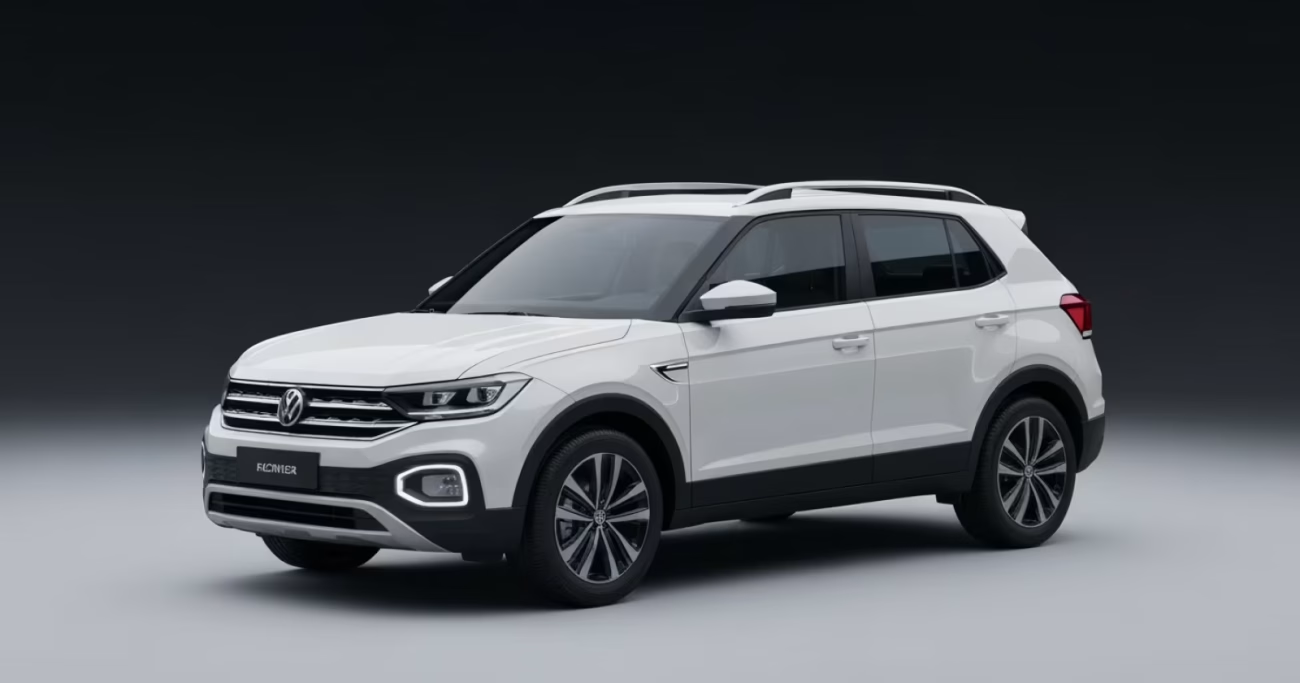
The assembly line at Pune’s Chakan plant is rolling again with something fresh, and if you have been eyeing the mid-size SUV segment, this one deserves your full attention. Volkswagen has just kicked off production of the Taigun facelift, and the changes go far deeper than a new bumper and updated headlights.
Production Is Live And Launch Is Days Away
Skoda Auto Volkswagen India has officially confirmed that the facelifted Taigun is now being built at the Chakan facility near Pune. The India debut is locked in for April 9, 2026, which means dealer stock should start flowing almost immediately after. I find the timing smart — launching right before the summer buying season when SUV demand typically peaks across India.
The Pune plant is no small operation either. It handles domestic production and doubles as an export hub under the group’s “Make in India, for India and the world” strategy. Since the original Taigun launched back in 2021, over 1.43 lakh units have rolled off this line, with roughly 30 percent shipped to global markets. That kind of volume tells you Volkswagen is serious about this nameplate.
Design Gets A Proper Refresh
I have always felt the Taigun had one of the cleaner designs in its class, but it was starting to look a bit dated next to the refreshed Creta and the Seltos. The facelift addresses that head-on. Expect revised bumpers at both ends, new lighting elements that likely include connected LED DRLs, and a sharper overall design language that brings it closer to Volkswagen’s global SUV family.
The grille appears to be wider and more prominent based on early production images. The profile retains that solid, planted stance that the Taigun is known for — tall roof, high ground clearance, and a boxy but refined silhouette. It still looks unmistakably like a Volkswagen, which I think is a good thing in a segment full of overwrought designs.
Interior And Features Borrow From The Kushaq
This is where things get genuinely interesting. The Taigun facelift is expected to pull several upgrades directly from the recently launched Skoda Kushaq facelift, which shares the same MQB-A0-IN platform. I am expecting a larger touchscreen infotainment system — likely a 10-inch or bigger unit — along with a fully digital instrument cluster replacing the semi-digital setup in the outgoing model.
The feature list is also getting a serious bump. A panoramic sunroof is almost certainly coming, which has become a non-negotiable in this segment. Ventilated seats are another likely addition, and honestly, for anyone driving through an Indian summer, that alone could be a deciding factor. Enhanced connectivity options, wireless Android Auto and Apple CarPlay, and an upgraded sound system round out what should be a much more premium cabin experience.
Volkswagen has said these updates are based directly on customer feedback, and I believe it. The outgoing Taigun’s biggest criticism was always that it felt a step behind on features compared to the Creta and Seltos, despite being a better car to drive. This facelift looks like it closes that gap.
Same Engines, But A Key Gearbox Upgrade
Under the hood, the Taigun facelift sticks with what works. You get two turbo petrol engine options, and both are genuinely enjoyable to drive. But the big news here is the gearbox change on the smaller engine.
| Specification | 1.0L TSI | 1.5L TSI |
|---|---|---|
| Displacement | 999cc | 1498cc |
| Power | 115 PS | 150 PS |
| Gearbox (MT) | 6-Speed Manual | 6-Speed Manual |
| Gearbox (AT) | 8-Speed Torque Converter (New) | 7-Speed DSG |
| Drive | Front-Wheel Drive | Front-Wheel Drive |
| Safety Rating | 5-Star (Expected) | 5-Star (Expected) |
| Key Rivals | Hyundai Creta, Kia Seltos | Skoda Kushaq, MG Astor |
The 1.0-litre TSI producing 115 PS is now expected to get a new 8-speed torque converter automatic, replacing the old 6-speed unit. This is a significant upgrade. Torque converters are smoother in city traffic compared to the AMT units some rivals offer, and the extra two ratios should improve both refinement and fuel efficiency on highway runs. For the 1.5-litre TSI with 150 PS, the excellent 7-speed DSG carries over unchanged — and frankly, it did not need changing.
I think this powertrain strategy is clever. The 1.0 TSI automatic was the volume seller but also the variant that drew the most complaints about gearbox behaviour. Swapping to a proper torque converter addresses the single biggest ownership gripe without the cost of developing an entirely new engine.
Safety Remains A Core Strength
The current Taigun holds a 5-star safety rating, and Volkswagen has made it clear that the facelift will maintain those standards. In a market where Bharat NCAP is pushing manufacturers to take crash safety seriously, the Taigun has always been ahead of the curve here. Six airbags, ESC, hill-hold assist, and a rigid body structure have been part of the package from day one.
With the facelift, I would not be surprised to see additional ADAS features making their way into the top variants. The Kushaq facelift introduced some driver assistance tech, and platform sharing makes it easy to bring those over. For families considering a mid-size SUV, this safety-first approach is a genuine differentiator against rivals that sometimes cut corners on lower variants.
Where It Stands Against The Competition
The mid-size SUV segment in India is brutal right now. The Hyundai Creta just got its own refresh, the Kia Seltos continues to sell in strong numbers, and the Maruti Grand Vitara offers hybrid efficiency that nobody else matches. The Taigun has always carved its niche as the driver’s choice — the one you pick when you actually enjoy being behind the wheel.
With this facelift, Volkswagen is clearly trying to add the feature richness and visual appeal that were missing, without sacrificing the driving dynamics and build quality that loyalists love. The 8-speed torque converter on the 1.0 TSI is a direct answer to the Creta’s CVT and the Seltos’ IVT, and I think it will be the smoother option in real-world city driving.
Pricing is going to be critical. The outgoing Taigun starts around ₹11.70 lakh, and I expect the facelift to command a premium of ₹50,000 to ₹80,000 across variants. If Volkswagen keeps the entry price under ₹12.50 lakh, it will be very competitive.
Should You Wait For It
If you are currently cross-shopping in this segment and your purchase timeline falls within the next few weeks, I would strongly recommend waiting for the April 9 debut. The Taigun facelift looks like it addresses nearly every weakness of the outgoing model while keeping everything that made it good in the first place. The new gearbox alone is worth the wait if you are considering the 1.0 TSI automatic.
Head to your nearest Volkswagen showroom and register your interest — pre-launch bookings typically come with early-bird benefits, and given the production has already started, delivery timelines should be tight. This is shaping up to be one of the most well-rounded mid-size SUVs you can buy in India in 2026, and I genuinely think it deserves a spot on your shortlist.
