
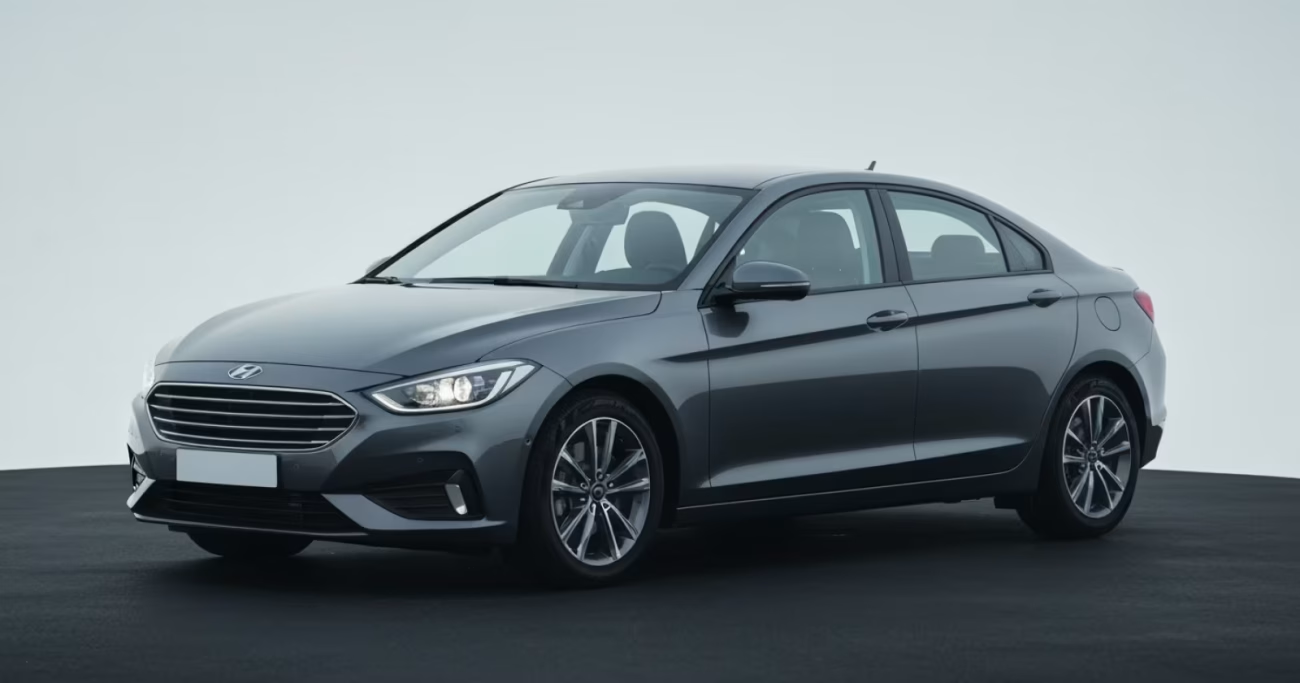
Something interesting is happening inside Hyundai India’s war room right now. The Korean automaker just posted its strongest April ever on Indian soil — and it did so while watching its export numbers fall off a cliff. That contrast tells a bigger story about where Hyundai is placing its bets in FY2027.
I have been tracking monthly sales data for years, and a 16.96% year-on-year jump in domestic volumes is not something you see every month. Hyundai moved 51,902 units across Indian showrooms in April 2026, up from 44,374 units in April 2026. That is a record for the month of April in Hyundai India’s history. The number is worth pausing on because it signals genuine demand recovery, not just channel stuffing or dealer push.
The Numbers Behind The Record
Let me break down the full picture for you. Total sales including exports came in at 65,610 units, which is a 7.96% improvement over the 60,774 units Hyundai shipped in April 2026. But here is where it gets complicated. Exports dropped sharply to 13,708 units — a 16.41% decline from 16,400 units in the same month last year. So the total growth story is entirely powered by domestic strength.
On a month-on-month basis, domestic sales actually dipped 5.74% from the 55,064 units Hyundai sold in March 2026. That is expected. March is always inflated by year-end registration pushes and corporate buying. The real comparison that matters is year-on-year, and that is where Hyundai looks genuinely strong.
| Metric | April 2026 | April 2026 | Change |
|---|---|---|---|
| Domestic Sales | 51,902 | 44,374 | +16.96% |
| Export Sales | 13,708 | 16,400 | -16.41% |
| Total Sales | 65,610 | 60,774 | +7.96% |
| March 2026 Domestic | 55,064 | — | -5.74% MoM |
| Venue Monthly Sales | 12,420 | — | Highest Ever |
Venue Is The Star Of The Show
If there is one model carrying Hyundai on its shoulders right now, it is the Venue. The compact SUV posted its highest-ever monthly domestic sales at 12,420 units. That is nearly a quarter of Hyundai’s entire domestic volume coming from a single nameplate. I find that both impressive and slightly risky — heavy dependence on one model is a double-edged sword.
The Venue surge is not accidental. Hyundai recently secured a 5-star Bharat NCAP safety rating for both the standard Venue and the Venue N Line. In a market where safety consciousness is rising fast, that rating is essentially free marketing. Buyers who were on the fence between a Venue and rivals like the Maruti Brezza or Kia Sonet now have a concrete safety credential to justify their choice.
Special editions have also played their part. The Venue Knight Edition brought cosmetic freshness without requiring a full model cycle update. It is a smart strategy — keep the showroom buzz alive between major facelifts.
Product Blitz Across Segments
Hyundai is not relying on the Venue alone, even if the numbers suggest heavy lifting from that corner. The Exter continues to hold its ground in the micro-SUV space, competing directly against the Tata Punch. The Verna remains one of the few sedans in India that still moves meaningful volumes. And the Creta, including its Summer Edition variant, continues to be the backbone of Hyundai’s SUV strategy.
I was particularly interested to see the Ioniq 5 mentioned in Hyundai’s growth narrative. It is not a volume player by any stretch — we are talking about a premium EV priced well above ₹40 lakh. But its presence in the lineup gives Hyundai credibility in the electric space, something that matters more for brand perception than for monthly sales charts.
The Grand i10 Nios Vibe Edition is another clever move. The hatchback segment is shrinking in India as buyers migrate to SUVs, but limited editions help squeeze residual demand from buyers who still want a compact, affordable car. Every unit counts when you are chasing records.
The Export Problem Nobody Is Talking About
Here is what I think deserves more attention. A 16.41% drop in exports is significant. Hyundai shipped only 13,708 units to international markets in April 2026, down from 16,400 units a year ago. That is nearly 2,700 fewer cars leaving Indian ports.
There could be multiple reasons. Global demand fluctuations, currency headwinds, or even a deliberate reallocation of production capacity toward the domestic market. If Hyundai is prioritizing Indian deliveries to reduce waiting periods and capture market share, the export dip makes strategic sense. But if it reflects weakening demand in key export markets like Africa, the Middle East, or Latin America, that is a longer-term concern.
For now, the domestic strength more than compensates. But I will be watching the export trend over the next two to three months to see if this is a blip or a pattern.
Where Hyundai Stands Against Rivals
Hyundai’s 51,902 domestic units put it firmly in the second spot behind Maruti Suzuki in the Indian market. The gap with Maruti remains large — Maruti typically moves over 1.4 lakh units domestically — but Hyundai’s growth rate is outpacing several competitors.
Tata Motors and Mahindra are the ones to watch. Both have been aggressive with new launches and SUV-heavy portfolios. Tata’s Nexon and Punch continue to eat into segments where Hyundai competes, while Mahindra’s XUV series and Thar variants attract buyers who might otherwise consider a Creta or Venue. Kia India, Hyundai’s sibling brand, also adds an interesting dynamic — the Sonet and Seltos share platforms with Hyundai models, creating internal competition.
What gives Hyundai an edge is portfolio width. Very few manufacturers in India can claim competitive products across hatchbacks, sedans, compact SUVs, mid-size SUVs, and EVs simultaneously. That spread insulates Hyundai from segment-specific slowdowns.
What This Means For The Rest Of FY2027
Starting a financial year with a record April is a strong signal. Hyundai clearly has momentum, and the product pipeline suggests more is coming. Updated variants, new color options, and potential feature additions across the Creta and Venue lineups could sustain this pace through the first quarter.
The real test will come during the monsoon months — July through September — when auto sales traditionally soften. If Hyundai can maintain domestic volumes above 50,000 units consistently, it will be on track for a landmark year.
I also expect Hyundai to address the export gap. The company has historically been one of India’s largest vehicle exporters, and a sustained decline would affect overall plant utilization and revenue mix. Balancing domestic ambition with export commitments will be the key management challenge this year.
If you have been considering a Hyundai — whether it is the Venue with its new 5-star safety rating, the ever-reliable Creta, or even the Exter as a first car — this is a good time to visit your nearest dealership. Strong sales months often mean better availability and competitive deals as dealers ride the momentum. Do not wait for the festive season rush when waiting periods stretch and discounts shrink.
