
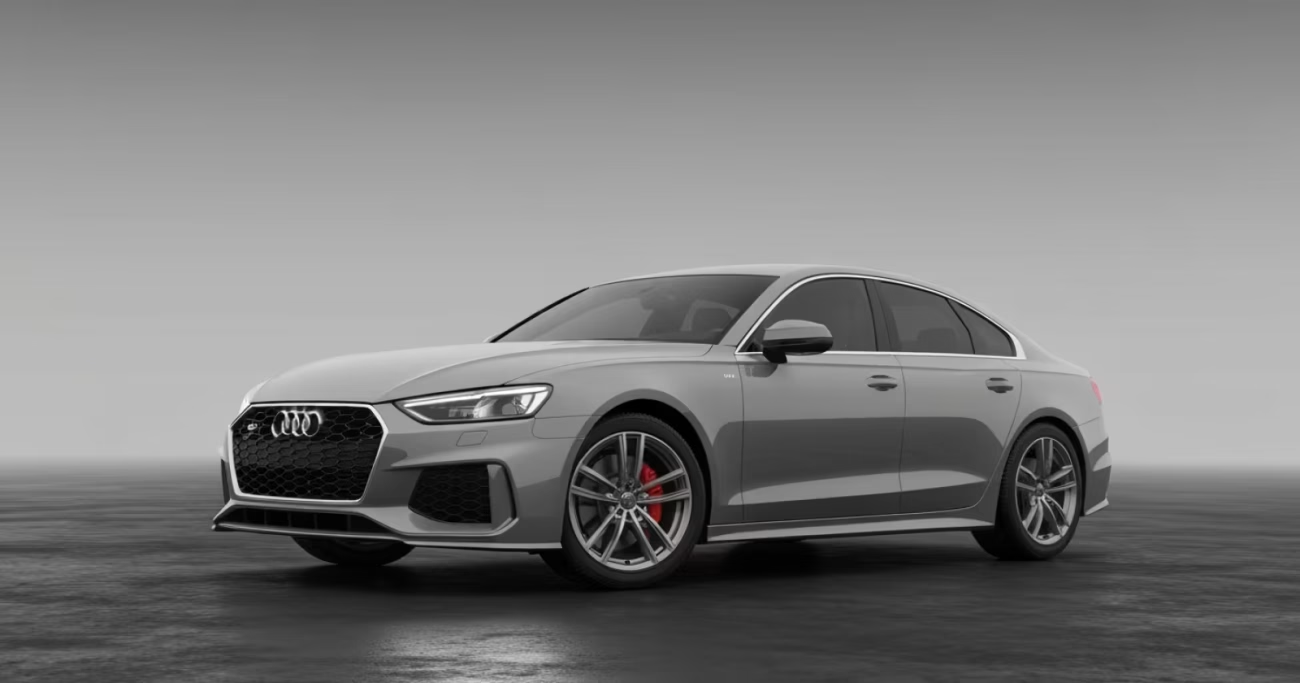
The most powerful SUV Audi has ever built doesn’t wear the badge you’d recognize. It wears its name in all caps, and it just landed in Beijing with 671 horsepower and a range that puts most European EVs to shame.
Audi’s China-only sub-brand, styled as AUDI in block letters, just pulled the covers off the E7X electric crossover. This thing stretches nearly 199 inches long, charges from 10 to 80% in 13 minutes, and offers a 4-seat executive cabin with reclining rear thrones. It’s a statement vehicle, and the statement is loud.
At a glance
| Spec | Detail |
|---|---|
| Peak power (AWD) | 671 hp dual-motor |
| Range (WLTC) | 465 miles on 109 kWh pack |
| 10-80% charge time | 13 minutes (900V architecture) |
| Overall length | 198.8 inches (nearly Q7 size) |
| Wheelbase | 120.5 inches (longest Audi SUV cabin ever) |
| Seating configs | 5, 7, or 4-seat executive layout |
| Price (est. from E5 reference) | From ~$33,100 (E5 starts at ¥235,900) |
Why 671 horses from an Audi EV changes everything
I need to put this number in context. The RSQ8, Audi’s current king of SUV power, runs a twin-turbo V8 making 631 hp. The E7X tops it by 40 horses using electric motors on a platform co-developed with SAIC. No turbochargers, no exhaust note, just instant torque from a dual-motor AWD setup that makes the combustion flagship look like last decade’s thinking.
Even the rear-drive base model puts out 402 hp, which is more than enough for a vehicle this size. The 900-volt architecture is the real story here. That 13-minute charge from 10 to 80% is faster than anything Audi sells in the US or Europe right now. Porsche‘s Taycan platform runs 800 volts. The E7X runs 900. Audi gave China the better hardware, and that’s not a small detail.
BMW and Mercedes charge more for less — think about that
I keep coming back to the E5 Sportback’s price as a reference point. That car starts at roughly $33,100 in China and just won China Car of the Year 2026. If the E7X follows a similar pricing philosophy, it could undercut the BMW iX and Mercedes EQE SUV by a staggering margin while offering more power, more range, and a longer wheelbase than either.
The 465-mile WLTC range on the 109 kWh battery is another number worth sitting with. Yes, WLTC testing is more generous than EPA, but even with a 20% haircut you’re looking at 370-plus miles of real-world range. The BMW iX xDrive50 manages around 320 miles on the EPA cycle. The math favors the newcomer, and it’s not particularly close.
What Audi isn’t saying about the US market
Here’s the catch. You almost certainly can’t buy one. The E7X is built for China on a China-specific platform with a China-focused partner. Audi hasn’t said a word about bringing the AUDI sub-brand to North America or Europe, and the odds of that happening anytime soon sit somewhere near zero. Tariff walls, homologation costs, and political headwinds all work against it.
But the technology doesn’t stay in one market forever. The 900-volt architecture, the Advanced Digitized Platform, the LiDAR-equipped driver assist suite — these are building blocks. Audi is using China as a proving ground for its most advanced EV tech, and what works there will eventually filter into global models. The PPE platform under the Q6 e-tron is already good. What comes next could be built on lessons learned from the E7X.
The back seat is the real flex
I’ve sat in a lot of luxury SUVs, and the spec sheet on the E7X’s executive 4-seat configuration reads like a first-class airline cabin. The rear seats recline to 120 degrees with a 23-bag pneumatic adjustment system. The headrests get 4-way power adjustment. A 21.4-inch screen drops from the headliner for rear passengers, controllable by touch, remote, or voice.
A 26-speaker Bose surround system handles audio duties, with dedicated headrest speakers in the back and shoulder-mounted speakers up front. I’d have expected Bang and Olufsen or Burmester at this level, and Bose feels like a surprising choice. But the speaker count and placement suggest Audi engineered this cabin around the passenger experience first, the driver second. That’s a very deliberate move aimed squarely at the Chinese luxury buyer who sits in the back.
How it stacks up
| Model | Peak power | Range | Charge (10-80%) | Edge |
|---|---|---|---|---|
| Audi E7X (AWD) | 671 hp | 465 mi (WLTC) | 13 min | Power + charge speed |
| BMW iX M60 | 610 hp | 288 mi (EPA) | ~35 min | Available globally |
| Mercedes EQE SUV 500 | 536 hp | 305 mi (EPA) | ~32 min | Brand prestige |
| Tesla Model X Plaid | 1,020 hp | 326 mi (EPA) | ~25 min | Raw acceleration |
Why this matters
- Audi’s most advanced EV tech debuts in China, not Europe
- 900-volt charging sets a new benchmark for the brand globally
- Chinese luxury EVs now match or beat German rivals on specs
The verdict
The E7X is the clearest signal yet that Audi’s center of gravity is shifting east. A 671 hp electric SUV with 465 miles of range and 13-minute charging would be the most compelling luxury EV on sale anywhere — if it were actually sold anywhere beyond China. For now, it’s a technology showcase and a competitive weapon aimed at Li Auto, NIO, and the rest of China’s domestic luxury EV wave. But the ripple effects will reach every market Audi operates in. When the next generation of global Audi EVs arrives with 900-volt charging and this level of rear-seat luxury, the E7X will be the reason why.
If you’re tracking the future of electric luxury SUVs, bookmark the AUDI sub-brand. What’s happening in Beijing today is a preview of what lands in your local Audi showroom within a few years. Keep an eye on how this platform evolves — it could reshape what we expect from a premium electric SUV worldwide.
