
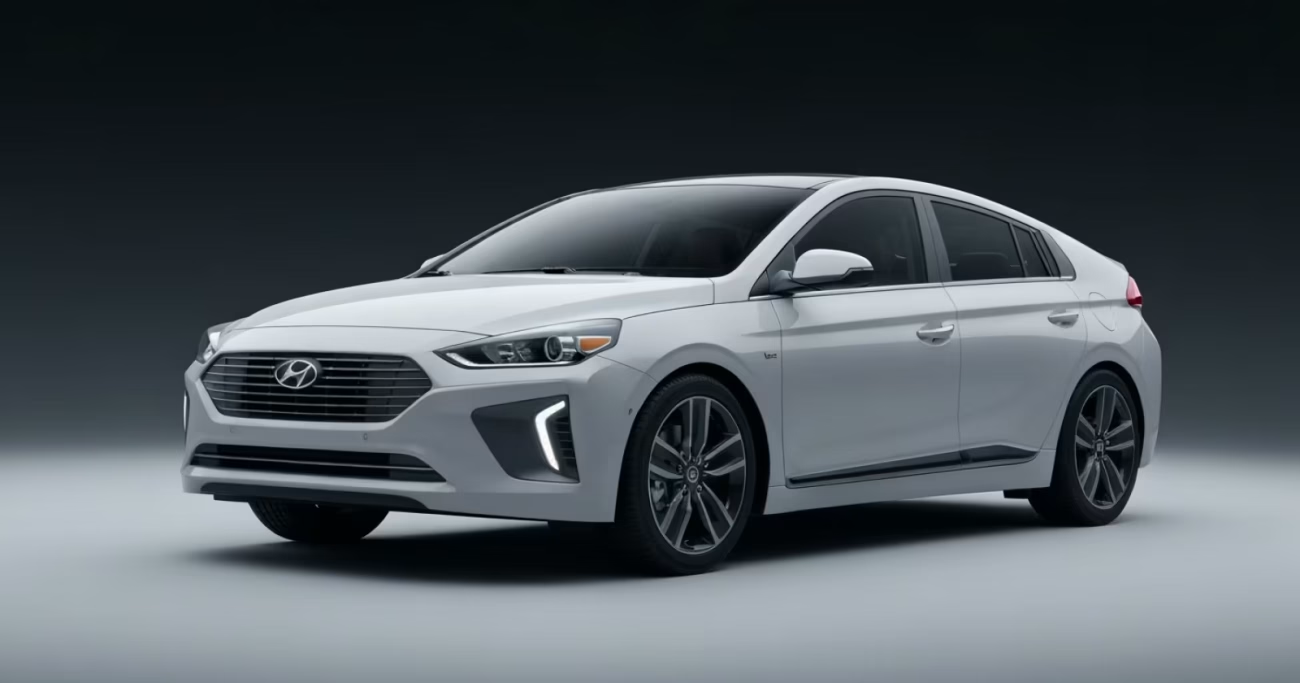
Hyundai just pulled the curtain on two concept cars that look like nothing the Ioniq brand has shown us before — and the internet is already going wild. The Earth and Venus concepts are early teases of what could be Hyundai’s most ambitious EV design reinvention yet, and if these reach production, they could rewrite the rules for premium electric cars in India and beyond.
I’ve been watching Hyundai’s EV journey closely, and I have to say — these teasers genuinely surprised me. Let me break down what we know so far and why this matters for Indian buyers keeping an eye on the premium EV space.
Why Hyundai Is Doing This Right Now
Hyundai has set a bold target: sell 3.3 million electrified vehicles globally by 2030. That includes BEVs, hybrids, and EREVs (Extended Range Electric Vehicles). The Ioniq brand is central to that plan, and it’s about to get bigger. A new Ioniq 3 is already confirmed for Europe, and these two concepts are a strong signal that even more models are in the pipeline.
The official unveiling is expected at the Ioniq Brand Launch event on 10th April, with a possible second appearance at the Beijing Motor Show 2026. So the timeline for more information is very close — and I expect the full picture to be dramatic.
The Earth Concept — Rugged Meets Futuristic
The Earth concept is the one that immediately reminded me of a future-forward crossover SUV. It carries sharp LED lights up front, a compact bonnet, and a steeply raked windshield that flows — possibly — into a full glass roof. That would give occupants a genuinely expansive view, which is a smart move for a premium EV positioning itself above the crowd.
The body panels are flat-surfaced with sharp bends. Think Cybertruck geometry, but wrapped in Hyundai’s design sensibility. You can spot squared wheel arches with plastic cladding, which hints at off-road or adventure-ready aspirations. The Earth concept arrives in a clean silver finish, and at the rear, the lighting elements mirror the sharpness of the front units. A roof-mounted spoiler tapers neatly into the raked rear windshield, giving it a sporty, purposeful silhouette.
This is clearly aimed at practical, family-oriented SUV and crossover buyers — exactly the segment exploding in India right now. If Hyundai brings an Earth-derived model to India, it would land directly in the territory occupied by the Tata Curvv EV and Nexon EV. And based on these teasers, it could have the visual firepower to compete hard.
The Venus Concept — Pure Premium Halo
The Venus concept is a different animal entirely. Where Earth is sporty and utilitarian, Venus is unapologetically luxurious. It arrives in a striking golden finish — a deliberate nod to themes of wealth, elegance, and aesthetics associated with the planet Venus. And from what the teasers reveal, it lives up to that name.
The rear section shows circular wheel arches, a fastback-style roofline, and a heavily raked rear windshield. A black-finish boot lid spoiler sits neatly at the tail, while horizontally stacked sleek taillamps give it a wide, confident stance. The Venus is expected to carry a low-slung profile, promising a higher range and superior performance compared to mainstream Ioniq models.
This is Hyundai’s halo play — a car designed to sit at the top of the Ioniq family and make people aspire to the entire lineup. I see shades of what the Ioniq 6 tried to do, but Venus appears to take that premium ambition significantly further.
Earth vs Venus — Key Differences At A Glance
| Feature | Earth Concept | Venus Concept |
|---|---|---|
| Body Style | SUV / Crossover | Fastback / Halo Sedan |
| Design Language | Sharp, angular, flat panels | Curvy, elegant, luxurious |
| Exterior Finish | Silver | Golden |
| Roofline | Gently sloping, possible glass roof | Fastback, steeply raked |
| Target Buyer | Family, practical SUV buyers | Premium, performance-focused |
| Expected Launch | Late 2027 / Early 2028 | Late 2027 / Early 2028 |
| Platform | IMA + SDV | IMA + SDV |
The Platform Powering Both
Both concepts are expected to ride on Hyundai’s IMA — the Integrated Modular Architecture — paired with a next-generation Software-Defined Vehicle platform. This is significant because SDV technology means over-the-air updates, smarter in-car software, and a more future-proof ownership experience. For Indian buyers who’ve been watching Tata and MG bring connected tech into the mainstream, this would be a serious step up.
Hyundai’s next-gen battery technology is also expected to feature across Earth and Venus-derived production models. Longer range, faster charging, and better thermal management in Indian conditions — these are the things that will genuinely move the needle for EV adoption here.
What This Means For India
India’s premium EV market is just beginning to find its feet. The Ioniq 5 and Ioniq 6 have established Hyundai as a serious player at the higher end, but the segment is still small. An Earth-derived SUV — rugged, practical, loaded with tech — could open up a much wider audience. And if the Venus reaches our shores even as a limited halo product, it would instantly become the most talked-about EV in the country.
Production models derived from these concepts are expected in late 2027 or early 2028, so India timelines would likely follow global launches by six to twelve months. That gives us time to watch, but not long to wait.
If Hyundai’s next Ioniq generation looks anything like these concepts, I genuinely think Indian EV buyers are in for something special. Keep this on your radar — follow us for the full Earth and Venus unveil coverage the moment it drops on 10th April, and drop a comment below telling me which one excites you more.
