
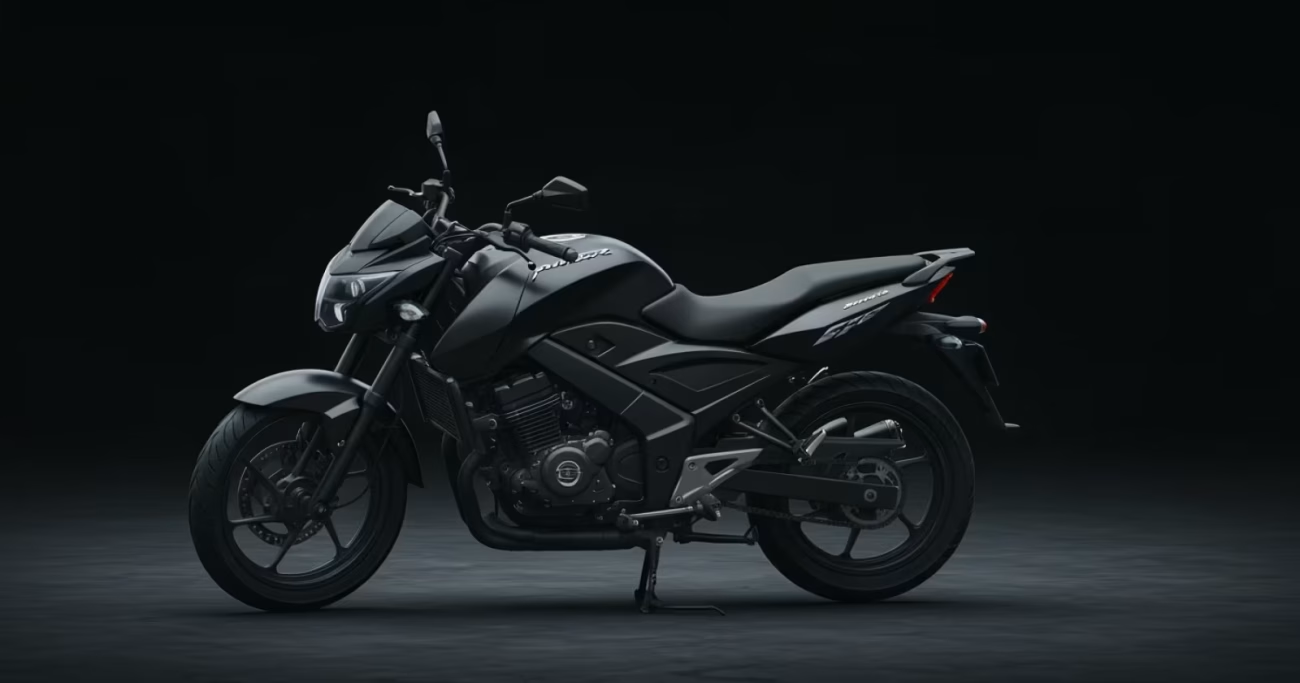
The motorcycle community did not expect this spec sheet to surface quite so early — and honestly, neither did I. Bajaj Auto is about to make a surgical change to two of its most beloved performance bikes, and the leaked numbers reveal exactly what’s changing under the skin.
Before the official curtain drops, sources close to Bajaj’s development pipeline have shared detailed engine specifications for the upcoming 2026 updates to the Pulsar NS400Z and Dominar 400. Here’s everything you need to know right now.
The GST Trigger Behind This Engine Change
If you’ve been tracking Indian two-wheeler policy, this move will make immediate sense. Motorcycles displacing above 350cc attract a steeper GST tax slab in India, and Bajaj has reportedly been absorbing that extra burden internally rather than passing it on to buyers. That’s a generous strategy — but it’s not one any brand can sustain indefinitely.
The fix is straightforward and clever. By trimming displacement to just below 350cc, Bajaj steps out of the higher tax bracket entirely. And critically, both bikes keep their existing names. The Pulsar NS400Z stays the Pulsar NS400Z. The Dominar 400 stays the Dominar 400. Brand equity preserved, GST liability reduced.
Full Breakdown Of The New 349cc Engine
The new engine displaces exactly 349.13cc. Bajaj has retained the bore at 89 mm — same as the outgoing unit — but shortened the stroke from 60 mm down to 56.1 mm. That single dimensional change is what trims displacement while keeping the engine’s core character intact.
Peak power comes in at 40.6 PS at 9,000 RPM. Peak torque is 33.2 Nm at 7,500 RPM. Against the current 373cc engine’s 43 PS and 35 Nm, that’s a reduction of 2.4 PS and 1.8 Nm respectively. I’ll be direct — for 90 percent of riders on Indian city roads or highway runs, that gap is functionally invisible.
The rest of the architecture stays untouched: single-cylinder, liquid-cooled, single spark plug, slip-and-assist clutch, wet sump forced lubrication, and a 6-speed sequential gearbox. Solid, proven, dependable.
Spec Comparison — New 350cc vs Outgoing 373cc
| Specification | New 350cc Engine (2026) | Outgoing 373cc Engine |
|---|---|---|
| Displacement | 349.13cc | 373.27cc |
| Bore | 89 mm | 89 mm |
| Stroke | 56.1 mm | 60 mm |
| Peak Power | 40.6 PS @ 9,000 RPM | 43 PS @ 9,000 RPM |
| Peak Torque | 33.2 Nm @ 7,500 RPM | 35 Nm @ 7,500 RPM |
| Cooling | Liquid-cooled | Liquid-cooled |
| Gearbox | 6-speed sequential | 6-speed sequential |
| Clutch | Slip and assist | Slip and assist |
Design, Features, And Colours — What Stays The Same
Both bikes are expected to roll into 2026 with zero visual changes. Same aggressive naked silhouette on the NS400Z, same touring-ready proportions on the Dominar 400. Colour options are also expected to mirror current showroom offerings, so no new shades are anticipated at this stage.
Equipment levels remain thoroughly impressive for the segment. You’re still getting USD front forks, sintered brake pads, a perimeter frame, disc brakes at both ends with dual-channel ABS, multiple riding modes, and a Bluetooth-enabled instrument cluster with integrated navigation. That spec sheet remains one of the strongest in this price bracket — full stop.
Pricing Expectations For The 2026 Update
Here’s the part that matters most for your wallet. Bajaj is expected to maintain pricing close to the current models rather than offering a reduction. The reasoning is logical: the company has been absorbing the higher GST burden itself all along. Switching to a 350cc engine normalises the cost structure going forward — it isn’t designed to trigger a price cut.
Whether buyers see a slight MRP revision or a straight carryover, the value proposition remains strong. Sitting alongside the TVS Apache RTR 310 and Triumph Speed 400 (which is also reportedly moving to a 350cc unit), the Pulsar NS400Z in particular is positioned for an interesting showroom battle in 2026.
When Is The Launch Happening?
Leaked information points to a launch within the coming weeks. Given how specific and detailed these specs are — bore dimensions, exact displacement figures, RPM-matched power outputs — this doesn’t read like a rumour. This reads like final engineering sign-off data that found its way out early.
Bajaj hasn’t made any official statement yet, but the precision of this leak suggests the announcement window is extremely close. Watch the official Bajaj channels carefully over the next few weeks.
My honest assessment? A 2.4 PS drop is not a dealbreaker — not even close. Bajaj has made a pragmatic, intelligent call that protects pricing and buyer value while solving a genuine tax inefficiency. If you’ve been holding off on the NS400Z or Dominar 400, now is the time to lock in your booking before launch day crowds hit the dealerships. Drop your pick in the comments — are you going naked street with the NS400Z or loaded tourer with the Dominar?
