
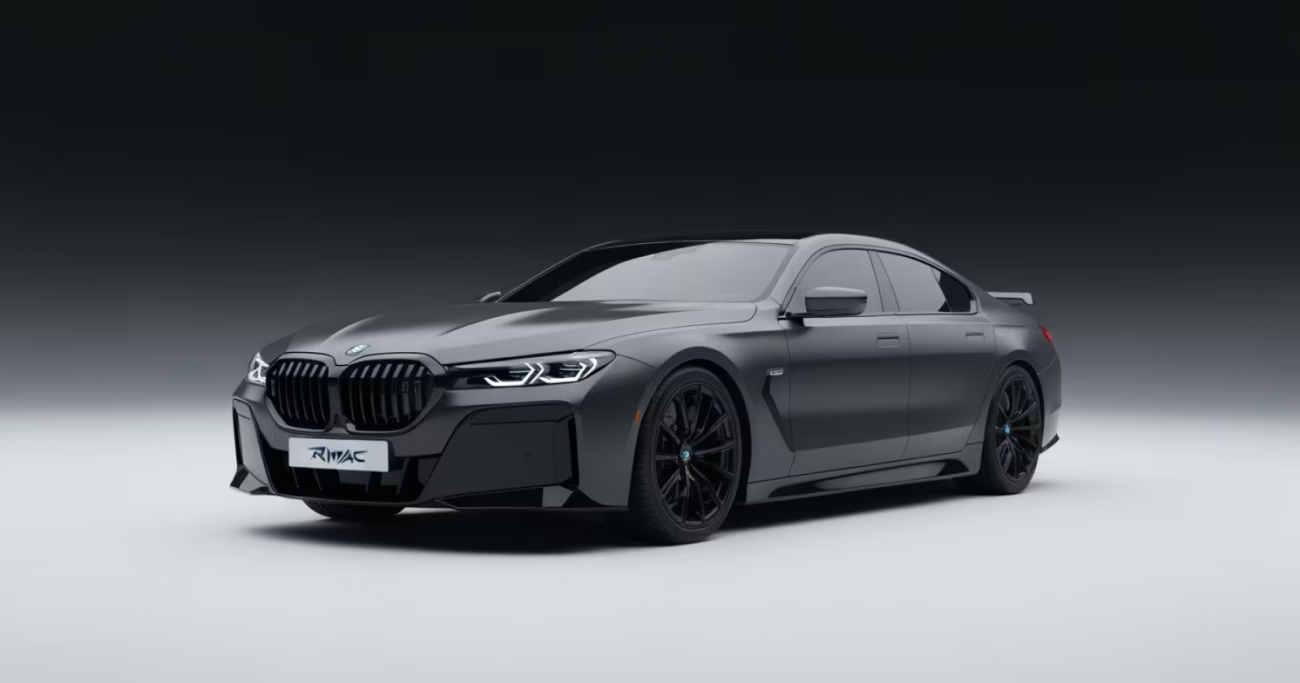
BMW just handed its flagship electric sedan to a Croatian hypercar company for the most consequential battery overhaul in the i7’s short history. The 2027 model will become the first BMW to carry Rimac-engineered battery technology — and the performance jump it promises is large enough to shift the competitive math across the entire luxury EV segment.
Why BMW chose a hypercar brand over traditional battery suppliers
When BMW and Rimac announced their technology cooperation back in 2023, I expected the results to take the better part of a decade to materialize. What actually happened was faster than almost anyone in the industry anticipated. Rimac didn’t just develop a new battery system — the company simultaneously constructed a brand-new 969,000-square-foot manufacturing campus near Zagreb, Croatia, purpose-built to produce that system at scale. That is roughly the footprint of 17 NFL football fields, built from the ground up in under three years.
The new battery blends BMW’s own Gen6 cylindrical cells — engineered for higher energy density through a scalable geometry — with Rimac’s Gen5 module-based architecture. The combined approach gives the pack a flexibility that neither company’s standalone technology could deliver alone. Mate Rimac described the collaboration as producing “significant improvements in energy, range, and charging performance” in “record time.” Given that his team built an entire factory during the same window, that quote carries real weight.
The real story behind a 10 to 15 percent range improvement
The current i7 eDrive50 already posts 314 miles of range — a solid number for a full-size luxury EV. The performance-spec M70 xDrive, pushing 659 horsepower through dual motors, manages around 260 miles. Apply the projected 10 to 15 percent improvement from Rimac’s battery and those figures climb to roughly 345 miles and 299 miles respectively. Pushing the M70 past the 300-mile barrier while maintaining that power output would be a genuinely difficult engineering achievement.
Here’s the catch: BMW has not locked in official range figures ahead of the April 22 reveal in Beijing. The projections above are extrapolated from the stated improvement targets, not confirmed specifications. What I find more telling than the range numbers themselves is the charging performance claim. Faster charging combined with extended range means shorter stops and longer usable trips — and that combination is what actually changes ownership behavior, not just spec sheet rankings.
| Spec | 2026 i7 eDrive50 | 2026 i7 M70 xDrive | 2027 i7 (Projected) |
|---|---|---|---|
| Range | 314 miles | 260 miles | ~345 / ~299 miles |
| Power | 449 hp | 659 hp | TBC at Beijing |
| Battery tech | BMW Gen5 Li-ion | BMW Gen5 Li-ion | BMW Gen6 + Rimac Gen5 |
| Charging speed | Standard | Standard | Improved (unconfirmed) |
| Base price | $105,700 | $185,900 | TBC |
Rimac’s Zagreb factory is bigger than the hypercar hype suggests
About 18 percent of Rimac’s new Zagreb campus is dedicated entirely to BMW’s production line. Roughly half of the remaining space serves other large-scale automakers whose names have not all been publicly confirmed. That setup tells me something important about where Rimac is actually headed. The company has quietly repositioned itself from a boutique supercar manufacturer into a legitimate Tier 1 automotive supplier, competing in territory typically owned by CATL, Samsung SDI, and Panasonic.
Rimac is also developing electric motors and solid-state batteries for Aston Martin, Porsche, and Ceer — a Saudi-backed electric supercar brand still in its early formation. The scalable design of the new BMW battery architecture further suggests these cells will spread to smaller BMW models over time, specifically those not built on the Neue Klasse pack-to-open-body platform. What started as a niche Croatian supercar brand is quietly becoming the technological backbone behind some of the most important EVs of the next decade.
The 2027 refresh goes well beyond a smarter battery pack
The battery upgrade arrives alongside a visual overhaul that directly addresses one of the most divisive aspects of the current 7 Series. Spy shots ahead of the Beijing reveal show a reworked headlight configuration — the controversial stacked horizontal lamps are reportedly being replaced by dual LED eyebrow elements and a lower-mounted projector. The change simplifies the front fascia considerably, which should help the 7 Series compete more comfortably against the restraint of the Mercedes-Benz S-Class.
Internal combustion 7 Series variants are expected to debut around the same time, though BMW hasn’t confirmed mechanical specifics for those trims. What strikes me about the refresh overall is that the battery development alone represents more substantive engineering progress than many luxury automakers deliver between full model generations. Achieving a 10 to 15 percent efficiency gain in three model years, through a cross-continental partnership rather than traditional in-house development, is a blueprint other legacy brands will study very carefully going forward.
The April 22 Beijing reveal is worth tracking closely whether or not a six-figure BMW is on your radar. What Rimac and BMW have built together points toward something larger than one car’s specifications — it signals a structural shift in how premium EV technology gets developed, manufactured, and deployed at scale. If the confirmed range figures land where projected, expect BMW to announce broader Rimac battery integration across its electric lineup almost immediately. Mark the date, follow the announcement, and pay attention to what BMW says about future rollout plans — because this partnership is just getting started.
