
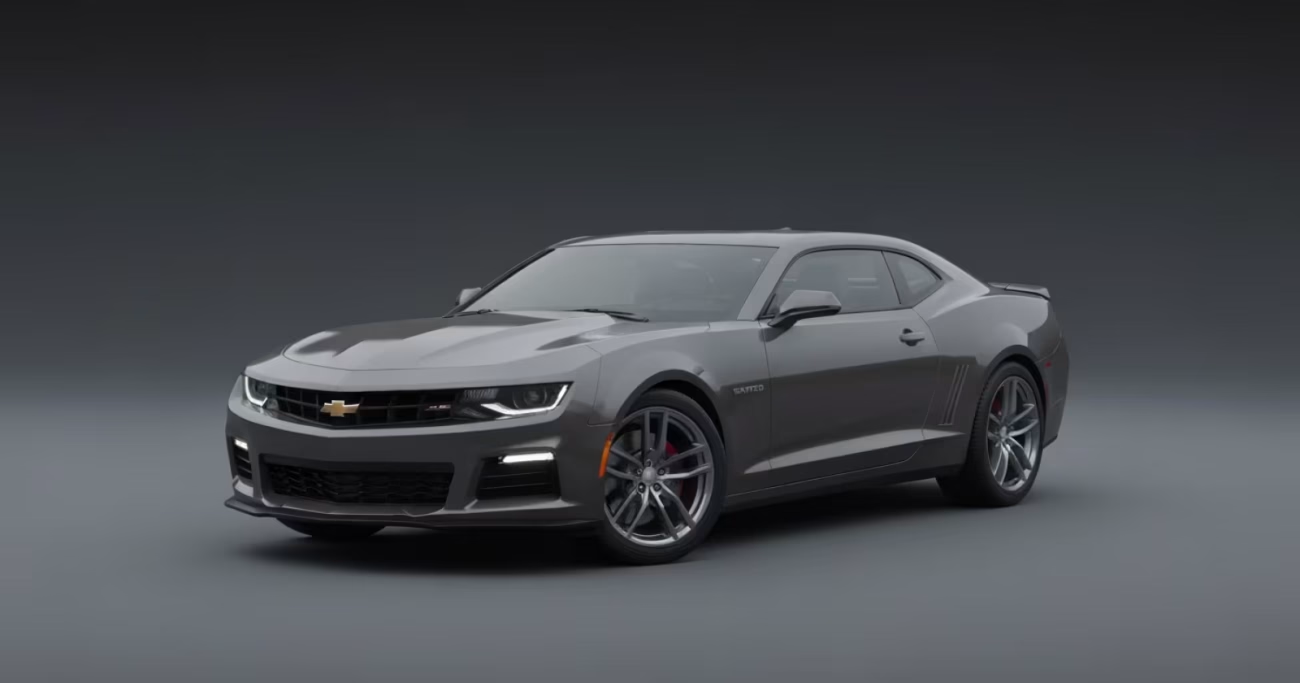
General Motors just quietly confirmed it is resurrecting two legends at once, and the muscle car world may never look the same again. A Chevy Camaro return was already the stuff of enthusiast dreams — but nobody saw a rear-drive Buick sedan coming along for the ride.
According to a report from Automotive News, a source at a major GM supplier confirmed that the upcoming redesigned Cadillac CT5 will serve as the platform donor for both a new Chevrolet Camaro and a brand-new Buick four-door sedan. That means three rear-drive, gas-powered, performance-oriented vehicles are heading to market before the end of the decade — and I genuinely did not have this on my 2026 bingo card.
Why the Camaro’s second comeback hits differently this time
The Camaro has already cheated death once. GM killed it in 2002 after sluggish sales, then brought it roaring back for the 2010 model year. The sixth generation ran until 2024, when rising crossover demand finally pushed GM to pull the plug again. Most of us assumed that was the end of the story.
It wasn’t. The new Camaro is expected to debut around 2027, sharing the next-generation CT5’s evolved GM Alpha platform — the same stiff, lightweight architecture that underpins the current CT4, CT5, and the outgoing Camaro itself. Alpha debuted under the 2013 Cadillac ATS and has delivered some of the sharpest handling dynamics of any GM product in decades. With modern refinements, it should be even better the third time around.
500 horsepower in base SS spec should make the Mustang sweat
Here’s where it gets serious. The new Camaro is expected to borrow a version of the 2027 Corvette’s 6.7-liter V8, tuned to produce around 500 horsepower in SS specification. That’s not a number Ford can laugh off. The current Mustang GT makes 486hp — the Camaro would walk in the door already swinging harder.
The real story is what could sit above the SS. If Chevrolet revives the supercharged ZL1 and the track-focused Z/28 — and there’s genuine hope that they will — you’re looking at a direct confrontation with the Mustang Dark Horse S/C and the Mustang GTD. GM hasn’t had a credible answer to Ford’s top-shelf pony cars in years. That gap could be closing fast.
| Model | Engine | Power | Drive | Expected Price |
|---|---|---|---|---|
| Chevy Camaro SS (2027, est.) | 6.7L V8 | ~500 hp | RWD | TBA |
| Ford Mustang GT (2026) | 5.0L V8 | 486 hp | RWD | ~$42,000 |
| Cadillac CT5 (2027, est.) | TBA | TBA | RWD/AWD | TBA |
| Buick Sedan (2027+, est.) | V6 Turbo / V8 (rumored) | TBA | RWD/AWD | TBA |
| Chevy Camaro ZL1 (2024, final) | 6.2L Supercharged V8 | 650 hp | RWD | $72,100 |
The Buick sedan nobody asked for — but everyone should want
Here’s the catch: the Buick four-door isn’t just a bonus product. According to Automotive News, a CT5 and a Camaro alone wouldn’t fill enough production capacity at GM’s Lansing Grand River assembly plant in Michigan. The plant currently builds the CT4 and CT5, but the CT4 ends production in June 2026, leaving a significant gap on the line. The Buick sedan exists, at least in part, to keep that factory humming efficiently.
That said, it’s shaping up to be far more interesting than a factory-fill exercise. The unnamed Buick will be the brand’s first rear-drive sedan in over 30 years — the last one was the 1996 Roadmaster Limited. Buick’s entire current lineup is front-drive-biased crossovers, so a performance sedan would be a genuinely shocking pivot. Reports suggest a turbocharged or supercharged V6 and possibly a V8 option, which would directly echo legendary Buick nameplates like the Grand National and GNX from the 1980s.
What GM isn’t saying about the platform strategy behind all of this
GM is being clever here, and I think it deserves credit for that. By spreading the development and retooling costs of one platform — the next CT5 — across three separate vehicles, the automaker dramatically improves the financial case for each of them. No single model has to carry the full weight of engineering a new rear-drive architecture. That’s how you justify bringing back a muscle car that was cancelled twice and launching a Buick performance sedan that has no direct precedent in decades.
What GM isn’t saying out loud is that this strategy also de-risks the bet on internal combustion. The automaker has been aggressively pushing EVs, but these three gas-powered performance cars signal that GM isn’t ready to abandon enthusiast buyers entirely. The Cadillac CT5 was originally rumored to go all-electric — and the fact that it’s now leading a gas-powered platform family tells you everything about where real customer demand still lives in 2026.
Why this matters
- GM’s platform-sharing strategy makes 3 performance cars financially viable at once
- Ford’s Mustang monopoly on the muscle car segment is about to face real competition
- Buick’s identity gets a rare injection of performance credibility after years of crossover-only sales
The verdict: if you’ve been mourning the Camaro since its 2024 farewell, the wait appears to have a defined end date. A 2027 arrival with 500-plus horsepower, a proper rear-drive chassis, and a potential ZL1 follow-up makes this one of the most exciting GM announcements in years. The Buick sedan is the wildcard that could either steal the show or get lost in the Camaro’s shadow. Either way, the muscle car segment just got a whole lot more interesting — and Ford should be paying close attention. I’d strongly encourage any enthusiast sitting on the fence about their next performance car purchase to hold off just a little longer, because what GM is cooking deserves a serious look before you sign anything.
