
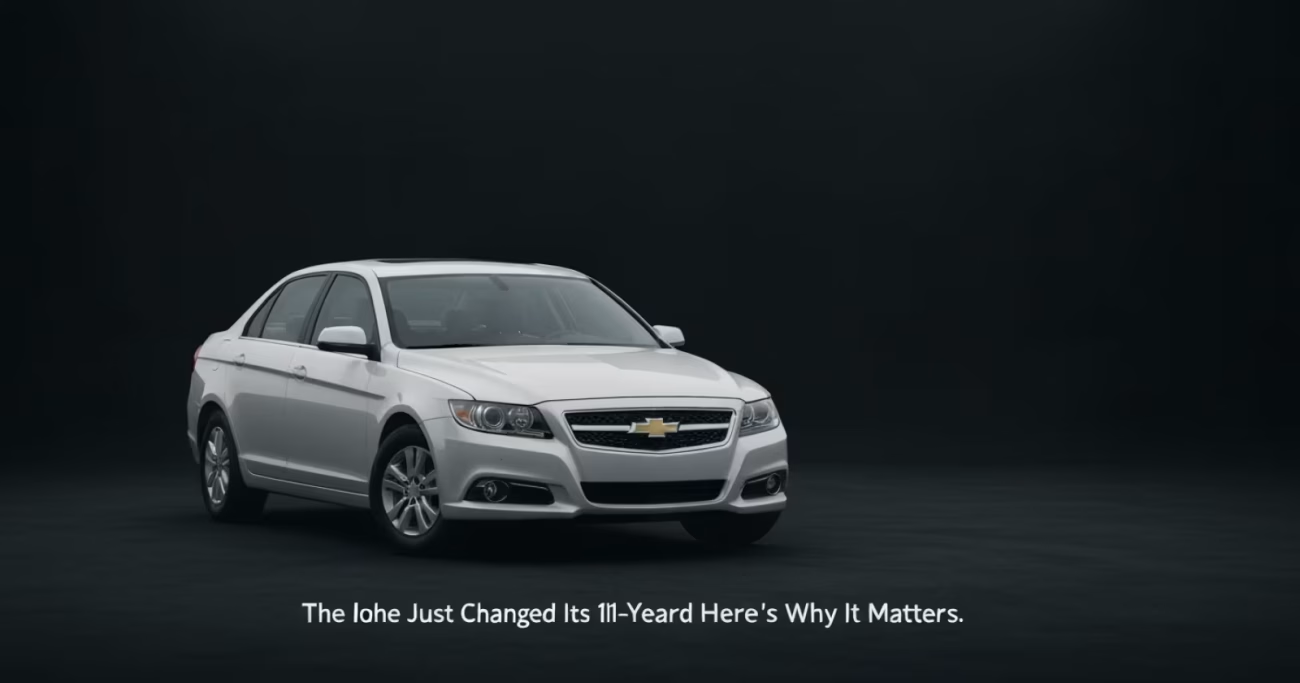
One of the most recognizable logos in the entire auto industry just got a quiet facelift. Chevrolet has confirmed a redesigned bowtie badge is coming to every market, including the United States, and the difference is so subtle you might need a magnifying glass to spot it.
At a glance
| Spec | Detail |
|---|---|
| Badge change | More horizontal shape, black replaces gold |
| First model | 2026 Chevrolet Sonic (South America) |
| U.S. confirmed | Yes, first U.S. model unannounced |
| Likely U.S. debut | Next-gen Silverado |
| New Sonic length | 166.5 inches (3 inches shorter than Bolt) |
| Sonic body style | SUV coupe, similar to Buick Envista |
| Other recent rebadges | Chrysler, Honda, BMW Alpina, Mazda |
Why Chevy ditching gold changes more than you think
For decades, that brass-gold bowtie has been the default face of every Chevrolet rolling off the lot. Black-out badge packages have been popular dealer add-ons and factory options for years, but the standard was always gold. Now Chevy is flipping that script entirely, making a predominantly black bowtie the new baseline across its global lineup.
The shape itself is getting tweaked too, stretched slightly wider and more horizontal than the current design. Chevy’s own press materials acknowledge the change, but honestly, the dimensional difference is almost impossible to detect without placing old and new versions side by side with measuring tools. The color shift from gold to black is the real visual story here.
Every automaker is doing this and there’s a pattern
Chevrolet is far from alone in this move. Over the past year alone, Chrysler unveiled a refreshed wing logo, Honda modernized its H-mark, BMW Alpina got a post-acquisition identity update, and Mazda previewed a cleaner version of its emblem. The auto industry is in the middle of a full-blown identity refresh cycle, and most of these changes share a common thread: simplification.
Flatter designs, darker palettes, and cleaner lines play better on screens than on chrome grilles. As digital showrooms, configurators, and app-based ownership experiences become the norm, badges need to look sharp at 72 pixels just as much as they do at 72 inches. Chevy’s move fits that broader strategy perfectly, even if the brand isn’t saying it out loud.
The new Sonic is real but don’t expect it here
The badge will make its physical debut on a brand-new Chevrolet Sonic launching in South America next month. Before anyone gets excited, this is not the scrappy little hatchback Americans remember. The 2026 Sonic is an SUV coupe in the mold of the Buick Envista, with a gently sloping roofline and crossover proportions. At 166.5 inches long, it is 3 inches shorter than the discontinued Chevy Bolt.
That compact footprint slots it between the South American Onix hatchback and the Tracker SUV in Chevy’s regional lineup. I would not hold my breath for a U.S. version. The margins on a vehicle this small would be razor-thin stateside, especially once you factor in the cost of federalizing it for American safety and emissions standards. Chevy has bigger fish to fry in this market.
What Chevy isn’t saying about the U.S. rollout
Representatives from Chevrolet’s U.S. office confirmed to journalists that the new bowtie will absolutely appear on American models. What they refused to share is which vehicle gets it first. The smart money points to the next-generation Silverado, which is widely expected to be the brand’s next major product launch in the States. A flagship truck carrying a fresh badge would make for a clean marketing narrative.
The real question is whether Chevy plans a hard cutover or a gradual phase-in across the lineup. Historically, badge transitions happen model by model as vehicles get redesigned or refreshed. That means some Chevys could wear the gold bowtie well into 2027 or 2028 while others sport the new black version. It is a small detail, but for brand consistency, the transition period always looks a little awkward.
How it stacks up
| Brand | Badge update year | Visual change level | Primary shift | Edge |
|---|---|---|---|---|
| Chevrolet | 2026 | Subtle | Gold to black, wider shape | Most iconic base logo |
| Honda | 2026 | Moderate | Thinner, flatter H-mark | Cleaner digital presence |
| Chrysler | 2026 | Significant | Modernized wing design | Strongest visual departure |
| Mazda | 2026 | Subtle | Simplified owl-wing emblem | Best premium positioning |
Why this matters
- Signals Chevy is preparing its brand identity for an EV-heavy future
- The Silverado badge debut could reshape truck marketing in 2026
- South America is now Chevy’s design launchpad, not Detroit
The verdict
A bowtie color swap and a few millimeters of shape change will not move the needle for most buyers walking onto a dealer lot. But that is not really the point. Chevy is aligning its visual identity with a darker, flatter, more digital-first design language that every major automaker is chasing right now. The Silverado will almost certainly be the vehicle that brings this badge to American driveways, and when it does, it will mark the first time in years that Chevy’s most visible product launched with a genuinely new face. Keep an eye on next month’s Sonic reveal for the first clean look at what every future Chevy will wear on its nose.
