
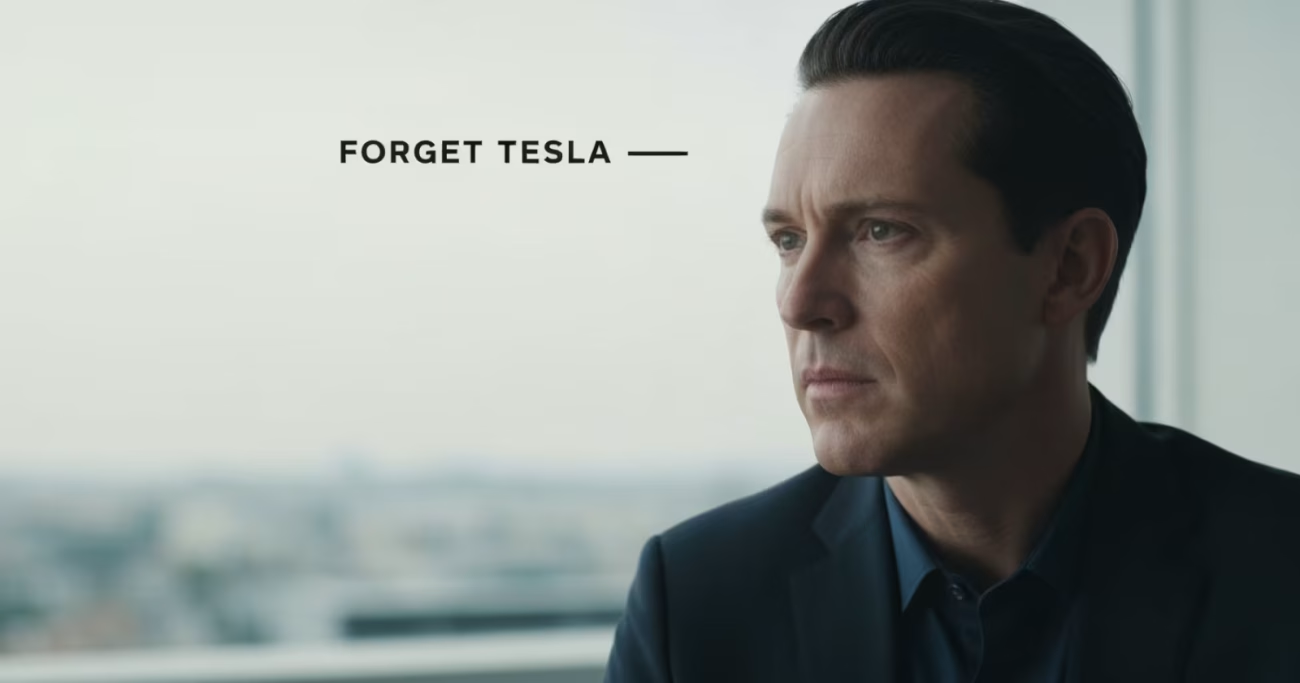
The head of America’s second-largest automaker just admitted he spent 6 months driving a Chinese electric sedan and came away humbled. Ford CEO Jim Farley is done worrying about Tesla. His attention has shifted 7,000 miles east, and the implications for every car buyer in America are enormous.
Why Farley stopped losing sleep over Tesla
In a revealing interview on the Rapid Response podcast with host Bob Safian, Farley made his position blunt. He told listeners that if Americans want domestic automakers to beat the Chinese in the car business, they need to stop fixating on Tesla. His reasoning was direct and a little uncomfortable: Tesla simply does not have an updated vehicle lineup right now.
That is a striking admission from the CEO of a company that has spent billions trying to compete with Elon Musk’s brand. But Farley has clearly moved on. After personally driving a Xiaomi SU7 electric sedan for 6 months in 2024, he came away with a different understanding of where the real competitive pressure lives. It is not in Austin. It is in Shenzhen, Hefei, and Changsha.
BYD’s cost structure is what keeps Farley up at night
Farley singled out BYD by name, praising the Chinese giant’s cost competitiveness, supply chain management, manufacturing expertise, and intellectual property. BYD overtook Tesla as the world’s top battery-electric vehicle seller in 2026, and the gap has only widened since. I find it remarkable that a Ford CEO would publicly credit a Chinese rival this openly.
The numbers tell the story. China’s auto industry sells roughly 29 million vehicles annually, dwarfing the 16.3 million sold in the US last year. But here is the catch: Chinese factories have capacity for 50 million units. That means their plants would run at barely half capacity if they only served the domestic market. So they export, aggressively, with shipments up 43% this year alone. China is now the world’s largest vehicle exporter, leapfrogging Japan and South Korea.
| Spec | Detail |
|---|---|
| China annual vehicle sales | 29 million units |
| China factory capacity | 50 million units |
| Chinese export growth (2026) | Up 43% year-over-year |
| Average Chinese vehicle subsidy | Up to $5,000 direct and indirect |
| Ford’s target EV price point | $30,000 for pickups and utility EVs |
| BYD vs Tesla (2026 BEV sales) | BYD overtook Tesla as No. 1 globally |
The $5,000 advantage nobody in Detroit can match
Farley pointed to something that should concern every American automaker and every consumer watching EV prices. The average Chinese vehicle benefits from up to $5,000 in direct and indirect government subsidies. With the US federal EV tax credit gone since last fall, that gap is now fully exposed. There is no equivalent cushion for domestic manufacturers.
He acknowledged that the industry needs government help, specifically for infrastructure, trade schools, and apprenticeship programs to train next-generation skilled workers. But he was careful not to lean on that crutch entirely. His exact words: we also cannot rely on the government, we have to do it ourselves. I respect the honesty, even if the math looks brutal for Detroit right now.
Ford’s pivot away from Lightning tells the real story
What Farley is not saying loudly is that Ford’s first-generation EV strategy essentially failed. He admitted the F-150 Lightning and, by implication, the Mustang Mach-E were designed the wrong way and lost significant money. The Lightning is being phased out. The Mach-E remains in the lineup for now, but its future feels uncertain at best.
The replacement strategy centers on Ford’s new Universal EV platform, targeting affordable commuter vehicles and $30,000 pickups and utility EVs. Farley credited Chinese competition for forcing this reset. He called it a gift, the pressure that made Ford stop phoning it in. That is a candid way to describe billions in losses, but he is not wrong. Without BYD breathing down the industry’s neck, there would be little urgency to build a $30,000 electric truck.
What Ford is not saying about the Escape and boring products
Farley also revealed that Ford killed the Escape because it did not fit the brand’s identity. The Bronco Sport now fills that compact crossover role, and the CEO was blunt about why. The Escape was not differentiating. His new mantra is no boring products, with a focus on what he calls passion vehicles for work, off-road, and on-road driving.
I think this is the most telling part of the entire interview. Ford is not just restructuring its EV lineup. It is restructuring its entire identity around vehicles that provoke an emotional response. That is a direct reaction to Chinese brands flooding global markets with competent but often generic alternatives. Ford’s bet is that American buyers will pay a premium for character. Whether that bet holds against a $5,000 subsidy advantage remains the open question.
How it stacks up
| Automaker | 2026 Global BEV Rank | Avg EV Price Target | Gov Subsidy Per Vehicle | Edge |
|---|---|---|---|---|
| BYD | No. 1 | Under $25,000 | Up to $5,000 | Cost and scale |
| Tesla | No. 2 | $35,000+ | None (US credit ended) | Brand and software |
| Ford (UEV platform) | Launching 2026-2027 | $30,000 | None currently | Trucks and utility focus |
| Xiaomi | Rising fast | Under $30,000 | Up to $5,000 | Tech ecosystem integration |
Why this matters
- China’s 50-million-unit capacity can supply all of North America alone.
- Ford’s $30,000 EV target resets the US affordability benchmark.
- The post-subsidy era forces American automakers to innovate or lose.
The verdict
Jim Farley just told the American auto industry to stop watching the rearview mirror at Tesla and start looking at the freight train coming from China. Ford’s pivot to affordable EVs on the UEV platform is the right call, but execution against manufacturers with a built-in $5,000 cost advantage and 43% export growth will be punishing. If Ford delivers a credible $30,000 electric pickup before BYD gains serious foothold in Western markets, Farley’s gamble pays off. If not, this interview will read like a warning nobody heeded in time.
If you are shopping for an EV in the next 18 months, keep a close eye on Ford’s UEV platform announcements and BYD’s expansion into new markets. The pricing war between Detroit and Shenzhen is about to reshape what you pay for your next vehicle, and the winners have not been decided yet.
