
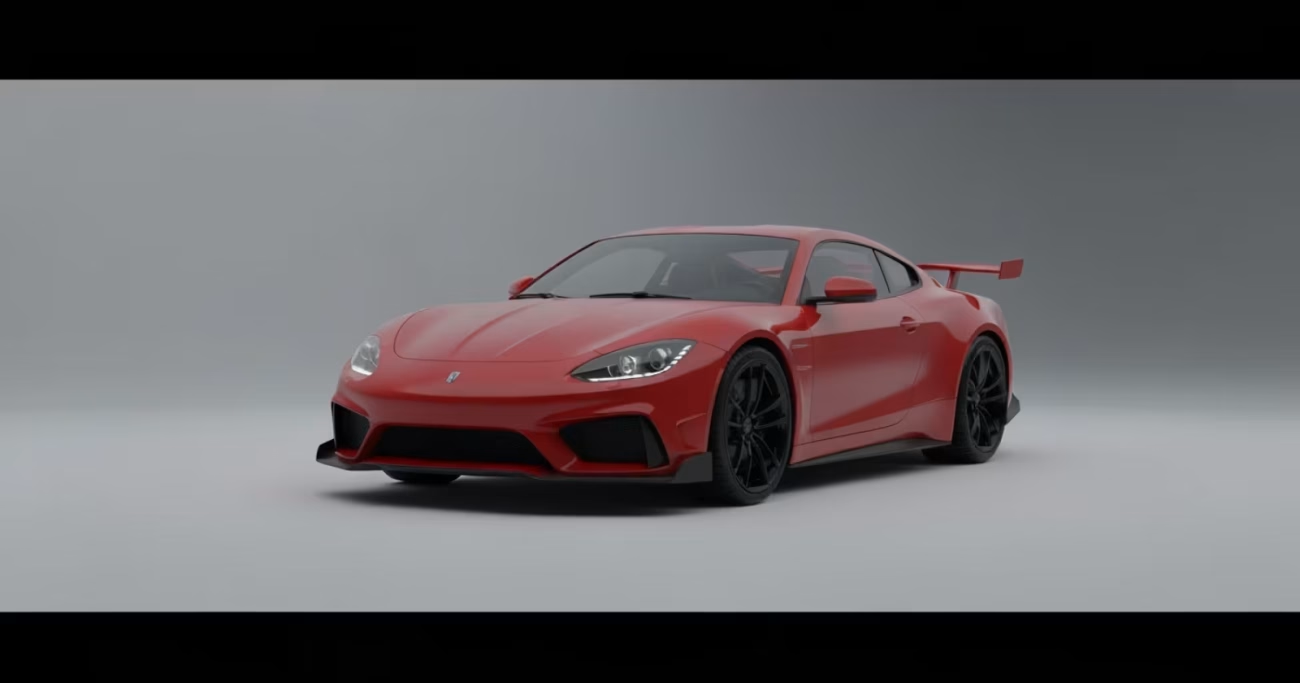
A Chinese automaker just showed up to Auto China 2026 with a twin-turbo V8, a carbon fiber monocoque, and 1,184 horsepower. This isn’t an EV. This is Great Wall Motor telling every European supercar brand that the rules of engagement just changed.
For years, China’s automotive dominance story has been written in kilowatt-hours and battery density. The Xiaomi SU7 Ultra holds the Nurburgring production EV record. But combustion-powered prestige has remained firmly in European and Japanese hands — until now.
At a glance
| Spec | Detail |
|---|---|
| Engine | Twin-turbo 4.0L V8, hot-vee configuration |
| Total output (road car) | 1,184 hp (hybrid assist + AWD) |
| GT3 race car output | ~592 hp (regulation limited) |
| Chassis | Carbon fiber monocoque — first from a Chinese OEM |
| Layout | Mid-engine, all-wheel drive |
| Lubrication | Dry-sump |
| GT3 race car reveal | 2027 Shanghai Auto Show |
Why a V8 from China changes everything
GWM calls the platform “GF” — short for Great Faith. That name sounds aspirational until you look at the spec sheet and realize they’re dead serious. The 4.0-liter V8 uses a 90-degree block with dry-sump lubrication and a hot-vee turbo layout, the same configuration you find in the Mercedes-AMG GT and Aston Martin Vantage. This isn’t a science experiment. It’s a proven architecture executed at the highest level.
The road car pairs that V8 with an electric hybrid system pushing combined output to 1,184 hp with all-wheel drive. For context, a Ferrari 296 GTB makes 819 hp. A McLaren 750S tops out at 740. GWM isn’t just entering the supercar conversation — it’s walking in and sitting at the head of the table.
The GT3 angle is where the real story lives
Here’s the catch most people will miss. The road car grabs headlines, but the GT3 program is the strategic play. GT3 is the most popular customer racing class on the planet, with series running on every continent. Ford, Ferrari, Porsche, Lamborghini, BMW, and Aston Martin all compete. Getting a car homologated for GT3 means global visibility, engineering credibility, and a revenue stream from selling race cars to privateer teams.
GWM plans to reveal the GT3 version at the 2027 Shanghai Auto Show. Even regulation-limited to around 592 hp, the company says it will carry the most powerful engine ever built by a Chinese automaker. That claim alone will draw scrutiny and attention in equal measure from every established player in the paddock.
GWM isn’t the only one — and that’s the point
Genesis is developing the Magma GT concept as its own mid-engine GT3 contender, targeting the Porsche 911 for its road car. Toyota is building the GR GT with a similar twin-turbo 4.0-liter V8 and hybrid assist, though it uses an aluminum monocoque and a front-engine, rear-drive layout. The GT3 grid is about to get very crowded, and what GWM isn’t saying publicly is that being first among the new wave matters enormously for brand perception.
The carbon fiber monocoque is a significant detail. GWM claims it’s the first from any Chinese automaker, putting it in the same structural league as McLaren. That’s not a small engineering flex. Carbon tubs are expensive, difficult to manufacture at scale, and signal that GWM views this as a halo project worth serious investment — not a concept that dies on a show stand.
What GWM isn’t saying about the price
No pricing has been announced, and that silence is telling. A mid-engine, carbon-tubbed, V8 hybrid supercar with 1,184 hp would cost north of $300,000 from any European manufacturer. If GWM can undercut that significantly — and Chinese automakers have a track record of aggressive pricing — the value proposition becomes almost absurd. The real question is whether Western buyers will trust a Chinese brand at supercar money.
Brand trust takes time, but motorsport accelerates it. Hyundai proved this with its WRC program, and Genesis is banking on the same playbook. GWM entering GT3 isn’t vanity. It’s a calculated move to earn credibility that no marketing budget can buy. Winning races, or even just being competitive, rewrites the narrative faster than any press release.
How it stacks up
| Model | Power | Engine | Chassis | Edge |
|---|---|---|---|---|
| GWM GF (road car) | 1,184 hp | 4.0L TT V8 hybrid | Carbon fiber monocoque | Highest output, AWD |
| Ferrari 296 GTB | 819 hp | 3.0L TT V6 hybrid | Aluminum/carbon | Proven pedigree |
| McLaren 750S | 740 hp | 4.0L TT V8 | Carbon fiber monocoque | Lightweight, track-focused |
| Toyota GR GT | 600+ hp (est.) | 4.0L TT V8 hybrid | Aluminum monocoque | Toyota reliability, RWD purity |
Why this matters
- China now competes in combustion supercars, not just EVs
- GT3 entry forces global motorsport to acknowledge Chinese engineering
- European supercar pricing faces a new pressure point
The verdict
GWM just did something no Chinese automaker has done before — built a credible, high-output V8 supercar platform with a real motorsport program behind it. If the GT3 car is competitive when it hits the track, the ripple effects will reach Maranello, Woking, and Stuttgart faster than anyone expects. The 1,184 hp road car is the headline, but the racing program is the foundation. China’s combustion era just started, and the established order should be paying very close attention.
If this kind of shift in the supercar world interests you, keep an eye on the 2027 Shanghai Auto Show — that’s when we’ll see the GT3 car in full. Bookmark this page, because I’ll be covering every development as GWM moves from platform reveal to production reality.
