
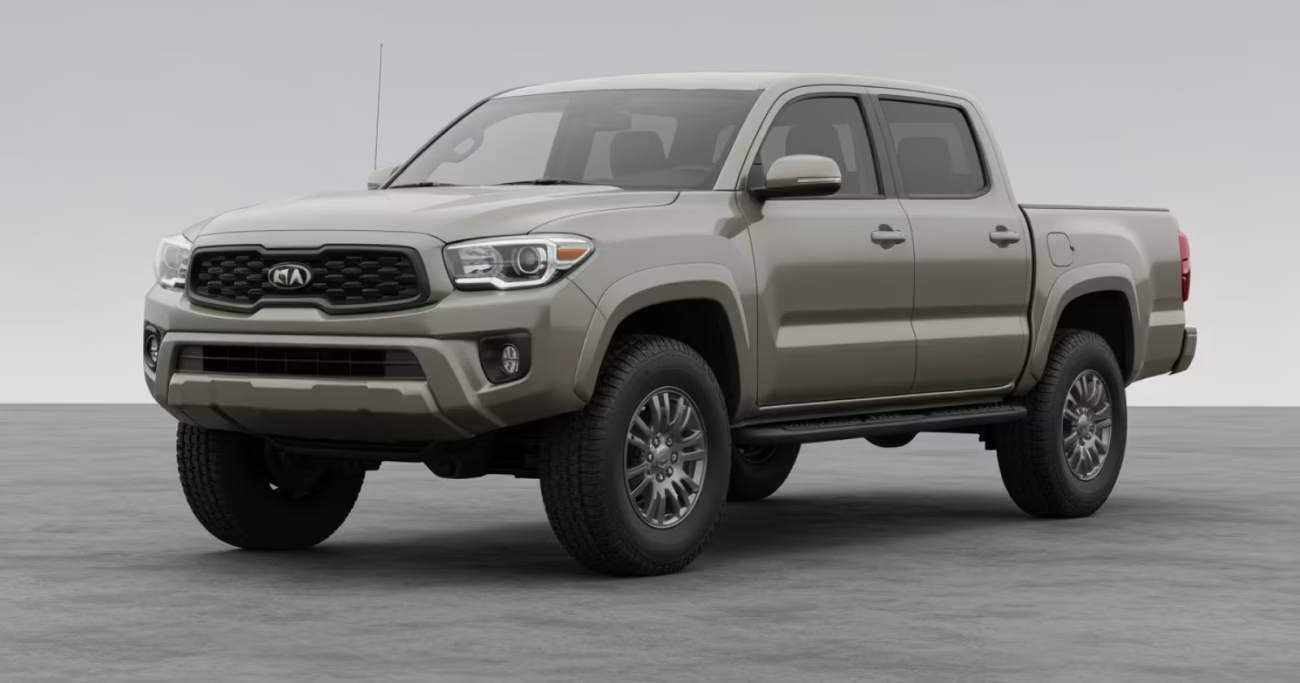
Kia just dropped a bombshell at its 2026 investor day, and the midsize truck segment will never look the same. A fully confirmed body-on-frame pickup is coming to North America, and Toyota, Ford, and Chevrolet all have a reason to pay attention.
I’ve been watching the truck market for years, and I genuinely didn’t expect Kia to make this move so decisively. But here we are — and the details are more interesting than most people realize.
Why Kia entering the truck segment changes the midsize game
Kia’s new North American pickup will be based closely on the existing Tasman, already on sale in global markets. That truck packs a turbocharged 2.5-liter four-cylinder producing 277 horsepower and 310 pound-feet of torque — numbers that put it right in line with the Tacoma’s i-FORCE MAX hybrid at 326 hp, and clearly above the base Ranger’s 270 hp.
But here’s the real story: Kia isn’t just copying what already exists. The company specifically mentioned HEV and extended-range electric variants for North America, with the hybrid reportedly borrowing the same powertrain as the Genesis GV80 — which means more than 300 hp from day one. That’s a serious opening move for a brand that’s never sold a body-on-frame truck in the US before.
The Chicken Tax problem Kia has already solved
One of the first things I thought about when this news broke was the Chicken Tax — the notorious 25% tariff that makes importing foreign-built pickup trucks financially unworkable. Kia clearly thought about it too. All signs point to North American production, which would not only sidestep the tariff but also give Kia the chance to tune the truck specifically for American tastes and terrain.
Local production also sets Kia up to compete on price without eating a massive import penalty. That matters enormously in a segment where the base Tacoma already starts above $35,000 and the Ranger pushes well past $40,000 in popular trims. If Kia can price aggressively at launch — and their track record with the Telluride and EV6 suggests they can — this truck could land with real force.
| Spec | Kia Tasman (Global) | Toyota Tacoma | Ford Ranger |
|---|---|---|---|
| Engine | 2.5L Turbo-4 | 2.4L Turbo-4 / Hybrid | 2.3L Turbo-4 |
| Horsepower | 277 hp | 278 hp / 326 hp (hybrid) | 270 hp |
| Torque | 310 lb-ft | 317 lb-ft / 465 lb-ft (hybrid) | 310 lb-ft |
| Towing Capacity | 7,716 lbs | 6,500 lbs | 7,700 lbs |
| Payload | 2,634 lbs | 1,440 lbs | 1,860 lbs |
| Drive System | Full-time 4WD (standard) | Part-time 4WD | Part-time 4WD |
| Target US Launch | By 2030 | On sale now | On sale now |
The one catch nobody is talking about — the Tasman’s rough global start
I’ll be honest: there’s a red flag buried in this otherwise exciting story. In Australia, Kia set a target of 20,000 Tasman sales per year. By mid-2026, they had moved roughly 3,700 units. That’s not a slow start — that’s a significant miss. The truck clearly hasn’t resonated the way Kia hoped in its first international market.
What Kia isn’t saying loudly is that the US launch may partly exist to spread out development costs across more markets. That’s not a bad business strategy, but it does raise the question of whether a truck that struggled in Australia will find its footing against the deeply loyal Tacoma and Ranger fan bases in America. Pickup buyers are famously tribal — I’ve seen friends turn down objectively better trucks simply because they’ve always driven a Tacoma. Kia will need to be exceptional, not just good.
Hyundai’s shadow — and why sharing a platform is actually smart
Kia’s corporate sibling Hyundai is also deep into its own body-on-frame midsize truck plans for America. The two brands are almost certain to share platforms, components, and likely production facilities. That kind of platform-sharing is exactly how Kia launched the Telluride so successfully — leaning on economies of scale while giving each brand its own identity and feature set.
The tech side of this truck is genuinely exciting. The global Tasman already offers a panoramic dual-screen cockpit and a Highway Driving Assist 2 system that works while towing — something no competitor currently offers at this price point. Pair that with Kia’s next-generation EV platform using fifth-generation batteries boasting 15% higher energy density and 40% increased capacity, and the extended-range variant could be something truly special by 2030.
I’ve been skeptical of automaker investor day promises before, but Kia has a track record of delivering on bold calls. The Telluride was laughed at before it became a consistent award winner. The EV6 was doubted before it outsold established rivals. If Kia executes this truck the same way, the Tacoma faithful might be in for a rude awakening before this decade is out.
If you’re in the market for a midsize truck in the next few years, keep this one on your radar. Follow Kia’s updates closely — because when a brand with this momentum enters your segment, the pricing pressure alone benefits every buyer in the market. Subscribe to alerts, bookmark this story, and watch what happens when an underdog with a real engineering budget decides it wants your truck money.
