
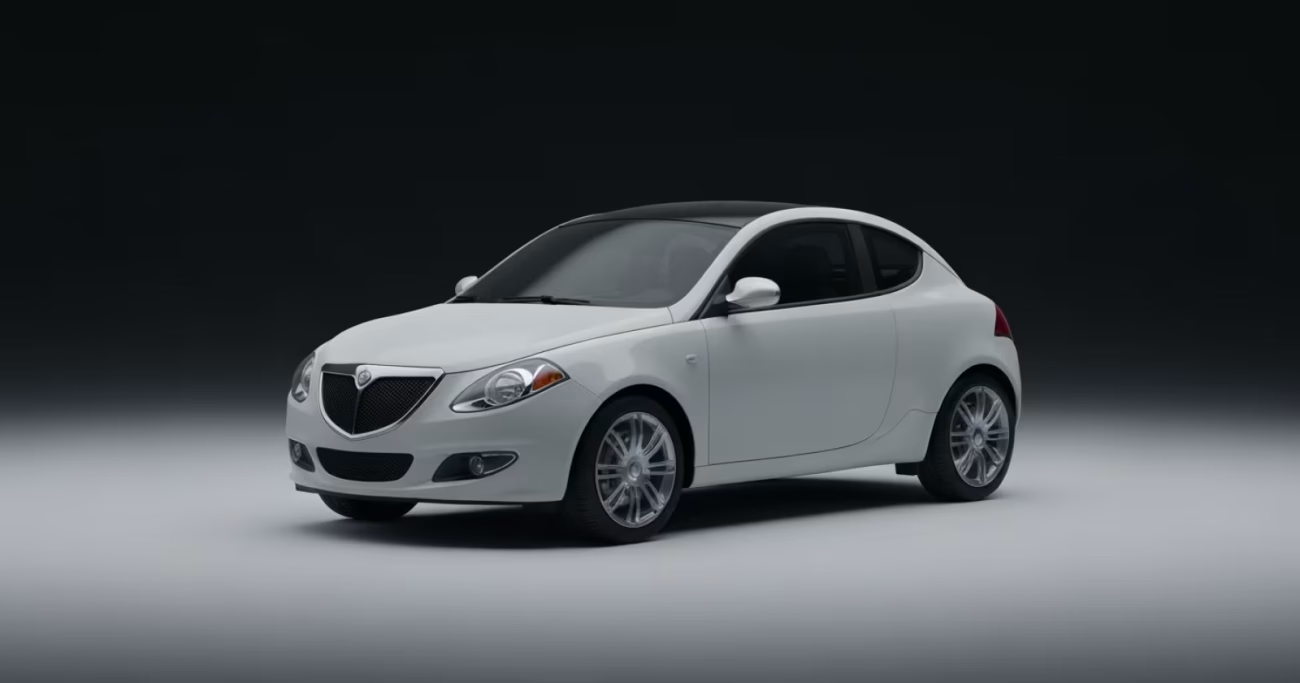
A turbocharged three-cylinder, a 6-speed manual, and a price that undercuts nearly everything in its class. That’s the pitch from a brand most Americans forgot existed — and it might be the most exciting cheap car nobody on this side of the Atlantic can buy.
Lancia just pulled the covers off the Ypsilon Turbo 100, the most affordable member of its revived hatchback lineup for 2026. It starts at 22,200 euros in Italy, but strip out the 20 percent value-added tax baked into every Italian car sale, and the real number lands closer to $20,000. For a brand-new turbo hatchback with a proper stick shift, that’s almost absurdly cheap.
What Lancia packed into a $20,000 hatchback
Under the hood sits a 1.2-liter turbocharged three-cylinder making 101 metric horsepower — 99 in American terms. That sounds modest until you see the torque figure: 151 pound-feet, available from just 1,750 rpm thanks to a variable-geometry turbocharger. Paired with a 6-speed manual and a curb weight likely under 2,800 pounds, this thing should feel genuinely peppy in city driving.
The sprint to 62 mph takes 10.2 seconds. Nobody’s going to confuse it with a hot hatch, but that low-end torque delivery means the Ypsilon Turbo 100 should punch well above its displacement in real-world traffic. Lancia estimates fuel consumption between 5.2 and 5.4 liters per 100 km, which translates to roughly 44.5 mpg. I can’t think of many new cars that deliver manual-transmission fun and that kind of efficiency at this price.
| Spec | Detail |
|---|---|
| Engine | 1.2L turbo 3-cylinder |
| Power | 99 hp (101 metric hp) |
| Torque | 151 lb-ft at 1,750 rpm |
| Transmission | 6-speed manual |
| 0-62 mph | 10.2 seconds |
| Fuel economy | ~44.5 mpg |
| Price (pre-tax equivalent) | ~$20,000 USD |
The Nissan Versa is gone — and Lancia filled the gap overnight
Here’s the thing that stings. The now-discontinued Nissan Versa occupied almost exactly this space in the American market: a similarly sized, similarly powered subcompact sedan at a comparable price. Nissan killed it. Nobody stepped in to replace it. Meanwhile, Lancia waltzed in with a car that’s lighter, more efficient, turbocharged, and comes with a manual gearbox — everything the Versa never offered.
In the US, the closest alternatives with a manual are the Volkswagen Jetta GLI, Honda Civic Si, and Mazda3 hatchback. All of them cost significantly more and target a different buyer. The Ypsilon Turbo 100 isn’t trying to be a sports car. It’s trying to be an honest, affordable, fun-to-drive daily — and that’s a category America has essentially abandoned.
Three trims, but the one everyone wants is missing
Lancia offers the Turbo 100 in base, LX, and HF-Line configurations. The LX adds diamond-cut alloy wheels, ambient lighting, USB-C rear charging, and front-and-rear parking sensors with camera views. The HF-Line swaps the luxury touches for sportier cosmetics. Both upgraded trims land at 25,200 euros, or about $29,667 before options.
What’s conspicuously absent is a full HF performance model. Lancia reserves that badge for the all-electric Ypsilon, where it delivers 276 horsepower to the front wheels. I’d love to see them drop a higher-pressure turbo or a small four-cylinder with around 150 hp into this platform. At just 160.6 inches long on a 100-inch wheelbase, a properly hot Ypsilon would be hilariously fun — think pocket rocket in the truest sense.
Why Stellantis won’t let Americans have nice things
The real story here isn’t the car itself. It’s the corporate strategy that guarantees we’ll never drive one. Parent company Stellantis has blocked its European-centric brands — Lancia, Peugeot, and others — from entering the North American market. The official plan is to reposition Chrysler as a premium mass-market brand, which so far has produced nothing more than a mild facelift on a minivan that’s been around for over a decade.
That decision looks increasingly tone-deaf. American buyers are desperate for affordable, engaging small cars, and the market keeps shrinking instead of growing. Stellantis is sitting on exactly the product people want and choosing not to sell it here. The only consolation is the 25-year import rule — so mark your calendars for 2051.
How the Ypsilon Turbo 100 stacks up against what we can buy
| Model | Power | Transmission | Est. Price | Edge |
|---|---|---|---|---|
| Lancia Ypsilon Turbo 100 | 99 hp / 151 lb-ft | 6-speed manual | ~$20,000 | Cheapest, lightest, best mpg |
| VW Jetta GLI | 228 hp / 258 lb-ft | 6-speed manual | ~$32,000 | Most powerful |
| Honda Civic Si | 200 hp / 192 lb-ft | 6-speed manual | ~$30,000 | Best all-rounder |
| Mazda3 Hatch | 191 hp / 186 lb-ft | 6-speed manual | ~$30,000 | Premium interior |
Why this matters
- Affordable manual hatchbacks are vanishing from every major market
- Stellantis is blocking viable products from reaching American buyers
- European brands prove small turbo cars can still be profitable
The verdict
The Lancia Ypsilon Turbo 100 is proof that the cheap, cheerful, manual-transmission hatchback isn’t dead — it’s just not welcome in America. At roughly $20,000 with a turbo three-cylinder, a proper stick shift, and near-45 mpg efficiency, this is the kind of car enthusiasts have been begging for. Stellantis has the product. It just refuses to sell it where demand is loudest. If the company ever reconsiders its North American brand strategy, the Ypsilon should be first through the door — because right now, nothing else fills this gap.
If you’re as frustrated as I am about the state of affordable enthusiast cars in the US, share this with someone who still believes the manual hatchback deserves to survive. And if you’re in Europe, do us all a favor and go drive one.
