
The numbers are in, and the luxury car battle in India just got a definitive scoreboard. I spent the last few days digging through the 2026 retail sales data sourced from Vahan and the Telangana Open Data portal, and what I found tells a fascinating story about where Indian luxury buyers are putting their money.
Mercedes E-Class Sits Comfortably At The Top
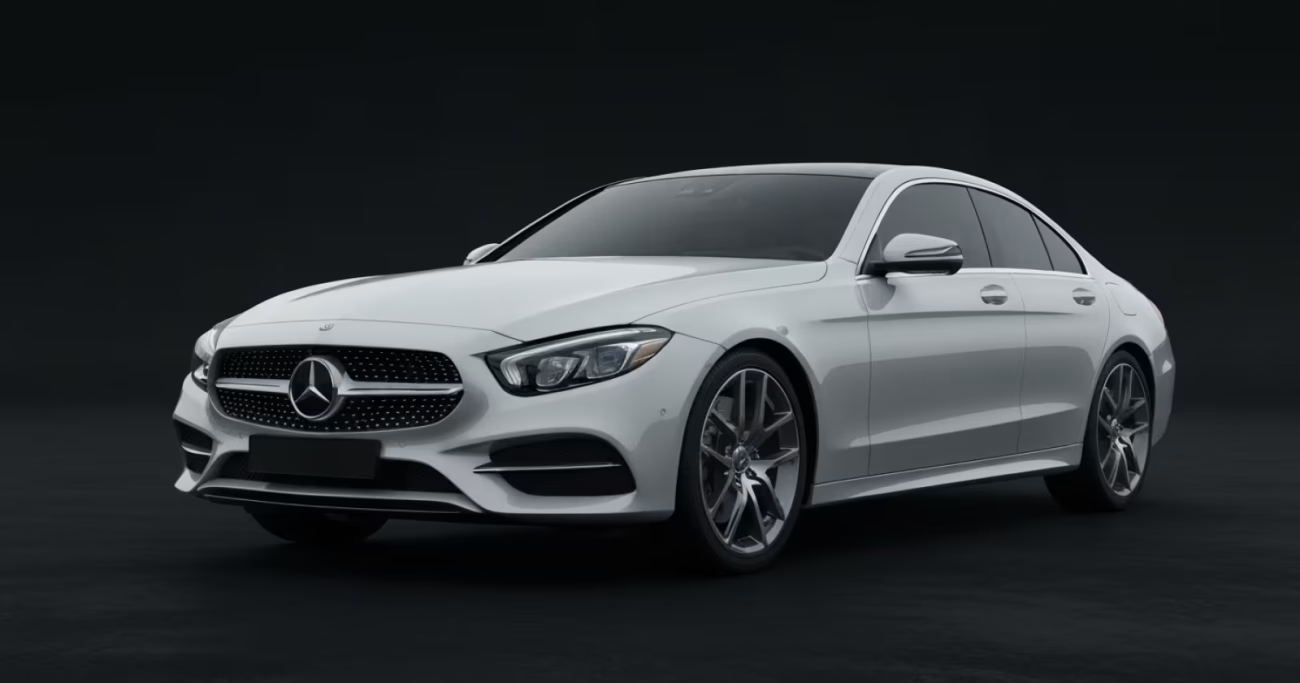
If there is one car that continues to define luxury motoring in India, it is the Mercedes E-Class. With 4,117 units retailed in 2026, it is not just the best-selling luxury sedan — it is the best-selling luxury car overall. That is a significant lead over everything else on this list, and it tells me that the executive sedan formula still works when done right.
Right behind it, the Mercedes GLE clocked 2,900 units. This is where things get interesting because the third spot does not belong to another traditional Mercedes or BMW. It belongs to the BMW iX1, an electric SUV, with 2,786 units. That is a statement. Indian luxury buyers are clearly warming up to EVs, and BMW’s decision to price the iX1 aggressively is paying off.
The BMW X1 follows closely at 2,734 units, and then we are back to Mercedes territory with the GLS at 2,645 units and the GLC at 2,631 units. The pattern here is unmistakable — SUVs are everywhere in the top ranks.
The Full Top 20 Breakdown
I have compiled the complete list so you can see exactly where each model stands. These are retail registration numbers for the full year of 2026.
| Rank | Model | Units Sold | Body Type |
|---|---|---|---|
| 1 | Mercedes E-Class | 4,117 | Sedan |
| 2 | Mercedes GLE | 2,900 | SUV |
| 3 | BMW iX1 | 2,786 | EV SUV |
| 4 | BMW X1 | 2,734 | SUV |
| 5 | Mercedes GLS | 2,645 | SUV |
| 6 | Mercedes GLC | 2,631 | SUV |
| 7 | BMW 5 Series | 2,534 | Sedan |
| 8 | Land Rover Defender | 2,470 | SUV |
| 9 | BMW 3 Series | 2,328 | Sedan |
| 10 | BYD Sealion 7 | 2,213 | EV SUV |
| 11 | BMW X5 | 2,053 | SUV |
| 12 | Mercedes GLA | 1,848 | SUV |
| 13 | Mercedes C-Class | 1,654 | Sedan |
| 14 | Audi Q3 | 1,631 | SUV |
| 15 | BMW X7 | 1,536 | SUV |
| 16 | Audi A4 | 1,140 | Sedan |
| 17 | Volvo XC60 | 786 | SUV |
| 18 | Volvo XC90 | 489 | SUV |
| 19 | BYD Sealion (Other) | 314 | EV |
| 20 | Tesla Model Y | 226 | EV SUV |
SUVs Own 74 Percent Of The Luxury Market
This is the number that jumped out at me the most. Nearly three out of every four luxury cars sold in India in 2026 were SUVs. That 74 percent share is not a slight preference — it is a landslide. Road presence, higher ground clearance for Indian road conditions, and the sheer practicality of a bigger cabin are driving this shift.
Sedans still account for about 26 percent, and honestly, I think that number holds up only because the E-Class and 5 Series are such strong products. Without those two models pulling serious weight, the sedan share would look even thinner. The C-Class at 1,654 units and the A4 at 1,140 units are respectable, but they are not setting the charts on fire.
What I find telling is that even in the luxury space, Indian buyers mirror the broader market trend. Mainstream buyers moved to SUVs years ago with models like the Creta and Seltos. Now the same preference has firmly taken root among buyers spending ₹50 lakh and above.
The Brand War — Mercedes vs BMW vs The Rest
Mercedes-Benz closed 2026 with 19,282 total retail units. That is a commanding lead, and it comes from having a deep portfolio. The E-Class, GLE, GLS, GLC, GLA, and C-Class all feature in the top 20. That kind of spread across segments is hard to beat.
BMW is not far behind at 17,730 units, and I would argue their strategy is more aggressive in some ways. The iX1 sitting at number three overall shows that BMW’s EV push is working in India. Add the X1, 5 Series, 3 Series, X5, and X7 to the mix, and BMW has a very balanced attack across price points.
Jaguar Land Rover came in at 5,979 units, and the Defender deserves special mention here. At 2,470 units, it single-handedly carries the brand. That is over 41 percent of JLR’s total volume from one model. The Defender has carved out a unique space — it is the luxury SUV for people who want something that looks and feels different from the German trio.
Audi recorded 4,777 units. The Q3 at 1,631 units is their volume driver, and the A4 still finds buyers despite being in a shrinking sedan segment. But compared to Mercedes and BMW, Audi’s numbers suggest they need a stronger SUV lineup or more aggressive pricing to close the gap.
BYD And Tesla — The EV Wildcards
This is the part of the data that excites me the most. BYD managed 2,527 units in 2026, with the Sealion 7 alone contributing 2,213 of those. For a brand that is relatively new to the Indian luxury space, cracking the top 10 overall is a serious achievement. The Sealion 7 offers a compelling package — long range, modern tech, and pricing that undercuts the German EVs.
Tesla, on the other hand, recorded just 226 units, all from the Model Y. That is a modest start, and it reflects the limited availability and higher pricing compared to what BYD offers. I expect Tesla’s numbers to grow as their India operations mature, but right now, BYD is winning the premium EV race in this market by a wide margin.
When I combine the BMW iX1 and BYD Sealion 7 numbers, that is nearly 5,000 units from just two EV models in the luxury space. Add the BMW i7 and Tesla Model Y, and it is clear that electric is no longer a fringe choice for luxury buyers in India. It is becoming a mainstream consideration.
Volvo Holds Steady, But Volumes Stay Niche
Volvo clocked 1,736 units for the year, with the XC60 at 786 units and the XC90 at 489 units leading the way. These are not blockbuster numbers, but Volvo has always played a different game — safety-first positioning, Scandinavian design, and a loyal customer base. Their shift towards full electrification could change the equation in the coming years, especially if they price their EVs competitively against the German alternatives.
What 2026 Could Look Like
Based on what I am seeing, a few things feel inevitable. SUV dominance will only grow as brands launch more crossover and coupe-SUV variants. EV adoption in the luxury segment will accelerate, especially as charging infrastructure improves in metro cities like Mumbai, Delhi, Bangalore, and Hyderabad. Mercedes will likely hold the top spot, but BMW’s EV strategy could narrow the gap further.
The real wildcard is BYD. If they expand their lineup and maintain competitive pricing, they could disrupt the traditional German hierarchy in ways we have not seen before. And with new entrants like VinFast and more Chinese EV brands eyeing India, the luxury landscape is about to get a lot more crowded.
If you are in the market for a luxury car right now, I would say take a serious look at the EV options before defaulting to a petrol or diesel. The BMW iX1 and BYD Sealion 7 numbers prove that early adopters are already making that switch. Whether you are upgrading from a Creta or trading in your old C-Class, the 2026 luxury market has more compelling choices than ever. Head to your nearest showroom, book a test drive, and see for yourself what these numbers are all about.
