
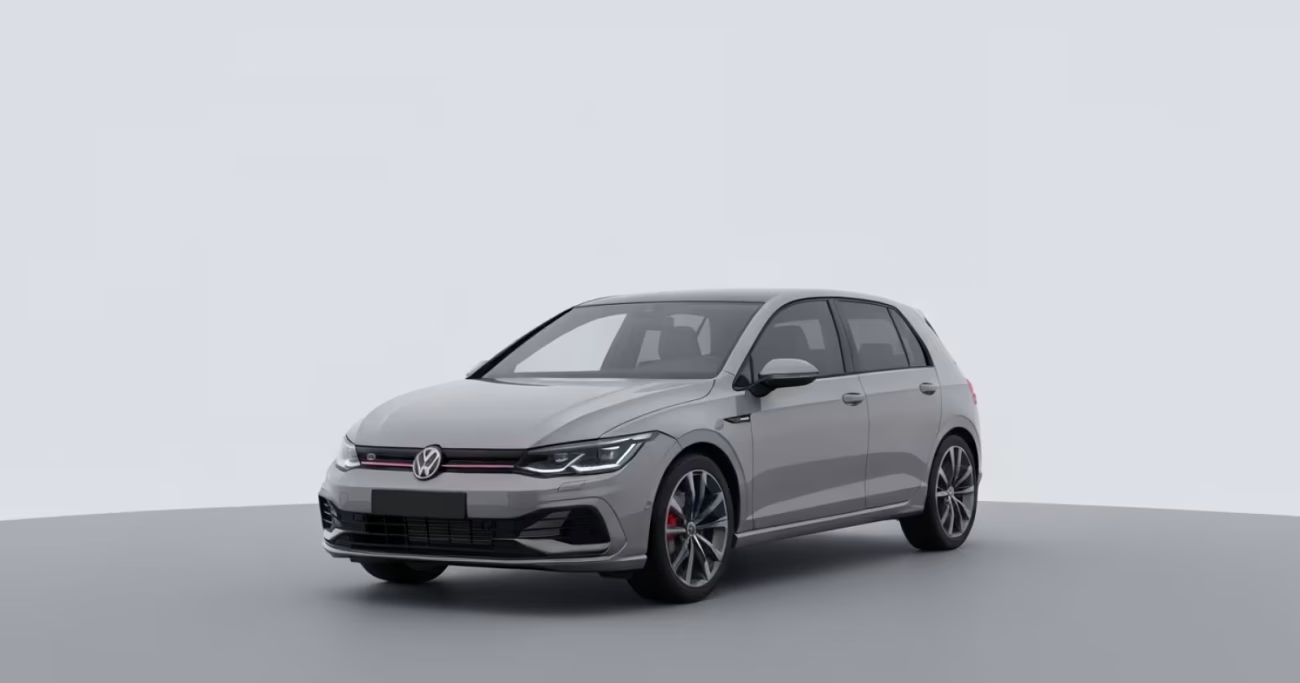
Volkswagen just told its own design chief not to change a single line on the next Golf. That kind of confidence from the top brass almost never happens, and the reason traces straight back to a car that rolled off the line over 2 decades ago.
The Mk9 Golf is shaping up to be the most deliberately nostalgic Volkswagen in a generation. R&D chief Kai Grünitz confirmed the next-generation hatchback pulls direct styling cues from the Mk4, widely considered the most timeless Golf ever built. And the engineering underneath is just as interesting as the sheet metal on top.
Why reaching back to the Mk4 changes everything for VW
Every Golf since 1974 traces its DNA to Giorgetto Giugiaro’s original design. But the Mk9 is doing something different. Instead of just nodding at the original, Volkswagen is channeling the Mk4’s bluffer, more upright proportions, the generation that turned the Golf from a practical hatchback into a genuine object of desire.
I think this is a smart move. The Mk4 still commands a cult following in 2026, with clean examples holding their value in ways no other used Golf can match. Teaser sketches show pronounced wheel arches and a squared-off rear end that immediately recall that era. Grünitz says the final design looks thoroughly modern despite the retro influence, and that it is nearly locked in.
The man behind the Mk7 is now running the entire show
Andreas Mindt submitted the initial Mk9 design proposal, and both VW brand boss Thomas Schäfer and Grünitz were so impressed they gave him a three-word review: “Don’t touch anything.” That kind of first-draft approval is almost unheard of in an industry where designs go through dozens of revision cycles.
Mindt already proved himself with the Mk7 Golf, arguably the sharpest-looking generation since the Mk4 itself. In February 2026 he was promoted from head of VW brand design to overseeing design for the entire Volkswagen Group. Schäfer credits Mindt’s openness to outside input and his problem-solving instincts as forces reshaping the wider organization. When the person drawing your next hatchback is now steering the look of Audi, Porsche, and everything in between, the stakes are real.
2 platforms, 1 nameplate, and what VW is not saying about the split
Here is the real story. The electric Mk9 Golf will ride on VW’s new SSP architecture, the Scalable Systems Platform designed to underpin roughly 80 percent of the group’s future EVs. But ICE-powered Golfs, including plug-in hybrids and the GTI and R performance variants, will stick with an upgraded version of the current MQB Evo platform.
VW originally planned to make the Mk9 fully electric. Slowing EV adoption killed that idea. Running 2 separate platforms for a single model line is expensive and complex, and the company has not detailed how it plans to manage that cost. I suspect the ICE versions will carry the volume while the SSP-based EV Golf serves as a technology showcase, but that balance could shift fast depending on how battery costs move over the next 3 years.
| Spec | Detail |
|---|---|
| Generation | Mk9 (9th generation) |
| Design influence | Mk4 Golf proportions and stance |
| EV platform | SSP (Scalable Systems Platform) |
| ICE/PHEV platform | MQB Evo (enhanced) |
| Expected US arrival | Around 2029 model year |
| Performance variants | GTI and R confirmed on ICE platform |
| Lead designer | Andreas Mindt (now VW Group design chief) |
The one catch nobody is talking about
Fans still have a long wait ahead. The current Mk8 received its mid-cycle refresh for the 2026 model year in the US, which means it likely will not bow out until after the 2028 model year. That pushes a realistic Mk9 US launch to around 2029. And there is no guarantee the standard Golf returns to America at all. VW may continue offering only the GTI and R in this market, just as it does today.
The other open question is pricing. Running 2 platforms means 2 sets of tooling, 2 supply chains, and potentially a wider price spread between the base EV and the ICE models than anything we have seen in the Golf lineup before. VW has not addressed this publicly, and I would not expect clarity until closer to the production reveal. For now, the company is betting that nostalgia-driven design and powertrain flexibility will be enough to keep the Golf relevant in a market that is shifting under everyone’s feet.
How it stacks up
| Model | Platforms offered | EV option | Est. US arrival | Edge |
|---|---|---|---|---|
| VW Golf Mk9 | SSP + MQB Evo | Yes | ~2029 | Dual powertrain flexibility |
| Toyota Corolla hatch | TNGA-C | No (hybrid only) | Current | Proven reliability |
| Honda Civic hatch | Honda platform | No (hybrid only) | Current | Interior space |
| Hyundai i30/Elantra N | K3 | No | Current | Performance value |
Why this matters
- Dual-platform strategy signals VW sees ICE lasting well into the 2030s
- Mk4 nostalgia play could recapture lapsed Golf buyers globally
- Mindt’s promotion ties Golf design DNA to every future VW Group model
The verdict
Volkswagen is making a calculated bet that looking backward is the fastest way forward. The Mk4-inspired design gives the Mk9 an emotional hook that no competitor in the compact hatchback segment can match right now. Offering both EV and ICE under one roof is ambitious and risky, but it keeps the Golf relevant no matter which direction the market turns. If VW executes this the way Mindt’s first sketch suggests, the Mk9 could be the generation that makes people care about the Golf again.
If you are a Golf fan or just someone watching where the compact car market is headed, keep this one on your radar. Bookmark this page, follow the Mk9 development closely, and be ready when VW finally pulls the cover off what could be the most important hatchback of the decade.
