
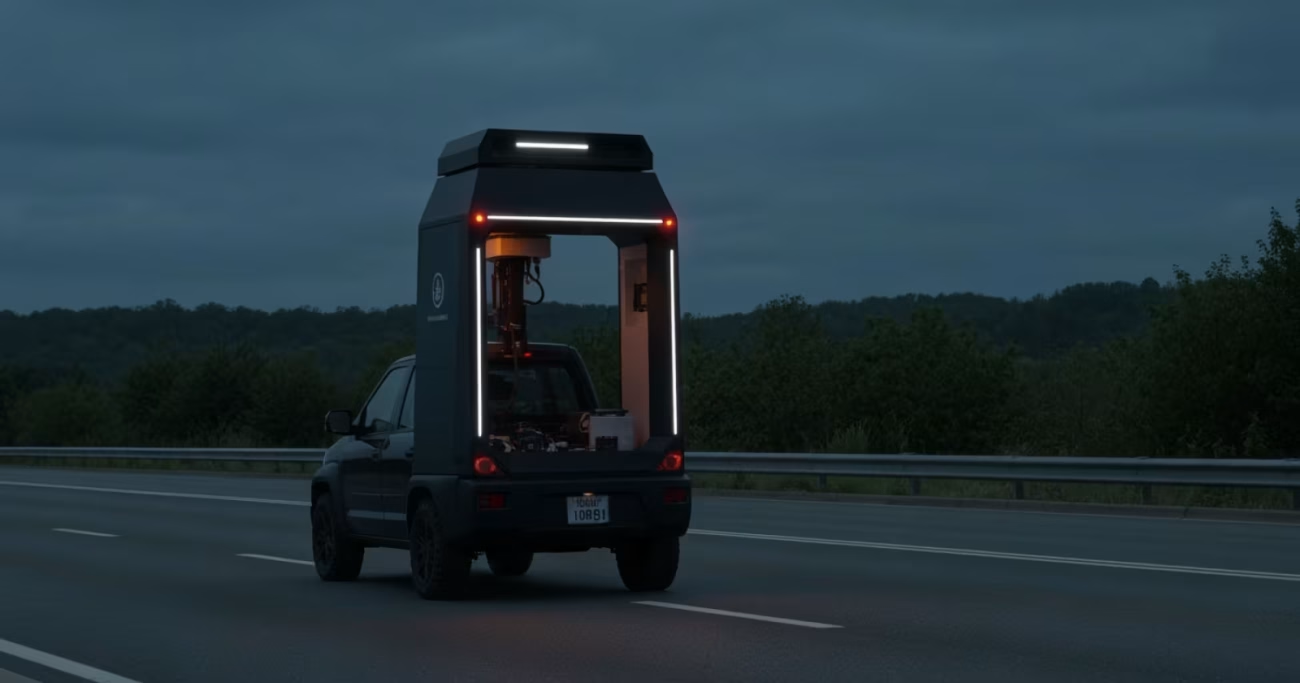
Someone parked what looks like a miniature armored Cybertruck on the side of a Maryland road — and it’s watching every car that drives past. These aren’t props, they aren’t military surplus, and they absolutely cannot be kicked over by an angry driver who just got flashed.
Montgomery County has quietly begun rolling out six of the most intimidating speed cameras I’ve ever seen on public roads. Built by German enforcement technology company Vitronic, they’re officially called the Poliscan Enforcement Trailer. Locals, predictably, are already calling them the “Cybertruck cameras.” One look and you’ll understand exactly why.
These things look nothing like any camera you’ve seen before
The angular silver body, the sloped sides, the squat aggressive stance — Vitronic’s trailers look less like traffic enforcement equipment and more like something that rolled off a sci-fi film set. Sharp edges everywhere. A low center of gravity. That unmistakable wedge shape that makes pedestrians do a double-take when they walk past one.
But here’s where it gets genuinely interesting. The armor-plated aesthetic isn’t just aesthetic. Montgomery County Assistant Chief Administrative Officer Earl Stoddard confirmed to WJLA that the front glass on these units is ballistic-grade. As in, rated to stop a bullet. The reason? Previous speed cameras in the county had been vandalized. Apparently, some drivers took their frustration out on the hardware directly, and Vitronic’s response was to build something that fights back just by existing.
No officer required — the cameras run themselves
What really separates these units from older mobile camera setups is the operational model. Traditional mobile speed enforcement in Maryland required a van parked nearby and, in many cases, an officer present. These new trailers need neither. Police can deploy them, walk away, and monitor everything remotely.
That changes the economics of speed enforcement completely. A single officer can effectively cover multiple locations simultaneously because the cameras are doing the watching. Montgomery County Police say the six large units can be repositioned between what officials are calling “high-injury networks” — roads where repeat speeding incidents have caused crashes or fatalities. The system identifies problem corridors, and the cameras move there.
At a glance
| Spec | Detail |
|---|---|
| Camera manufacturer | Vitronic (Germany) |
| Official product name | Poliscan Enforcement Trailer |
| New large trailer units | 6 deployed in Montgomery County |
| Total new cameras in expansion | 140 (including 96 portable, 38 school zone fixed) |
| New red-light cameras added | 76 |
| Fine for 12–15 mph over limit | $40 |
| Fine for 40+ mph over limit | $425 |
| Fine in construction zones | Up to $1,000 |
| Glass protection rating | Ballistic-grade (bulletproof) |
140 new cameras is a number that should make every Maryland driver pay attention
The 6 Cybertruck-lookalike trailers are the flashiest part of this story, but they’re only a fraction of what’s coming. Montgomery County announced last fall that it’s adding 140 speed cameras total across its road network. That includes 96 smaller portable units — the kind that can be dropped on any street corner — and 38 fixed cameras specifically positioned in school zones.
Add the 76 new red-light cameras to that figure and you’re looking at a monitoring infrastructure expansion that’s genuinely difficult to navigate around. The county isn’t deploying these randomly either. Officials have been mapping injury data, identifying the specific stretches where aggressive driving causes the most harm, and that’s where the hardware is going first.
The fines are designed to genuinely hurt your wallet
I’ll be direct: the penalty structure here is graduated in a way that targets the most dangerous behavior disproportionately. A driver going 13 mph over the limit gets hit with a $40 fine — annoying, but survivable. A driver doing 40 mph or more over the posted limit faces a $425 ticket. That’s not a slap on the wrist; that’s a real financial consequence.
Construction zones are where the numbers get serious. A speeding violation in an active work zone can cost up to $1,000 in Maryland. The county hasn’t changed its fine structure with this rollout — these numbers were already on the books — but the new cameras dramatically increase the probability of actually getting caught. More cameras in more locations means the assumption that you can speed freely between enforcement points no longer holds.
Why the vandalism-proof design matters more than it sounds
Ballistic glass on a speed camera sounds excessive until you consider that Montgomery County didn’t spec it out of paranoia — they spec’d it because people were actually destroying cameras. That’s a remarkable thing to sit with. The enforcement infrastructure was being physically attacked, which tells you something about how contentious automated traffic enforcement has become in some communities.
Vitronic’s solution was to make the hardware cost-prohibitive to damage. You’re not going to scratch bulletproof glass with a rock. You’re not going to knock over a trailer built like a military asset with your foot. The design sends a message that goes beyond just catching speeders — it signals that this infrastructure is permanent, hardened, and not going away because someone decides to take a swing at it.
If you drive regularly through Montgomery County, the time to adjust your habits is right now — not after the first $425 ticket lands in your mailbox. These cameras are already live, they’re multiplying, and unlike a cop sitting in a speed trap, they never take a coffee break.
