
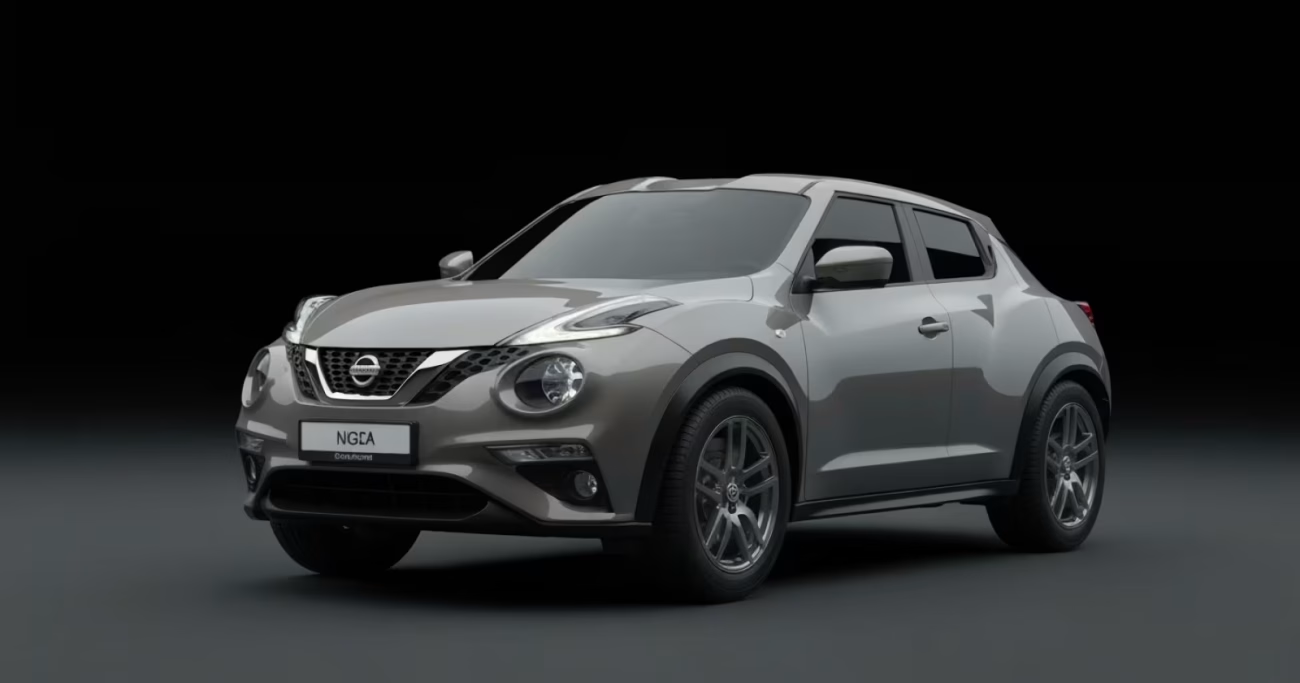
After 1.5 million sales in Europe and 15 years of polarizing design, Nissan just ripped up the Juke playbook entirely. The third-generation model trades every smooth curve for sharp, chiseled polygon panels and drops the combustion engine for a fully electric powertrain.
That combination makes this the most radical reinvention of a subcompact crossover anyone has attempted in 2026. And Nissan is betting big that European buyers will follow.
At a glance
| Spec | Detail |
|---|---|
| Generation | Third (debut 2026, on sale spring 2027) |
| Platform | CMF-EV (shared with Leaf) |
| Powertrain | Fully electric (specs TBA) |
| European sales to date | 1.5 million units across 2 generations |
| Design origin | UK, Spain, and Germany |
| Production site | Sunderland Plant, United Kingdom |
| US availability | None planned |
Why the polygon body is more than a styling stunt
I’ve followed every Juke generation since the original dropped in 2010 with those bug-eyed headlamps that people either loved or roasted. Each version pushed quirky design further, but the third-gen model goes somewhere entirely new. Chunky, flat body panels replace the organic shapes, a floating roof adds visual tension, and multi-spoke wheels echo the angular theme across every surface.
Nissan showed the car in a bright green finish with gloss-black accents, and the effect is striking. No interior photos have surfaced yet, but I’d expect the cabin to mirror the exterior’s blocky geometry. This isn’t a subtle facelift. It’s a complete identity reset that signals Nissan wants the Juke to stand out in a segment now crowded with safe, rounded electric crossovers from every major brand.
What Nissan isn’t saying about the electric powertrain
Here’s the catch. Nissan revealed the car but disclosed zero powertrain details. No horsepower figure, no battery capacity, no motor count, no charging speed. For a vehicle arriving in showrooms roughly 12 months from now, that silence is unusual and worth paying attention to.
The CMF-EV platform offers some clues, though. The latest European Leaf rides on the same architecture and offers 52-kilowatt-hour and 75-kilowatt-hour battery options, with the larger pack delivering up to 604 kilometers of WLTP range. I’d expect the Juke to slot in at or slightly below those numbers given its smaller footprint. If Nissan can deliver north of 350 kilometers of real-world range in a subcompact crossover at a competitive price, the math starts looking very interesting against rivals like the Peugeot e-2008 and the upcoming Renault 4 E-Tech.
The hybrid Juke isn’t going anywhere just yet
Buried in the announcement was a telling line: the Juke HEV “will remain an important part of the lineup.” That strongly suggests the current hybrid model, powered by a 1.6-liter four-cylinder and an electric motor producing 141 horsepower, will continue selling alongside the new EV for a transition period.
I reached out alongside other outlets for clarification, and Nissan’s spokesperson offered no comment on the current model’s future. The real story here is that Nissan is hedging. Not every European buyer is ready to go fully electric, and keeping a hybrid option on dealer lots protects volume while the EV ramps up. It’s a pragmatic move, even if it slightly dilutes the boldness of the new model’s debut.
Forget the US market — Europe is the only battlefield that matters
The original Juke lasted just 1 generation in the United States before Nissan pulled it. The third-gen model won’t cross the Atlantic either. Every aspect of this car, from design to engineering to production, is rooted in Europe. Development happened across the UK, Spain, and Germany, and assembly stays at the Sunderland Plant.
That focus makes strategic sense. Europe’s emissions regulations are tightening fast, and Nissan needs every electric model it can field to meet fleet CO2 targets. The Juke’s 1.5 million European sales prove the nameplate has real equity on that continent. Pouring resources into a US launch for a subcompact crossover that Americans largely ignored would be a distraction Nissan can’t afford right now, especially as the brand works through its broader restructuring.
How it stacks up
| Model | Powertrain | Est. Range (WLTP) | Platform | Edge |
|---|---|---|---|---|
| Nissan Juke EV (2027) | Full EV | 350-400 km (est.) | CMF-EV | Bold design, proven nameplate |
| Peugeot e-2008 | Full EV | 406 km | e-CMP / STLA Small | Established EV, wider availability |
| Renault 4 E-Tech | Full EV | 400 km (est.) | CMF-BEV | Retro appeal, competitive pricing |
| Hyundai Kona Electric | Full EV | 514 km | K3 | Longer range, global reach |
Why this matters
- Nissan’s first fully electric subcompact crossover targets Europe’s toughest CO2 rules.
- The CMF-EV platform now spans from Leaf to Juke, spreading development costs.
- Keeping the hybrid alive signals the EV transition still needs a safety net.
The verdict
Nissan needed the third-gen Juke to do 2 things at once: prove the brand can still design a head-turner and deliver a credible electric crossover for Europe’s most competitive segment. The polygon styling accomplishes the first goal convincingly. Whether the powertrain delivers on the second remains an open question until Nissan releases actual numbers.
If range and pricing land near Leaf territory, this car could become the volume EV Nissan desperately needs in Europe. The Juke has always thrived on being the weird one in the parking lot. Now it just needs the battery to match the attitude.
If you’re shopping the European subcompact crossover space or just tracking where Nissan’s electric strategy is headed, keep this one on your radar. Spring 2027 will arrive fast, and the full spec sheet should surface well before then.
