
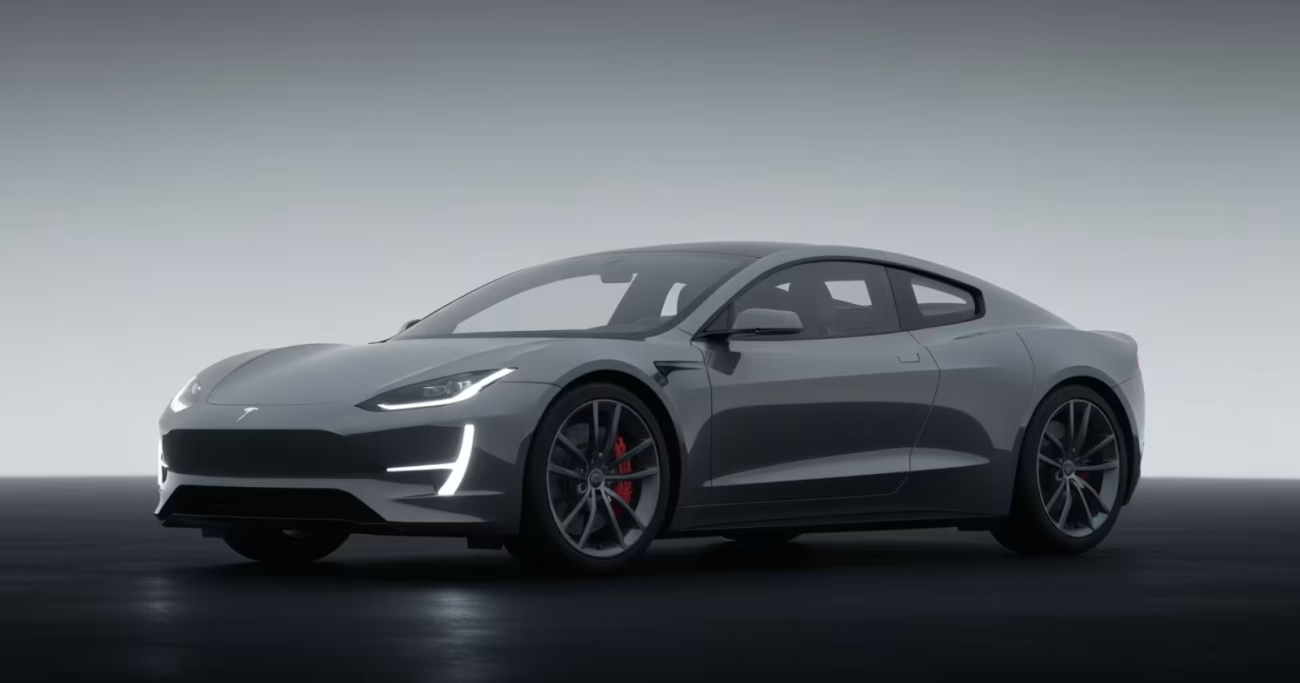
The era of actually driving a Tesla is almost over. Elon Musk just confirmed that every vehicle in the lineup is going nearly fully autonomous — except for one holdout that still doesn’t technically exist yet.
During Tesla’s Q1 2026 earnings call on April 22, Musk dropped a line that should make every car enthusiast sit up straight. The new Roadster, whenever it finally arrives, will be the only Tesla you can still drive with your own 2 hands. Every other model is headed toward full autonomy. Let that sink in for a moment.
At a glance
| Spec | Detail |
|---|---|
| Manual driving | Only Tesla to retain full driver control |
| Development time | 9 years and counting since prototype reveal |
| Possible debut | “In a month or so” per Musk (April 2026) |
| Revenue impact | Musk admits it won’t “move the needle massively” |
| Tesla Q1 2026 net income | $477 million |
| Q1 2026 deliveries | 358,023 vehicles worldwide |
| Cybercab range | Around 200 miles per charge |
Why a manually driven Tesla is now the rarest thing Musk sells
I’ve been covering the auto industry long enough to know that when a CEO says “almost entirely autonomous,” they’re drawing a line in the sand. Musk made it crystal clear during the earnings call: “In fact, long term, the only manually driven car will be the new Tesla Roadster.” That single sentence rewrites the entire Tesla ownership experience for millions of current and future buyers.
Think about what this means in practice. The Model 3, Model Y, Cybertruck, Cybercab, Semi — all of them are being engineered toward a future where the steering wheel is essentially decorative. The Roadster becomes a strange artifact, a sports car built for the pure act of driving in a company that’s actively trying to eliminate driving from the equation.
9 years of “testing and validation” and still no production car
Here’s the catch with the Roadster. It was first teased back in 2017. We’re now deep into 2026 and the car hasn’t moved past the prototype stage. Musk told analysts the company might debut it “in a month or so,” but then immediately hedged with a familiar excuse. “It requires a lot of testing and validation before we can actually have a demo and not have something go wrong with the demo.”
I’ve lost count of how many times we’ve heard a version of that timeline. The real story is that Musk himself admitted the Roadster won’t move the revenue needle. It’s a passion project sitting behind the Cybercab, the Semi, and the broader autonomy push in Tesla’s priority list. When your CEO calls your flagship sports car “very cool” but financially irrelevant, that tells you everything about where it stands internally.
The Cybercab is the car Musk actually cares about right now
Production of the 2-seat, self-driving Cybercab has officially started in Austin. Musk said it’s expected to eventually replace the Model Y fleet and become Tesla’s highest-volume vehicle. That’s a massive statement — the Model Y has been one of the best-selling cars on the planet. Replacing it with a vehicle that has no steering wheel is a bet that autonomy will be mainstream before most people expect.
But Musk also pumped the brakes on expectations. He warned that initial Cybercab and Semi production will be “very slow,” ramping up exponentially toward the end of 2026 and into 2027. Meanwhile, Tesla’s Q1 numbers show a company still heavily dependent on the Model 3 and Model Y, which made up nearly all of the 408,386 vehicles produced last quarter. The autonomous future is coming, but the present is still very much about traditional cars with traditional drivers.
What Tesla isn’t saying about the Model S and Model X
I noticed something telling during the earnings call. When asked about new vehicle models — specifically a compact car or a family vehicle — Musk essentially dodged. He had “pretty much nothing to say” about replacements for the aging Model S and Model X. If the entire lineup is going autonomous, what happens to these 2 models that were designed around the driving experience?
The silence is louder than any announcement. It suggests Tesla may quietly phase out the S and X rather than redesign them for an autonomous world. That leaves the Roadster as the last monument to the idea that a Tesla should be something you drive, not something that drives you. For enthusiasts who fell in love with the brand because of the original Roadster’s raw electric thrill, this is a bittersweet moment.
How it stacks up
| Model | Driver control | Expected availability | Estimated base price | Edge |
|---|---|---|---|---|
| Tesla Roadster | Full manual driving | TBD (possibly late 2026) | ~$200,000 | Only manually driven Tesla |
| Porsche Taycan Turbo GT | Full manual driving | Available now | ~$230,000 | Proven track performance |
| Rimac Nevera | Full manual driving | Available now | ~$2,400,000 | 1,914 hp hypercar benchmark |
| Tesla Cybercab | No manual option | Ramping 2026 | ~$30,000 (est.) | Lowest cost autonomous Tesla |
Why this matters
- Tesla is splitting its brand between autonomy and driving purity
- The Cybercab replacing Model Y reshapes the entire EV market
- Driver-focused sports cars become Tesla’s rarest, most niche product
The verdict
Tesla just told the world that driving yourself will soon be a luxury, not the default. The Roadster — if it ever actually reaches production — becomes the last stand for human-controlled Tesla ownership. That makes it either the most important car in Tesla’s lineup or the most irrelevant, depending on how fast autonomy actually takes over. I think Musk is betting the entire company on a future where the Roadster is a collector’s novelty, and based on the Q1 numbers and Cybercab ramp, he might be right.
If you’re someone who values the act of driving and you’ve been waiting on this Roadster, keep watching closely over the next few months. A demo could surface by summer 2026, and when it does, it might be your last chance to buy a Tesla that was built for you to actually drive. Stay tuned and don’t let this one slip past you.
