
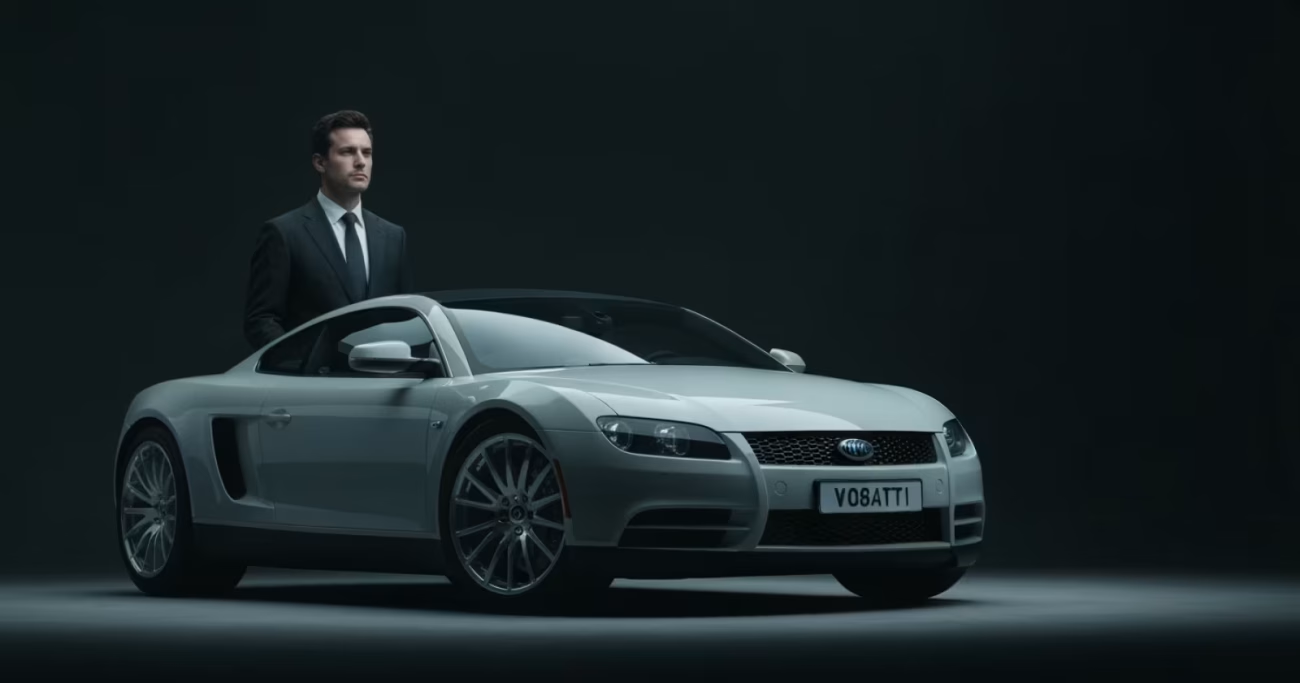
One of the longest-running partnerships in hypercar history just ended. Porsche has officially sold its entire stake in Bugatti, handing the keys of a $4 million brand to a 37-year-old Croatian engineer who daily-drives a Volkswagen.
The deal severs a connection that stretches back to 2000, when the Volkswagen Group first acquired Bugatti under the bold vision of Ferdinand Piëch. Now, after 26 years, roughly 950 hand-built hypercars, and an engine legacy that redefined what road cars could do, the German conglomerate is walking away entirely.
At a glance
| Spec | Detail |
|---|---|
| Porsche stake sold | 45% of Bugatti Rimac joint venture |
| Buyer | HOF Capital-led consortium (New York) |
| Rimac retained stake | 55% majority control |
| Estimated JV valuation | Over $1 billion |
| Current flagship | Tourbillon — 1,775 hp, $4.075 million |
| Porsche also sold | 20.6% stake in Rimac Group |
| Deal expected to close | Before end of 2026 |
Why Porsche walked away from a billion-dollar brand
This is not a story about Bugatti failing. It is a story about Porsche needing to save itself. The Stuttgart automaker saw global sales drop 10% in 2026, hammered by a collapsing Chinese market and fresh tariff pressure in the US. Corporate parent Volkswagen Group has been demanding cost cuts and tighter focus across every brand in the portfolio.
Selling the Bugatti Rimac stake and the separate 20.6% holding in Rimac Group lets Porsche pocket an estimated $500 million or more from the hypercar venture alone. CEO Dr. Michael Leiters put it plainly: the company needs to focus on its core business. That means more Macans, more 911 variants, and fewer distractions at the ultra-low-volume end of the market where margins are razor-thin despite seven-figure sticker prices.
Mate Rimac now holds the keys to 26 years of legacy
I find this the most fascinating part of the whole deal. Mate Rimac, who founded his electric hypercar company in a garage in Zagreb, now has de facto control over one of the most storied names in automotive history. The consortium led by HOF Capital and BlueFive Capital bought Porsche’s shares, but Rimac retains its 55% majority. That means every product decision, every engineering direction, and every design choice runs through him.
The real story here is that Rimac is not some EV zealot looking to electrify Bugatti out of existence. He is a self-described internal combustion fan who personally championed the Tourbillon’s naturally aspirated 8.3-liter V16. That engine replaced the legendary W16 not with batteries, but with 16 screaming cylinders and 3 electric motors producing a combined 1,775 hp. If anything, Bugatti’s soul might be safer in his hands than it was under a cost-cutting German conglomerate.
What Rimac is not saying about the US market
Bugatti’s largest market is the United States. Rimac, meanwhile, has been trying to crack the American market with the all-electric Nevera, a 2,100-hp monster that has struggled with visibility despite its outrageous performance. Owning Bugatti outright gives Rimac something money alone cannot buy: an established dealer network, brand recognition among ultra-wealthy American collectors, and a service infrastructure already in place.
I think this is the quiet strategic play nobody is talking about enough. Rimac does not just get Bugatti’s heritage. It gets Bugatti’s customer list, Bugatti’s relationships, and Bugatti’s credibility in a market where a Croatian startup would otherwise spend a decade building trust. The Tourbillon, with its $4.075 million base price and 2.0-second 0-60 time, is the perfect vehicle to keep that pipeline warm while Rimac figures out its broader American strategy.
The one catch nobody is talking about
Ferdinand Piëch’s original promise was audacious: 1,000 hp and 250 mph before the decade was out. The 2005 Veyron delivered on that promise and then some. Every successor pushed the numbers further — 1,184 hp in the Veyron Super Sport, 1,479 hp in the Chiron, and a staggering 1,825 hp in the track-only Bolide that touched 311 mph. That relentless escalation was funded by Volkswagen Group’s deep pockets.
Rimac does not have those pockets. The company is profitable in its technology division, but building hypercars at a rate of 20 to 30 per year is not a cash machine. With only about 450 Tourbillons planned and financial terms of this deal kept anonymous, the question becomes whether a consortium of private investors will have the patience and the capital to fund the next chapter. Piëch had the will of a dynasty behind him. Rimac has vision, talent, and a billion-dollar valuation — but the margin for error just got a lot thinner.
How it stacks up
| Model | Power | 0-60 mph | Base price | Edge |
|---|---|---|---|---|
| Bugatti Tourbillon | 1,775 hp | 2.0 sec | $4,075,000 | V16 hybrid, ultimate GT |
| Rimac Nevera R | 2,107 hp | 1.81 sec | ~$2,400,000 | Pure EV, top power |
| Hennessey Venom F5 | 1,817 hp | 2.6 sec | ~$2,100,000 | Top speed focused |
| Pagani Utopia | 852 hp | 2.8 sec | ~$3,400,000 | Artisan craftsmanship |
Why this matters
- Volkswagen Group’s hypercar era is officially over
- Rimac becomes the most powerful independent hypercar company alive
- Porsche’s retreat signals deeper cost pressure across German automakers
The verdict
This split marks the end of a 26-year chapter that gave us the Veyron, the Chiron, and some of the most extreme road cars ever built. Mate Rimac now carries that legacy forward with full creative control and a clear passion for combustion engines that should reassure purists. The real risk is financial — building $4 million cars without a corporate safety net requires flawless execution. But if anyone in the current hypercar landscape has the engineering talent and the ambition to pull it off, it is the guy who built a 2,100-hp electric car in Croatia and then convinced the world to take him seriously.
If you are following the hypercar world or considering where the ultra-luxury automotive segment is headed, keep a close eye on Rimac’s next moves. The Tourbillon is just the beginning of this new independent era, and the decisions made in the next 12 months will shape Bugatti’s identity for a generation.
