
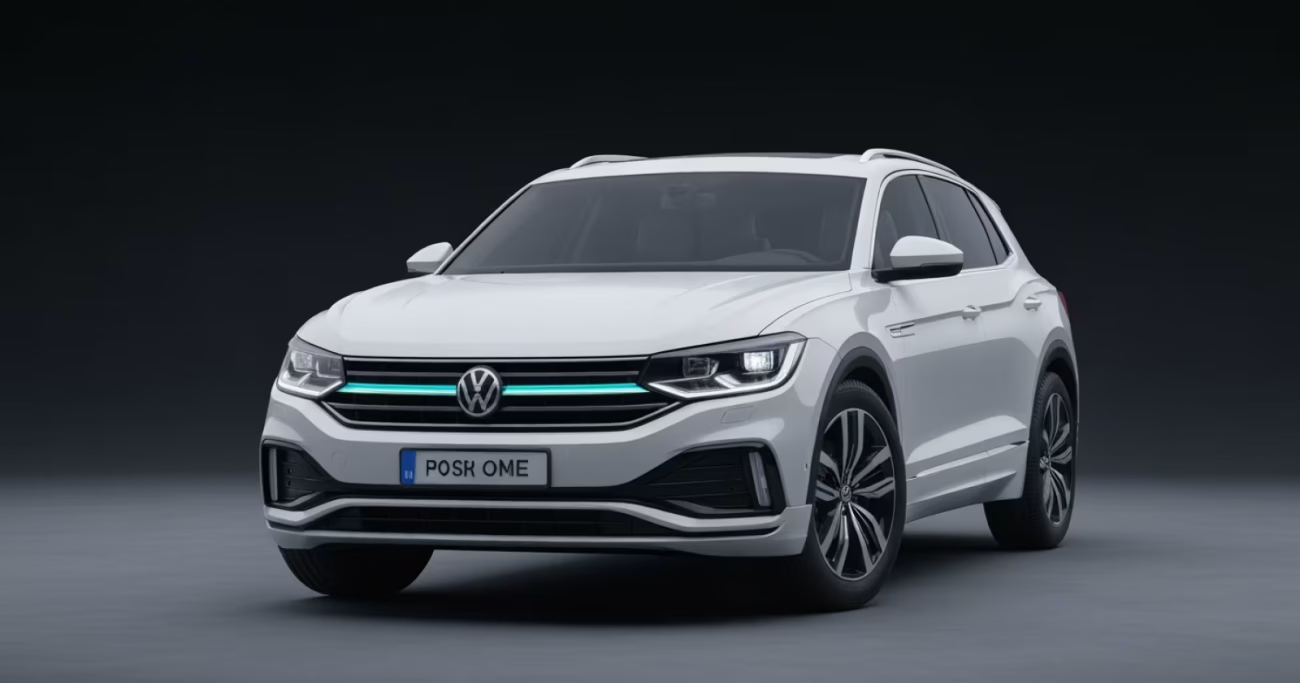
There’s a slice of the car-buying public that nobody talks about — the ones who could write a check for a Porsche but would genuinely rather not. Volkswagen just confirmed they’re building a car specifically for those people, and it could be one of the most interesting electric SUVs of the decade.
VW recently closed the order books on the Touareg, signaling the end of a nameplate that’s run for over two decades. But rather than walk away from the segment entirely, the company’s top sales executive is now floating the idea of a fully electric successor — one aimed squarely at the affluent-but-understated buyer who wants substance without the status symbol.
The buyer VW is chasing isn’t who you’d expect
Martin Sander, Volkswagen’s head of sales and marketing, put it plainly in an interview with Autocar. These are customers who want “great design and space, and a very high level of quality and sophistication” — but, for whatever reason, don’t want a premium badge on the hood.
He described typical Touareg buyers as “very down-to-earth people who are affluent” but deliberately “low-key.” Many are business owners. Showing up at a client’s home in a Porsche Macan or an Audi Q8 sends a signal they’d rather not send. A well-appointed Volkswagen? That’s the move.
It’s a genuinely underserved niche. The luxury SUV market is crowded with brands competing on prestige. VW is betting there’s a meaningful group of buyers who actively want to opt out of that game — and will pay handsomely to do so.
The platform that could make this SUV genuinely dangerous on spec sheets
Here’s where things get interesting. If the next-generation Touareg gets the green light — and Sander’s language suggests it’s a serious conversation, not a pipe dream — it would almost certainly ride on either VW Group’s PPE or SSP electric platform.
The PPE architecture already underpins the electric Porsche Cayenne. That model gets a 113 kWh battery, 390 kW DC fast charging, and a dual-motor all-wheel drive setup producing around 435 hp. If the electric Touareg borrows that same foundation, VW would be offering near-Cayenne-level performance at a significantly lower price point — potentially tens of thousands less.
VW may choose to detune the powertrain to protect margins and maintain brand hierarchy. But even a conservative version of this platform would produce a genuinely formidable machine.
| Spec | Detail |
|---|---|
| Expected powertrain | Dual-motor all-wheel drive (electric) |
| Projected output (platform max) | ~435 hp (based on PPE platform) |
| Battery capacity (projected) | ~113 kWh |
| DC fast charging speed (platform max) | 390 kW |
| Likely platform | PPE or SSP (VW Group) |
| Closest internal rival | Porsche Cayenne Electric (starts ~$100K+) |
| Status | Under consideration — not yet approved |
Why this idea makes more commercial sense than it first appears
Sander acknowledged the Touareg’s sales numbers were modest. That admission would normally kill any talk of a successor. So why is VW still exploring this?
The real story is about customer retention. VW Group’s internal structure creates a problem: as buyers get wealthier, they’re expected to graduate from VW to Audi to Porsche. But a meaningful number of those customers don’t want to graduate. They identify with the VW brand. Without a flagship product to keep them in the tent, VW loses them to competitors entirely — Mercedes GLE, BMW X5, Volvo EX90.
A well-executed electric flagship SUV doesn’t just serve a niche. It plugs a leak in VW’s customer base that’s been quietly costing them revenue for years.
The one thing standing between this SUV and a showroom floor
Nothing is confirmed yet. Sander’s comments were exploratory, and VW is navigating a challenging financial period that has already forced factory consolidations across Europe. Committing to a low-volume, high-investment flagship is a hard sell internally when the company is under cost pressure.
The saving grace may be platform economics. If the PPE architecture is already paid for — which it is, courtesy of Porsche and Audi — the incremental cost of adapting it for a VW flagship drops considerably. The engineering heavy lifting is already done. VW would largely be paying for design, interior development, and positioning.
That’s a very different financial equation than building a bespoke flagship from scratch, and it’s probably the argument Sander’s team is making behind closed doors right now.
How it stacks up
| Model | Est. Power | Battery | Est. Price (base) | Edge |
|---|---|---|---|---|
| VW Electric Touareg (projected) | ~435 hp | ~113 kWh | TBC (~$80-95K est.) | Luxury without premium badge |
| Porsche Cayenne Electric | 435 hp | 113 kWh | ~$105K | Brand prestige, driving dynamics |
| BMW iX xDrive50 | 516 hp | 111.5 kWh | ~$94K | Performance and tech stack |
| Volvo EX90 Twin Motor | 510 hp | 111 kWh | ~$78K | Safety suite, Scandinavian discretion |
Why this matters
- VW could undercut Porsche Cayenne pricing by $10K–$25K on a shared platform.
- Affluent badge-averse buyers are a growing, untapped segment in electric vehicles.
- Platform sharing makes a low-volume flagship financially viable for the first time.
The verdict
If Volkswagen pulls this off, it won’t just be an interesting car — it’ll be a genuinely smart piece of business. The target buyer is real, the platform exists, and the pricing gap between VW and Porsche is wide enough to park something substantial in.
The risk is that VW’s cost pressures shelve the project before it reaches a design studio. But the logic is sound enough that betting against it feels premature. Watch for a formal decision in 2026 as VW’s product roadmap takes shape.
If you’ve been waiting for a large, luxurious electric SUV that doesn’t announce itself at every valet stand, this might be exactly the vehicle worth tracking. Keep an eye on VW’s official channels and bookmark this one — the next update could come faster than the industry expects.
