
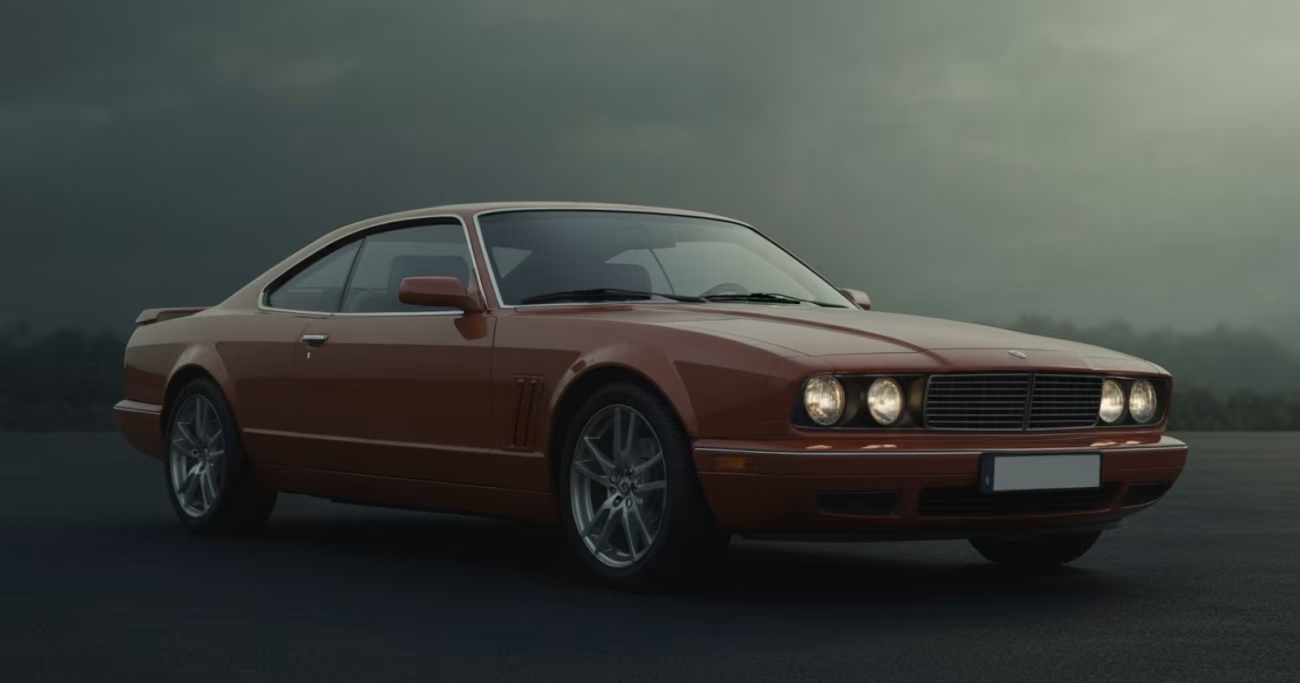
A parking security team at one of America’s biggest automakers just ticketed cars that the company itself built. The vehicles were vintage, the brands were dead, and the guards had no idea they were looking at family.
At Stellantis North American headquarters in Auburn Hills, Michigan, reserved parking spots sit closest to building entrances. They’re a perk for employees who drive a company product. Show up in a Ram truck or a Jeep Wrangler, and you get the short walk. Show up in a Toyota, and you park in the back. Simple enough — until history gets involved.
A 1987 Plymouth got ticketed at the company that built it
Sometime in early 2026, the owner of a 1987 Plymouth Gran Fury walked out of the Auburn Hills office to find a parking violation on the windshield. Security had flagged the car as a non-Stellantis product. Plymouth, of course, spent its entire existence under the Chrysler umbrella before being discontinued in 2001. Chrysler is now part of Stellantis.
Before that incident, an Eagle Talon owner got the same treatment. The Talon was a product of Diamond-Star Motors, a joint venture between Chrysler and Mitsubishi. It wore an Eagle badge — a brand Chrysler created in 1988 and killed by 1998. Both cars are, by every definition, Stellantis heritage vehicles. Neither one was recognized by the people enforcing the parking rules.
The real story is a corporate identity crisis 14 brands deep
Here’s the catch. Stellantis isn’t just Jeep, Ram, Dodge, and Chrysler. The company traces its lineage through a staggering web of mergers, acquisitions, and brand kills that spans continents and decades. Plymouth, Eagle, DeSoto, Imperial — all dead American brands that once lived under the Chrysler roof. Then Chrysler merged with Fiat in 2014, and Fiat merged with PSA Group in 2021 to form Stellantis.
That merger brought in Peugeot, Citroën, Opel, Vauxhall, and others. So technically, a 1990s Peugeot 405 has as much claim to a preferred parking spot as a 2026 Dodge Charger. A Stellantis representative acknowledged to The Wall Street Journal that the brand history is, in their words, “wonky.” That might be the understatement of the decade.
| Brand | Origin | Status | Stellantis Connection |
|---|---|---|---|
| Plymouth | 1928 | Discontinued 2001 | Chrysler subsidiary |
| Eagle | 1988 | Discontinued 1998 | Chrysler subsidiary |
| DeSoto | 1928 | Discontinued 1961 | Chrysler subsidiary |
| Lamborghini | 1963 | Now under VW Group | Owned by Chrysler 1987-1994 |
| Peugeot | 1810 | Active | PSA Group merger into Stellantis |
| Dodge | 1900 | Active | Core Stellantis brand |
| Jeep | 1941 | Active | Core Stellantis brand |
What Stellantis isn’t saying about its own heritage problem
The company told The Wall Street Journal it plans to “rectify the situation,” but the details remain vague. A seminar for parking staff? A printed list of every brand that ever fell under the corporate tree? The logistics of that education effort reveal something deeper — Stellantis itself struggles to communicate what it actually is. When your own security team can’t identify your products, the branding problem goes beyond a parking lot.
And the rabbit holes go deep. During the 1970s, Chrysler had ties to the British Rootes Group and sold a rebadged Hillman Imp as the Plymouth Cricket. Lamborghini was a Chrysler property from 1987 to 1994, meaning a Diablo technically qualifies as a legacy vehicle. At some point, drawing the line between “ours” and “not ours” becomes genuinely philosophical.
The one catch nobody is talking about
There are no actual fines attached to these parking tickets — at least not usually. But vehicles can be booted, which adds real inconvenience to what should be a non-issue. Imagine driving a lovingly maintained classic Plymouth to work, parking it in a spot reserved for company cars, and coming back to find a boot on the wheel. The irony is almost too perfect.
I think the bigger issue is what this says about corporate memory. Stellantis was formed to be a global powerhouse, combining American muscle with European engineering heritage. But if the people on the ground floor — literally the ground floor of the parking structure — don’t know the difference between a Plymouth and a Honda, that heritage isn’t being preserved. It’s being forgotten in real time.
How it stacks up
| Automaker | Total Heritage Brands | Currently Active Brands | Discontinued U.S. Brands | Identity Complexity |
|---|---|---|---|---|
| Stellantis | 14+ | 6 in North America | 5+ | Extreme |
| General Motors | 10+ | 4 in North America | 4 | High |
| Ford Motor Co. | 5+ | 3 in North America | 2 | Moderate |
| Toyota | 3 | 3 globally | 1 (Scion) | Low |
Why this matters
- Stellantis heritage vehicles risk losing recognition at the company’s own facilities.
- Corporate mega-mergers create identity gaps that reach everyday operations.
- Classic car owners who support the brand get penalized for brand loyalty.
The verdict
This story is funny on the surface, but it points to a real tension inside Stellantis. A company built on over a century of American automotive history can’t recognize that history in its own parking lot. The fix is simple — train the staff, print a list, maybe even celebrate the heritage instead of ticketing it. If Stellantis wants to honor its past while selling its future, it needs to start by knowing what it actually owns. The day a Plymouth gets booted at a Chrysler building is the day corporate memory officially flatlines.
If you drive a classic Mopar, Eagle, or any other Stellantis ancestor, this is worth keeping on your radar. Share this with fellow enthusiasts who’d appreciate the absurdity — and maybe keep a Wikipedia printout in the glovebox, just in case.
