
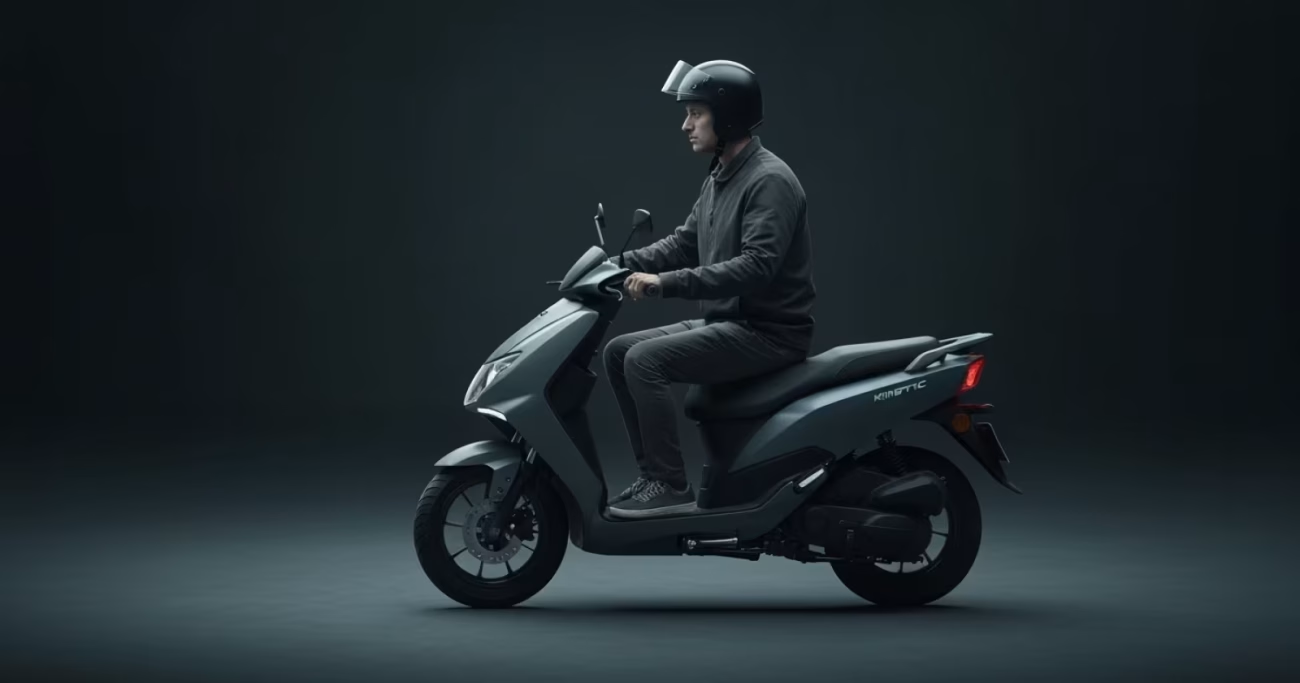
A scooter that ditches the key entirely and hides a 3-metre charging cable inside its body — sounds like something from a concept stage, not a showroom floor. Yet here it is, priced under ₹1.18 lakh, and I rode it through Pune traffic to find out if the reality matches the ambition.
The Legend Returns, Now Fully Electric
Kinetic Watts and Volts, led by Ajinkya Firodia, brought back the iconic Kinetic Honda DX nameplate in mid-2026 — but swapped the petrol engine for a battery and hub motor. The new Kinetic DX electric scooter is a neo-retro machine that genuinely tries to capture the soul of the original while packing features no other electric scooter in India currently offers.
Two variants are on sale. The base DX starts at ₹1,11,499 and the DX Plus tops out at ₹1,17,499. Impressively, most of the headline features come standard on both trims. The DX Plus adds a telematics suite branded as “Telekinetic Features” and the onboard Easy Charge system, which I think is the single most compelling reason to pick the higher variant.
Design That Earns a Second Look
I will be honest — I did not expect to like the way this scooter looks as much as I did. Kinetic’s design team has pulled off something genuinely difficult. They have woven retro cues from the original DX into a modern electric body without making it look like a costume. The iconic fender shape is there. The long flat seat is there. But the LED headlight flanked by integrated turn indicators, the colour LCD instrument cluster, and the futuristic switchgear all feel contemporary.
Five colour options are available on the DX Plus — Red, Blue, Black, Grey, and White. The base DX is limited to Black and Grey. I found myself drawn to the White shade, though I suspect Red and Blue will move faster in showrooms. The illuminated Kinetic logo on the body is a polarising touch. Some will love it, others will find it unnecessary. There is also a built-in speaker that pairs with the Kinetic Connect app for music playback, which is a fun addition for city commutes.
Features That Break the Mould
This is where the Kinetic DX genuinely separates itself from the Ola S1, Ather 450X, and TVS iQube crowd. Four features stood out during my time with the scooter, and none of them exist on any direct rival right now.
First, the Easy Key system. There is no physical key. No smart key fob. You punch in a password on the instrument cluster and the scooter wakes up. It sounds brilliant in theory, and I will get to the concerns later.
Second, Easy Charge. Press a button on the switchgear, a flap behind the front apron opens, and out comes a neatly hidden 3-metre charging cable with a standard plug. No carrying a separate charger. No hunting for the cable in your underseat storage. Just pull up to any 5-amp socket and plug in. For apartment dwellers running an extension cord down from a balcony, this length should be enough.
Third, Easy Flip foot pegs. One toggle press and both pillion foot pegs deploy simultaneously. Fold them back with your foot. Hands stay clean. It is a small thing, but it is the kind of thoughtful engineering that makes daily life easier.
Fourth, the 37-litre underseat storage. Kinetic demonstrated fitting a full-face helmet, a half-face helmet, and still having a shallow compartment left for groceries. There is an LED boot light, a USB Type-A port, and a smartphone cutout inside. For a scooter at this price, that is genuinely impressive cargo management.
Ride Experience From Pune Streets
I am 182 cm tall, and the floorboard sits a bit high for my frame. My knees were pushed up noticeably, and during U-turns the handlebar grazed my knees more than once. For riders under 175 cm, this should not be an issue. The seat itself is long and wide enough to accommodate most body types comfortably.
Performance is adequate for city use. The 0-60 km/h sprint takes around 10 seconds and 0-80 km/h comes in about 20 seconds. Three riding modes are available — Range, Power, and Turbo. Range mode dulls the throttle response significantly. I found no real performance difference between Power and Turbo, except Turbo unlocks a higher top speed of 90 km/h, which the scooter reaches slowly. For daily Pune traffic, Power mode is the sweet spot.
The ride quality leans stiff. I felt rattles and minor vibrations over broken patches, and a softer suspension tune would have made a noticeable difference on Indian roads. Braking is handled by a front disc and rear drum — functional and predictable, nothing exceptional. Ground clearance at 165 mm was never an issue during my ride.
| Specification | Kinetic DX / DX Plus |
|---|---|
| Price | ₹1,11,499 / ₹1,17,499 |
| Battery | 2.6 kWh LFP |
| Motor | Rear Hub, 6.4 bhp peak |
| Claimed Range | Up to 105 km |
| 0-60 km/h | ~10 seconds |
| Top Speed | 90 km/h (Turbo mode) |
| Tyres | 100-section, 12-inch both ends |
| Brakes | Disc (front) / Drum (rear) |
| Boot Space | 37 litres |
| Ground Clearance | 165 mm |
| Onboard Charger | DX Plus only (3m cable) |
| Colours | 5 (DX Plus) / 2 (DX) |
Where Kinetic Needs to Improve
The ambition is clear, but execution gaps are hard to ignore. On two of the units I tested, the Easy Charge cable did not retract smoothly. On one unit, the reverse mode refused to engage. The cruise control feature — which does not let you adjust speed with toggles — could not even activate on my test scooter. When features are this central to the product’s identity, inconsistent quality control becomes a serious concern.
The switchgear deserves a specific mention. The buttons look futuristic and are tightly packed together. Without gloves, muscle memory eventually helps. With thick riding gloves, I had to look down at the controls every single time I wanted to press something. That is a safety issue in traffic.
My biggest reservation is the Easy Key password ignition. Passwords can be shoulder-surfed. In a household with multiple riders, sharing a password means everyone has permanent access. There is no temporary code, no one-time PIN, no biometric fallback. Kinetic says users can track the scooter and set geo-fence alerts via the telematics suite — but that suite is only on the DX Plus. The base DX gets the password system without any tracking capability at all. There is also no way to remotely disable the scooter. A biometric or two-factor system would have been far more secure and would have truly justified the keyless approach.
The artificial start-up sounds and voice alerts also feel overdone. They add a layer of unnecessary drama to what is otherwise a clean, practical machine.
Should You Book One
The Kinetic DX is not a perfect electric scooter. But it is a genuinely interesting one. The onboard charger alone solves a real problem that no Ola, Ather, or TVS product currently addresses. The 37-litre boot is class-leading. The neo-retro design has real character. And at ₹1.11 lakh, the pricing undercuts several rivals that offer fewer practical features.
If Kinetic tightens quality control over the next few production batches and refines the switchgear ergonomics, this scooter could carve out a loyal following — especially among urban commuters who value practicality over outright speed. I would recommend visiting a Kinetic showroom, spending time with the Easy Charge and Easy Key systems yourself, and making sure the fit matches your riding style before signing the cheque. This one rewards a proper test ride more than most scooters in its class.
