
A full aerodynamic validation cycle at General Motors used to take 2 weeks. Now it takes seconds. That single stat tells you everything about where the auto industry is heading in 2026, and why every other automaker should be paying close attention to what’s happening inside GM’s design studios.
Why GM betting big on AI design tools changes everything
GM isn’t replacing designers with algorithms. The automaker is doing something arguably smarter — it’s keeping human hands on the pencil while letting AI handle the grunt work that used to eat up months of development time. Processes that once demanded weeks of coordination across multiple teams now collapse into minutes.
The real story here isn’t about robots stealing jobs. It’s about a legacy automaker figuring out how to move at tech-company speed without losing the human instinct that makes a Cadillac feel different from a Chevy. That distinction matters more than most people realize.
From sketch to 3D animation in less than a day
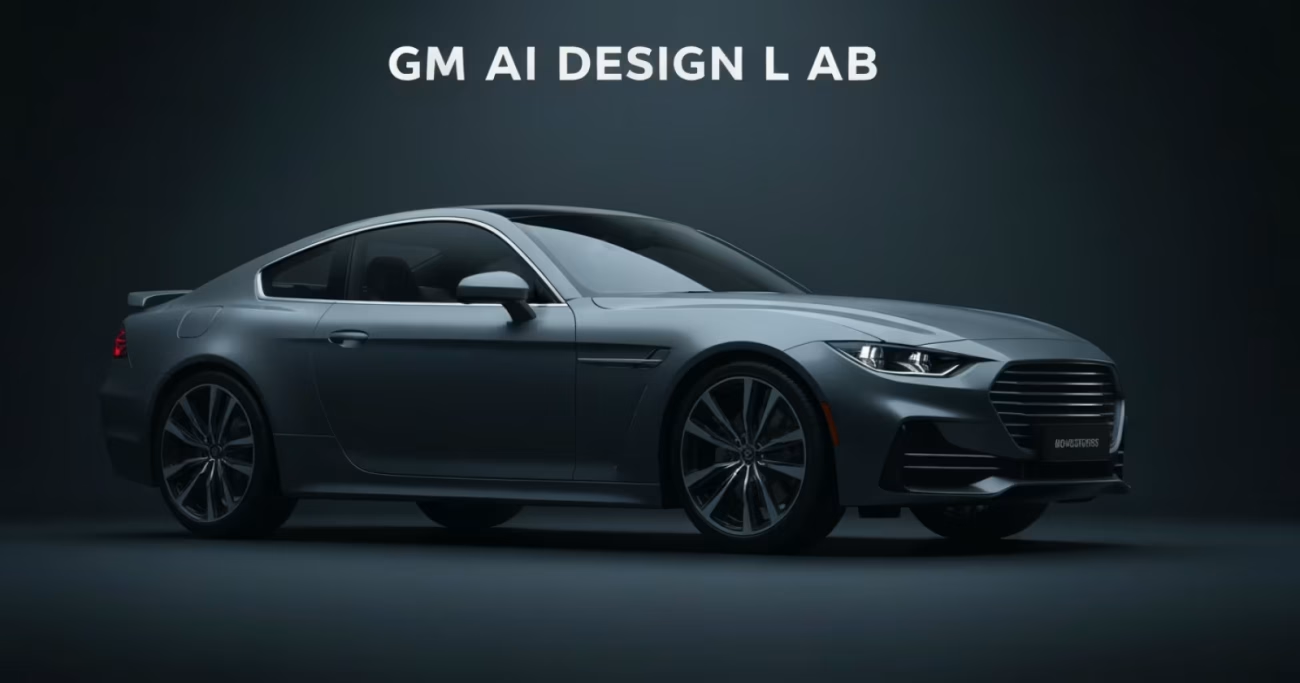
Designer Daniel Shapiro recently fed hand-drawn sketches of a futuristic Chevrolet concept into GM’s AI visualization tools. The system generated multiple images and a teaser animation showing the concept in full 3D motion. What used to require multiple teams and multiple months of work got done by a single designer before the end of the workday.
Here’s the catch — Shapiro is the first to admit this isn’t a magic button. He describes the process as working with the AI and often working against it to land on the right result. The tool accelerates output, but the creative judgment still belongs to the human sitting in front of the screen. Every new vehicle at GM still starts at the tip of a pencil.
| Spec | Detail |
|---|---|
| Design-to-animation time | Under 1 day (previously months) |
| Aero validation cycle | Seconds (previously 2 weeks) |
| Designers needed per concept viz | 1 (previously multiple teams) |
| Brands managed under AI workflow | 4 — Chevy, Buick, GMC, Cadillac |
| AI role per GM | Force multiplier, not replacement |
| Key AI application | Virtual wind tunnel + design iteration |
The virtual wind tunnel nobody is talking about
The design sketches get the headlines, but the engineering side of GM’s AI push might be even more significant. The automaker’s aerodynamics team built an AI-powered virtual wind tunnel that predicts drag coefficients and feeds that data directly into digital sculpting tools in real time. An aerodynamicist and a designer can now sit at the same screen, adjust a roofline or hood shape, and instantly see how those changes affect drag.
GM traditionally relied on high-fidelity computational fluid dynamics simulations and full-scale physical wind tunnel testing. Both are expensive. Both are slow. Rene Strauss, Director of GM’s Virtual Integration Engineering, put it plainly — what used to take about 2 weeks for a full design-engineering iteration cycle now happens instantly. That kind of time compression doesn’t just save money. It lets teams explore 10 ideas where they previously had bandwidth for 2.
What GM isn’t saying about the long-term play
GM frames all of this as AI augmenting human creativity, not replacing it. And right now, that’s accurate. The decision-making still rests with people who understand what makes each of GM’s 4 brands feel distinct. Shapiro and his colleagues are the ones deciding what feels like a Buick versus what feels like a GMC. No algorithm has that cultural intuition yet.
But the trajectory is hard to ignore. Every time AI handles a task that used to require a specialized team, the headcount math changes. GM insists it isn’t handing the keys over, and there’s no reason to doubt that in 2026. The question is what happens in 2028 or 2030 when these tools get exponentially better. The automaker is embedding AI throughout its entire design and development workflow. That’s not a small experiment — that’s an infrastructure decision.
How it stacks up
| Automaker | AI Design Integration | Concept-to-Viz Speed | Aero Validation | Edge |
|---|---|---|---|---|
| GM | Full workflow embedding | Under 1 day | Real-time AI wind tunnel | Speed + scale |
| BMW | Quality control AI | Not disclosed | Traditional CFD + tunnel | Manufacturing QC |
| Mercedes-Benz | AI data center research | Not disclosed | Traditional CFD + tunnel | Data infrastructure |
| Ford | Selective AI pilots | Weeks | Traditional CFD + tunnel | Legacy testing rigor |
Why this matters
- AI compresses vehicle development timelines from years to months
- Smaller design teams can now produce flagship-level output
- Automakers slow to adopt AI tools risk falling permanently behind
The verdict
GM is making the smartest possible bet right now — using AI to amplify human talent rather than replace it. The automaker’s ability to cut a 2-week aero cycle to real-time feedback gives it a development speed advantage that competitors like Ford and Stellantis will struggle to match without similar investments. This approach works today because the tools still need skilled humans to steer them. But GM is quietly building the infrastructure for a future where fewer people do more work, and every automaker watching should be taking notes. The companies that treat AI as a design partner in 2026 will be the ones still standing in 2030.
If you’re in the market for a new GM vehicle or just fascinated by how quickly AI is reshaping the cars we drive, keep a close eye on Chevrolet’s upcoming concepts. The next wave of GM designs will be the first shaped by this accelerated workflow, and I think the results are going to speak for themselves. Bookmark this page and stay tuned for updates as these AI-assisted designs move closer to production.
