
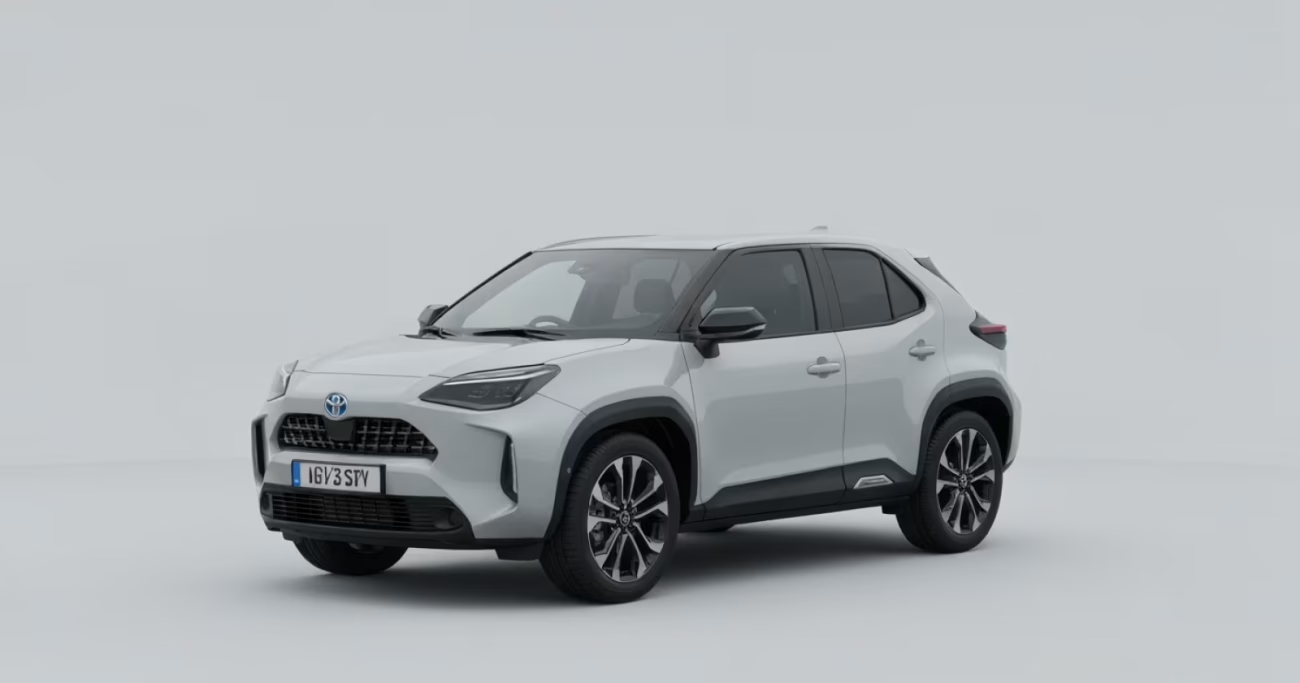
Toyota just refreshed its best-selling car in all of Europe, and most Americans have never even heard of it. The Yaris Cross moved 200,000 units in 2026 alone, quietly outselling crossovers twice its size on the other side of the Atlantic.
Now it gets a facelift sharp enough to make you wonder why Toyota keeps this thing locked away from US showrooms. The new face borrows design cues that feel almost premium, paired with hybrid efficiency numbers that would embarrass half the compact SUV segment here at home.
At a glance
| Spec | Detail |
|---|---|
| Powertrain | 1.5-liter Hybrid 130, 116 hp (114 hp US equivalent) |
| Fuel economy (WLTP) | 55.3 – 62.7 mpg |
| European sales (2026) | 200,000 units |
| Drive options | FWD or AWD |
| Trims | Mid, Mid+, High, GR Sport |
| GR Sport wheels | Dedicated 18-inch machined alloys |
| US availability | None — dropped after 2020 model year |
Why those headlights change everything for Toyota’s smallest crossover
The old Yaris Cross was perfectly fine to look at, in the way a kitchen appliance is fine to look at. Functional, clean, forgettable. This facelift throws that out the window. The new LED headlamps have an expressive, almost sculptural quality that reminds me of what Mazda has been doing with its lighting design — and a touch of that wavy BMW look from the early 2010s.
Toyota made these LED units standard across every trim, which is a smart move. A honeycomb front grille ties the whole face together and gives the Yaris Cross a presence it never had before. New alloy wheels on higher trims, a fresh Celestite Grey paint replacing Shimmering Silver, and a new Precious Bronze bi-tone option with a black roof round out the visual upgrades. It finally looks like it belongs next to the Corolla Cross, not beneath it.
63 mpg and 116 horsepower — here’s the catch nobody mentions
The Hybrid 130 powertrain is unchanged, and that is both the strength and the limitation. At 116 horsepower from a 1.5-liter engine, this is not a crossover that thrills you on a highway on-ramp. What it does instead is sip fuel at a rate that borders on absurd. Toyota claims 4.4 to 4.7 liters per 100 kilometers on the WLTP cycle, which translates to roughly 55 to 63 mpg.
For context, the Corolla Cross Hybrid sold in the US manages around 37 mpg combined on the EPA cycle. Different test standards, sure, but the efficiency gap is real. Toyota has also addressed one of the original model’s biggest complaints — cabin noise. A 2024 update dramatically cut noise and vibration levels, and that refinement carries forward into this facelifted version. The real story is that Toyota listened to owners and actually fixed what they complained about, which is rarer than it should be.
The GR Sport trim is what Toyota isn’t saying about performance
Toyota leans hard on its Gazoo Racing pedigree here, name-dropping 4 World Endurance Championship wins and the Haas F1 technical partnership. The GR Sport trim gets retuned suspension for sharper handling, a unique front bumper, suede-type sport seats, ambient lighting, a wireless charger, and blind spot monitoring. It sounds like a proper little hot crossover on paper.
Here’s what Toyota glosses over: the GR Sport is FWD only and runs the same 114 hp hybrid powertrain as every other Yaris Cross. There is no power bump. No sport exhaust. No turbo. The suspension tuning and cosmetic upgrades are real, but calling this a performance variant stretches the definition. It is a better-equipped, better-looking Yaris Cross with firmer dampers. I respect the honesty of the package even if the marketing oversells it slightly.
What Americans are missing — and why Toyota won’t bring it back
The Yaris nameplate disappeared from US dealerships after the 2020 model year, and those final models were rebadged Mazdas anyway. Toyota decided the American market did not want a subcompact crossover when the Corolla and Corolla Cross covered the entry-level space. The numbers back that decision up — the Corolla sold nearly 250,000 units in 2026, climbing 6.5% year over year.
But I think there is a gap Toyota is choosing to ignore. The Yaris Cross sits below the Corolla Cross in size and price across Europe, targeting urban buyers who want something small, efficient, and easy to park. American cities are not getting any less congested. With fuel prices unpredictable and EV adoption hitting speed bumps, a 63 mpg hybrid crossover under $25,000 would find buyers here. Toyota just does not seem interested in finding out.
How it stacks up
| Model | Power | Fuel economy | European sales (2026) | Edge |
|---|---|---|---|---|
| Toyota Yaris Cross Hybrid | 116 hp | 55 – 63 mpg (WLTP) | 200,000 | Best efficiency, top seller |
| Renault Captur E-Tech | 143 hp | ~52 mpg (WLTP) | ~150,000 | More power |
| Peugeot 2008 Hybrid | 136 hp | ~50 mpg (WLTP) | ~130,000 | Interior design |
| VW T-Cross | 115 hp | ~42 mpg (WLTP) | ~110,000 | Brand recognition |
Why this matters
- Toyota’s European dominance in small crossovers keeps growing unchecked
- Hybrid efficiency above 60 mpg pressures rivals to respond fast
- The US subcompact crossover gap remains wide open for someone
The verdict
The facelifted Yaris Cross is Toyota doing what Toyota does best — taking something that already works and making it just good enough to stay ahead. European buyers who want maximum efficiency in a compact, good-looking package have no real reason to shop elsewhere. The 63 mpg figure alone puts pressure on every rival in the segment. If Toyota ever reconsiders bringing a version of this to the US, the Corolla Cross should be nervous — because its baby brother just grew up a little.
If you are in Europe and shopping for a small crossover in 2026, the refreshed Yaris Cross deserves a spot on your shortlist. Take a close look at the GR Sport if you want the sharpest looks and handling, but go in knowing the powertrain is the same across the board. Test drive one back to back with a Captur or 2008 and let the fuel economy numbers do the talking.
