
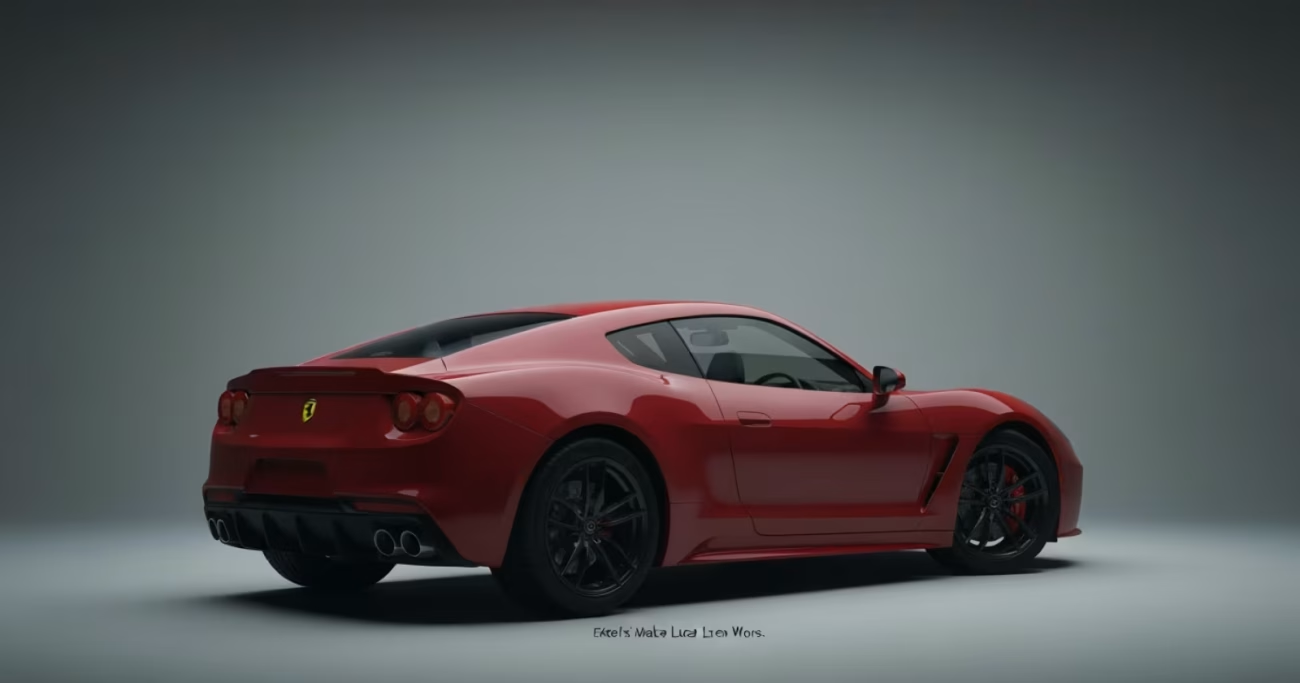
Ferrari has filed a patent for a shifter that looks manual but does not shift gears in the normal sense. That alone would be enough to annoy purists, but the real story is that it may control traction, steering assistance, park, and drive instead.
The Luce was already drawing attention for its vintage-inspired cabin, and this could make that interior feel even stranger. Instead of restoring the manual experience, Ferrari may be turning the classic gated look into a mode selector for an EV-era control system.
The fake manual is stranger than the real manual
Ferrari’s patent is called “Command Device for a Motor Vehicle and Motor Vehicle Comprising the Same,” and the name tells the story. This is not a traditional gearbox idea. It is a control interface dressed up like a heritage shifter.
Here’s the catch: the patent suggests six slots that can trigger different vehicle functions. One slot could be park, another neutral, and others could handle traction control, launch control, torque vectoring, or steering assist. That is a lot of responsibility for a lever meant to trigger nostalgia.
The Luce is exactly the kind of car where this matters. Ferrari is trying to make an EV feel emotional, but this solution risks feeling theatrical instead of authentic. The real story is not the shape of the shifter. It is the amount of software control Ferrari wants to hide inside it.
What Ferrari is not saying about convenience
The company describes the system as “simple and cost-effective,” which sounds tidy on paper. In practice, the interface could become a small museum exhibit that also manages core driving functions. That is a very different promise from a real manual transmission.
Ferrari also mentions turning the knob to adjust settings, plus optional touch sensors for more precise control. That means the driver could need to select a slot, rotate a control, and possibly use sensor inputs just to change vehicle behavior. The real story is that the shifter becomes a multitool, not a performance instrument.
| Spec | Detail |
|---|---|
| Patent focus | Manual-look control device, not a real gearbox |
| Likely functions | Park, neutral, traction control, launch control |
| Input method | Slot selection plus rotary adjustment |
| Extra tech | Touch sensors and actuators |
| Biggest concern | Confusion around critical driving controls |
| Production status | Patent only, no confirmed road use |
Why the Luce needs clarity, not cosplay
Enthusiasts can accept a lot if the execution is honest. A fake clutch and fake gated shifter might feel playful if they only manage sound or feel, but this patent goes much further by tying the lever to critical vehicle functions. That is where the idea starts to look like a liability.
Ferrari is not alone in chasing old-school engagement. Hyundai has explored virtual shifting, and Toyota has been working on ways to simulate a manual feel in electric cars. The difference here is that Ferrari’s approach appears more abstract, more symbolic, and less transparent about what the driver is actually controlling.
For a car like the Luce, that matters a lot. Buyers drawn to Ferrari expect precision, not a guessing game. If the interface makes mode changes feel clever but slows down real understanding, the cabin could become less premium, not more.
The one catch nobody is talking about
Patent drawings do not guarantee production, and this filing may never reach a showroom car. That matters because automakers often patent ideas just to protect intellectual property, not to commit to them. Still, the concept reveals how Ferrari is thinking about EV interaction.
The concern is not simply that the shifter is fake. It is that the fake shifter may end up doing too much. When park, drive, traction control, and launch behavior all route through one nostalgic object, the result may be more confusion than charm.
That is why this patent feels like a warning sign for the Luce, not a clever detail. If Ferrari wants to win over skeptics, it needs controls that feel intuitive first and dramatic second. Right now, this idea leans too hard on drama.
The verdict
Ferrari’s fake manual idea is inventive, but it also feels like a solution built for a problem few drivers actually have. I would expect enthusiasts to be intrigued and then immediately skeptical once they see that the shifter may control core systems instead of gears. For the Luce, that could add more confusion to an already delicate design conversation.
If Ferrari brings this to production, the company will need to prove that nostalgia can coexist with clarity. Otherwise, this patent will be remembered as another flashy EV gimmick with a familiar shape and a very unfamiliar purpose. That is not a victory for the manual idea.
If this kind of patent matters to you, keep following how Ferrari handles the Luce and its EV cabin strategy. The next move will tell a lot about whether this is real innovation or just heritage theater with extra steps.
