
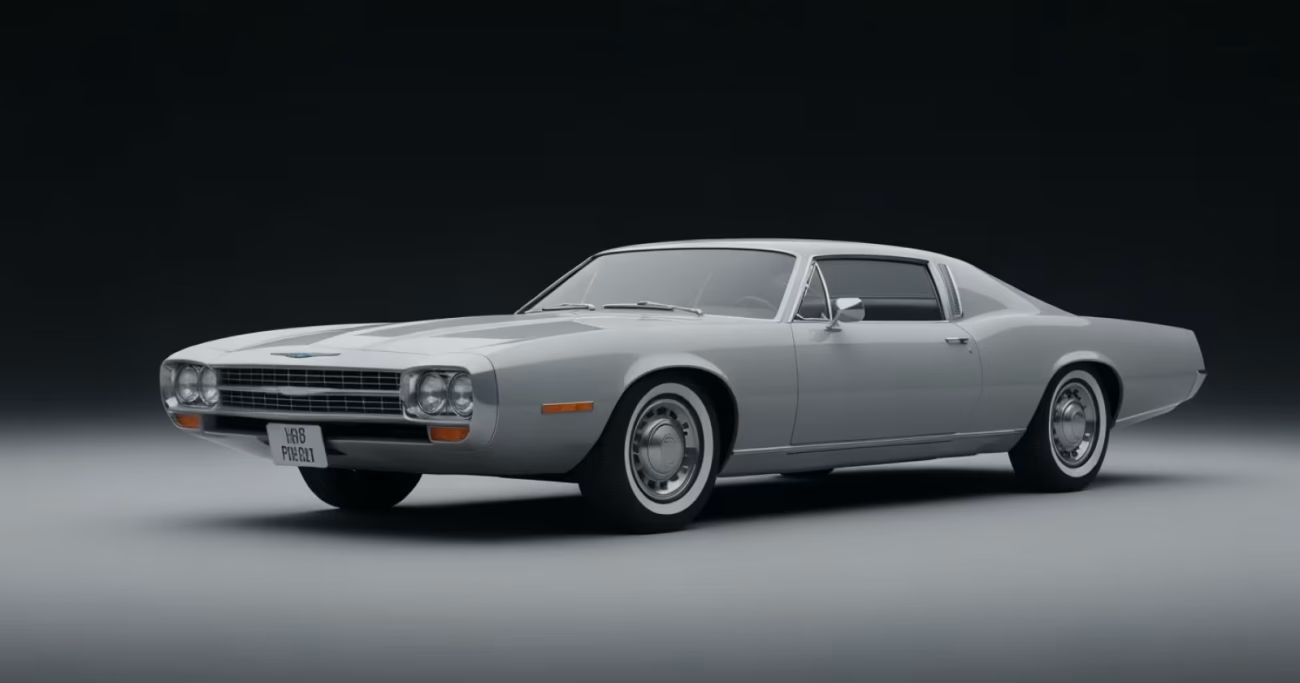
The new Chrysler Airflow has been shown before Chrysler was ready to talk publicly. It is aiming straight at the Toyota RAV4 and a starting price below $40,000.
That is a sharp turn from the low, sleek EV concept many people still remember. The real story is Chrysler trying to rebuild itself with a mainstream crossover that can take multiple powertrains.
Chrysler is betting on a safer shape
The Airflow preview points to a higher-riding SUV, not the dramatic concept that appeared back in 2022. I see a flatter roof, a raked rear window, and a much more conventional profile built for mass-market buyers.
Here’s the catch: Chrysler is not chasing attention with odd styling. It is chasing volume, and that means the Airflow has to look familiar enough to attract family shoppers while still feeling new enough to matter.
Stellantis says the model will ride on the new STLA One platform and be the first American vehicle on that architecture. The company also wants it to support battery-electric, front-drive hybrid, and other multi-energy setups, which is a big hint about where the brand wants flexibility.
The real story is not just the hardware. It is Chrysler finally getting a product that can be sold as a practical crossover instead of a one-note leftover brand with a minivan and not much else.
RAV4 crosshairs make this a real test
Chrysler has reportedly pointed the Airflow at the Toyota RAV4, which tells me exactly how serious this is. That is one of the toughest battlegrounds in the market, where shoppers care about price, efficiency, space, and long-term trust.
What Chrysler isn’t saying is that this comparison raises the pressure instantly. If the Airflow misses on value or execution, it will not just look weak against Toyota. It will also reinforce every old doubt about Chrysler’s smaller models.
There is also a meaningful pricing clue. A starting figure below $40,000 would place the Airflow in a competitive mainstream zone, where it has to win on packaging and flexibility rather than brand prestige.
That matters because Chrysler cannot afford another forgettable entry. The brand has been warned for years that it needs more product or less uncertainty about its future, and the Airflow looks like the answer management wants to test first.
Shared parts could help, not hurt
Stellantis is building more than 30 STLA One vehicles globally by 2035, including models from Peugeot and Opel. That makes shared components a realistic part of the Airflow story, and maybe even a necessary one.
I think that is smart. Common architecture can reduce cost and speed up development, especially when Chrysler needs a faster path to market than its history of delays and weak follow-through would suggest.
Analyst Sam Abuelsamid’s view adds another layer: the Airflow and the Dodge GLH could share components with Peugeot and Opel STLA One vehicles, plus parts from other STLA families. That gives Stellantis room to mix and match without starting from zero.
The real story here is scale. Chrysler does not need an expensive one-off halo car right now. It needs a credible product that can survive in the showroom and create momentum for the next one.
This could decide Chrysler’s next chapter
Chrysler’s recent history at the lower end of the market is not comforting. Models like the 200, PT Cruiser, and Sebring left scars, and that makes the Airflow a much bigger risk than a normal crossover launch.
Here’s the catch: the company no longer has the luxury of patience. Stellantis appears to believe Chrysler still has value, but that belief has a deadline, and a year or two is not much time to prove it with a brand-new model.
| Model | Price | Powertrain | Target | Edge |
|---|---|---|---|---|
| Chrysler Airflow | Below $40,000 | BEV capable, hybrid-ready | Toyota RAV4 | Multi-energy flexibility |
| Toyota RAV4 | Mid-$30,000s+ | Gas, hybrid, PHEV | Mainstream crossover buyers | Proven reputation |
| Honda CR-V | Mid-$30,000s+ | Gas, hybrid | Family shoppers | Strong packaging |
| Jeep Cherokee | Higher than Airflow | Platform-adjacent | Near-premium buyers | Brand strength |
My read is simple: the Airflow matters because Chrysler needs a believable win, not another idea. If Stellantis delivers the right size, the right price, and the right powertrain spread, this crossover could reset how people view the badge.
That is why I would watch this one closely. It is not just a new SUV; it is a test of whether Chrysler still belongs in the mainstream future of the American market.
If this kind of early product reveal matters to you, keep watching the next Stellantis updates closely. The Airflow may be the clearest sign yet that Chrysler is trying to fight its way back with volume, flexibility, and a far more practical plan than the old concept suggested.
