
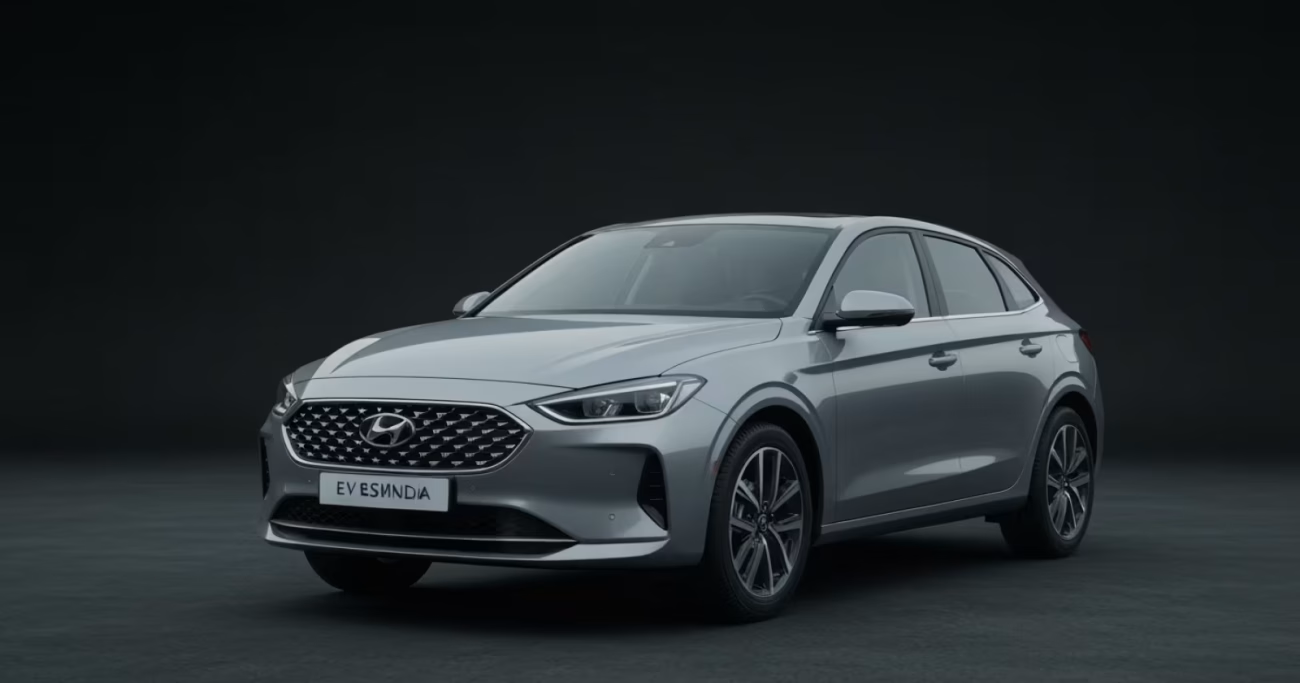
Hyundai is no longer treating Tamil Nadu as just another manufacturing base. I see it becoming the company’s most important EV staging ground for India, and that makes this compact electric SUV story far more interesting than a routine plant update.
The bigger clue is simple: when an automaker talks about localization, charging infrastructure, exports and a new mass-market EV all in one breath, it usually means the next phase is already underway. That is exactly why this 2026 compact eSUV plan has my attention.
Tamil Nadu is becoming Hyundai’s EV center of gravity
Hyundai Motor India Ltd. is pushing Tamil Nadu into a lead role for its electric future, with Chennai and Sriperumbudur at the heart of the plan. I find that significant because it ties product development, manufacturing and supplier growth into one local ecosystem instead of spreading everything thin.
The company has already set up a battery sub-assembly plant in the state and is working on localizing EV components such as power electronics. That kind of groundwork usually points to a product that needs strong cost control, and in India that is the difference between a niche EV and a mass-market hit.
Hyundai’s aim is to lift localization from 82% to 90% over the next five to six years. For buyers, that matters more than it sounds, because higher localization can support sharper pricing, better parts availability and a more stable ownership experience.
The compact eSUV that could take on Nexon EV
Inside Hyundai, the upcoming model is reportedly known as HE1i, and it is expected to sit in the sub-4 metre space. I think that instantly places it in the most competitive part of India’s EV market, where Tata Nexon EV and Mahindra XUV 3XO EV already have strong visibility.
This is not just another electric crossover either. Hyundai appears to be preparing its first dedicated mass-market electric vehicle for India, and that gives the launch a much bigger strategic meaning than a standard model expansion.
The vehicle is expected to use Hyundai-Kia’s E-GMP based architecture, similar in direction to the Inster EV sold overseas. If the battery options land close to the expected 42 kWh and 49 kWh packs, the model could offer more than 300 km of range in real-world friendly terms, which is the sweet spot many Indian EV shoppers keep waiting for.
| Key focus | Hyundai plan |
|---|---|
| Manufacturing base | Sriperumbudur, Tamil Nadu |
| EV segment | Sub-4 metre compact eSUV |
| Expected rivals | Tata Nexon EV, Mahindra XUV 3XO EV |
| Localization target | 82% to 90% |
| Charging network in Tamil Nadu | 39 stations and 78 charging points |
| Investment commitment | Over Rs 26,000 crore |
Why the pricing story could matter most
I always look at EV launches through the pricing lens first, and this one has the right ingredients to be aggressive. Hyundai is talking about local battery sourcing through Exide Energy Solutions and deeper supplier participation from Tamil Nadu, and that is exactly how a company tries to keep sticker prices within reach.
If the new eSUV lands with a practical range, a familiar Hyundai feature set and pricing that stays close to the heart of the compact EV market, it could become a serious disruptor. In India, buyers do not forgive an EV that is too expensive for its size, even when the badge is strong.
Hyundai’s plan to increase sourcing from Tamil Nadu-based suppliers by around Rs 4,000 crore is also important in a broader sense. More local sourcing means more resilience, and for an EV program that aims to scale in India and abroad, that is a very sensible move.
More than a car: a manufacturing and export play
What makes this announcement stand out to me is that Hyundai is not thinking only about domestic buyers. The company has said India will also serve as a global production hub for the model, which means Tamil Nadu is being positioned as an export engine too.
That makes a lot of sense given Hyundai’s history in the state. More than 3.9 million vehicles have already been exported from Tamil Nadu to over 150 countries, so this new EV will enter a factory network that already knows how to build at international scale.
Hyundai also reaffirmed an investment commitment of over Rs 26,000 crore in Tamil Nadu between 2023 and 2032, part of a larger Rs 45,000 crore plan. For me, that signals confidence not just in the plant, but in India’s long-term EV demand and export relevance.
Charging, jobs and the skill angle
Hyundai is not stopping at vehicles and factories. The company already operates a DC fast-charging network in Tamil Nadu with 39 stations and 78 charging points, and it plans to expand that network over the next two to three years. That is a smart move because ownership confidence often depends on charging convenience more than brochure numbers.
The job creation angle is equally meaningful. Hyundai expects its localization push and supplier expansion to create around 2,000 additional jobs, while the new skill development initiative with the Government of Tamil Nadu should prepare young workers for EVs, hydrogen mobility, robotics, automation and AI-enabled manufacturing.
I also like that the training plan includes workplace communication and language skills. In the real world, those are the kinds of details that help workers move from local industry to global opportunity.
What this means for Indian EV buyers
From a buyer’s perspective, this is Hyundai setting the table for a stronger EV future in India. The new compact eSUV gives the company a direct shot at one of the hottest segments in the market, and the Tamil Nadu strategy suggests Hyundai wants to compete on value, scale and confidence rather than just badge appeal.
If the final product arrives with the expected range, a sensible price and Hyundai’s usual polish, the compact EV segment could get a lot more crowded very quickly. And that is good news for anyone waiting for a cleaner, more practical alternative to the usual suspects.
I’ll be watching the next few months closely because the real story here is not just a launch in 2026. It is Hyundai building an EV ecosystem in Tamil Nadu that could shape how India makes, sells and exports electric cars for years. If you care about EVs, localization and the next big compact SUV battle, this is one development you should not ignore.
Keep an eye on this one, because the moment Hyundai reveals final specifications or pricing direction, the segment could change fast. If you want the smartest Indian EV updates as they break, stay tuned and follow the next wave of compact eSUV news closely.
