
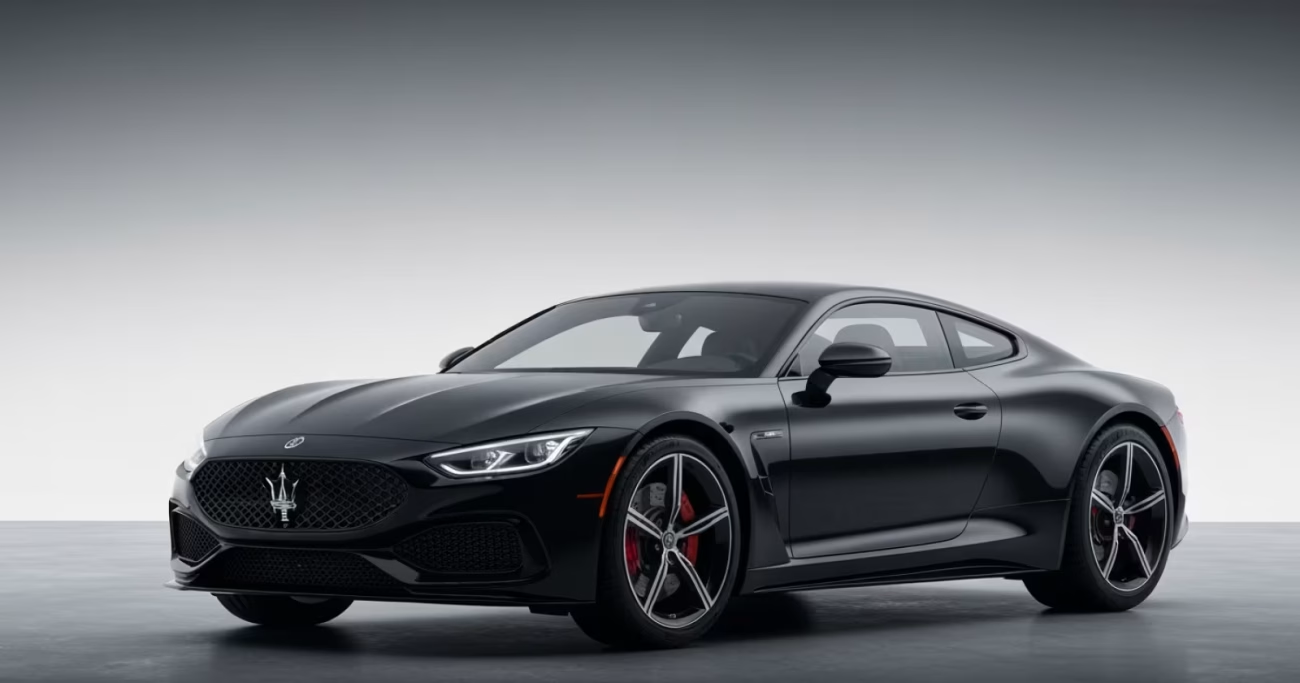
Bugatti stole the room when it named its hypercar the Tourbillon — borrowing one of watchmaking’s most revered complications and strapping it to a 1,800 hp machine worth nearly $4 million. Now Maserati has answered with a Tourbillon creation of its own, and the Italian brand is making absolutely no attempt to fight on Bugatti’s terms.
That restraint, as it turns out, might be the smartest move the Trident has made in years.
What Maserati Is Actually Doing With the Tourbillon Name
Maserati’s Tourbillon debut is rooted in artisanal luxury rather than raw horsepower theater. Where Bugatti leans into stratospheric performance figures and a price tag that locks out virtually every buyer on earth, Maserati is channeling the watchmaking spirit of the tourbillon itself — precision, balance, mechanical poetry — and expressing it through limited-edition Italian craftsmanship.
The tourbillon complication in horology exists to defeat gravity’s effect on a watch movement. Maserati’s interpretation flips that metaphor into automotive form: a vehicle or collector piece designed to transcend the typical compromises of the segment, not overpower them. It’s a philosophical statement as much as a product launch, and for a brand rebuilding its identity in 2026, philosophy matters.
Bugatti Charges $4 Million for More — But That Misses the Point
Here’s the real story: Maserati was never going to out-Bugatti Bugatti. The Tourbillon hypercar from Molsheim produces 1,800 combined horsepower, uses a naturally aspirated V16 engine flanked by three electric motors, and costs somewhere in the neighborhood of $3.96 million. Those numbers are essentially a closed conversation for any rival without Volkswagen Group’s full war chest behind them.
Maserati’s answer is to reframe the question entirely. Rather than chasing peak power or peak price, the Trident is positioning its Tourbillon as a statement of Italian design culture — something closer to a wearable piece of art or a gallery-quality automobile than a track weapon. Here’s the catch though: that strategy only works if the execution is genuinely extraordinary, and Maserati’s recent track record on follow-through has been inconsistent at best.
| Detail | Specification |
|---|---|
| Brand | Maserati |
| Concept Name | Tourbillon |
| Inspiration | Swiss/Italian watchmaking tourbillon complication |
| Direct Rival Reference | Bugatti Tourbillon (~$3.96M, 1,800 hp) |
| Positioning | Artisanal luxury, not hypercar performance |
| Production Expectation | Extremely limited (collector-grade) |
| Year Debuted | 2026 |
Why Maserati’s Restraint Here Is Actually a Strength
There’s something quietly bold about refusing to enter a horsepower arms race you can’t win. Maserati has been navigating a complicated brand repositioning since separating from Ferrari decades ago, and recent years under Stellantis have brought both promising models — the MC20, the electric Granturismo — and frustrating delays. Launching something called Tourbillon without trying to attach a 1,500 hp figure to it takes discipline.
The watchmaking reference also does real work for the brand’s identity. Tourbillon watches from Patek Philippe or A. Lange and Söhne don’t compete with Casio on specifications — they compete on legacy, hand-finishing, and mechanical integrity. If Maserati can genuinely embed that ethos into this project, it builds a lane that Bugatti, Lamborghini, and Ferrari aren’t really occupying. That’s a meaningful gap in 2026’s luxury market.
The One Catch Nobody Is Talking About
What Maserati isn’t saying out loud is that the Tourbillon name carries enormous expectations from two directions simultaneously. Watch collectors and luxury purists will scrutinize every material choice, every panel gap, every finish. Automotive enthusiasts will inevitably compare performance figures to Bugatti’s benchmark whether Maserati invites that comparison or not. Positioning a product above both conversations requires execution that the brand hasn’t always delivered consistently.
Maserati also operates in a market where exclusivity claims are only as powerful as the demand behind them. If the Tourbillon sits unsold — or worse, becomes available at discount — the brand equity borrowed from watchmaking’s most prestigious complication evaporates overnight. The pressure is real, the stakes are high, and I think the next 12 months will tell us whether this was visionary positioning or a beautiful name wasted on an underpowered strategy.
How it stacks up
| Model | Power Output | Estimated Price | Core Positioning | Edge |
|---|---|---|---|---|
| Maserati Tourbillon | TBD | TBD (collector tier) | Italian artisanal luxury | Heritage + accessibility vs. Bugatti |
| Bugatti Tourbillon | 1,800 hp | ~$3.96M | Ultimate hypercar performance | Unmatched power and prestige |
| Ferrari Monza SP2 | 810 hp | ~$1.75M | Open-top Italian icon | Ferrari badge + track pedigree |
Why this matters
- Luxury brands are increasingly competing on identity, not horsepower alone.
- Maserati’s repositioning in 2026 hinges on projects exactly like this one.
- The tourbillon name sets a craftsmanship standard that’s difficult to walk back.
The verdict
Maserati’s Tourbillon debut is a genuinely interesting strategic bet in a market where outspending rivals on raw performance is no longer a viable path for mid-tier luxury brands. It speaks to enthusiasts who value Italian design culture over drag-strip dominance, and to collectors who understand that the most prestigious complications in watchmaking aren’t the fastest — they’re the most refined. If the execution matches the ambition, Maserati carves out a lane nobody else is occupying. If it doesn’t, the name will haunt the brand far longer than any spec sheet. Keep a close eye on how this one delivers — and if you’re a Maserati follower, now is the time to track every detail as they emerge.
