
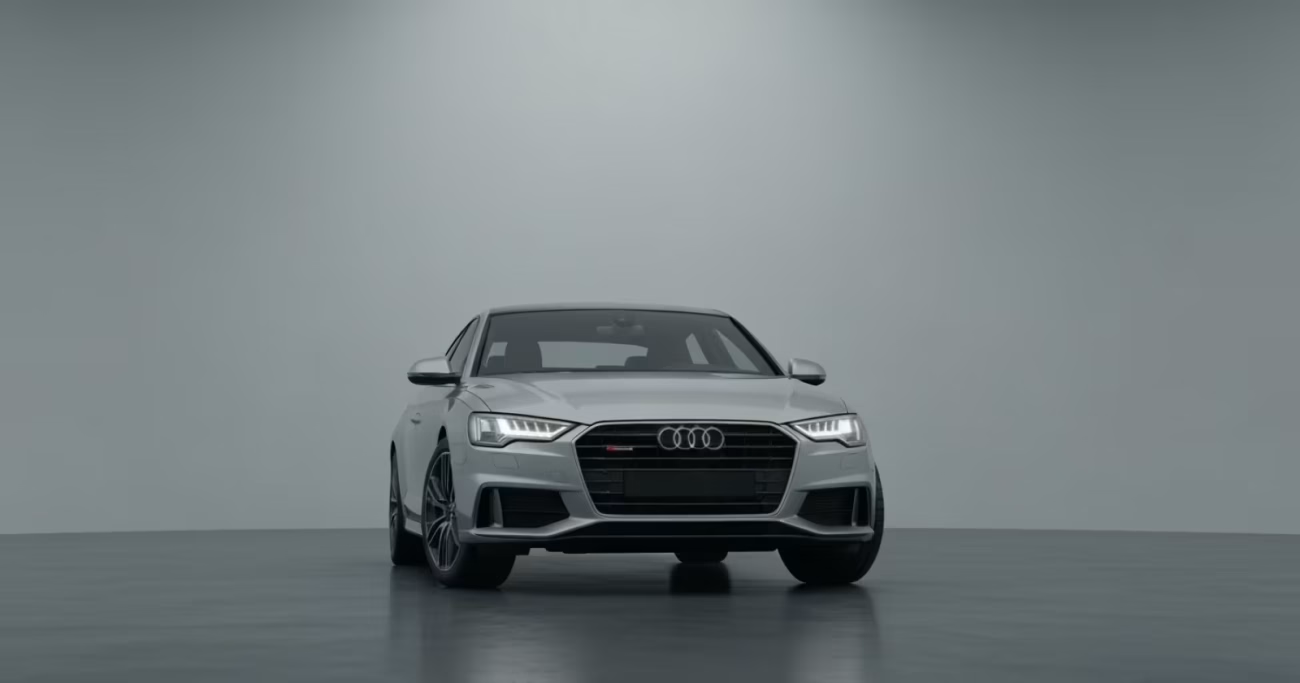
Two of the most popular entry-level luxury cars in Europe are about to vanish from dealer lots for good. After racking up nearly 2.3 million combined sales, Audi is pulling the plug on both models to chase profits and electrification at the same time.
At a glance
| Spec | Detail |
|---|---|
| Models axed | A1 hatchback and Q2 crossover |
| Combined lifetime sales | Nearly 2.3 million units |
| Replacement | A2 e-tron EV, arriving late 2026 |
| A2 e-tron estimated base price | Under 30,000 euros |
| Outgoing A1 starting price | Under 23,000 euros |
| New cheapest Audi (gas) | A3, significantly pricier than A1 |
| Factory freed up | Martorell, Spain (A1) and Ingolstadt, Germany (Q2) |
Why killing 2 bestsellers is actually a survival move
I know it sounds counterintuitive. You don’t normally axe cars that sold 2.3 million units combined. But the real story here is margin, not volume. The A1 and Q2 were popular with young buyers and downsizers, yet they barely moved the needle on Audi’s bottom line during what the company itself admits has been a painful stretch financially.
Audi had a rough couple of years heading into 2026, and the math on redesigning these subcompacts to meet tightening European emissions rules just didn’t add up. Rather than pour development money into low-margin cars facing regulatory headwinds, the brand chose to cut them loose entirely. That decision was actually confirmed internally 5 years ago, so this has been a long time coming.
What Audi isn’t saying about the price gap it just created
Here’s the catch nobody is really talking about. The outgoing A1 started below 23,000 euros. The A3, which now becomes the cheapest car wearing 4 rings, costs considerably more. That leaves a gaping hole at the bottom of the lineup that won’t be filled until the A2 e-tron arrives later this year, and even then, that electric replacement is expected to start under 30,000 euros. That’s a 7,000-euro jump at minimum for anyone who wanted the most affordable Audi.
European subsidies and local EV incentives could soften the blow for some buyers, but I think Audi is making a calculated bet here. The brand would rather lose budget-conscious shoppers entirely than keep selling cars that dilute margins during a financial recovery. If you’re in Europe and want a cheap Audi with a combustion engine, the window is closing fast.
The factory shuffle that reveals Volkswagen Group’s real EV bet
This isn’t just an Audi story. The Martorell plant in Catalonia where the A1 was built is a SEAT-operated facility, and Volkswagen Group is repurposing it to produce a wave of next-generation affordable EVs. I’m talking about the VW ID. Polo, ID. Cross, Skoda Epiq, and Cupra Raval, all expected to hover around 25,000 euros. The group is clearly anticipating massive demand for small, cheap electric cars in Europe and needs every square meter of factory floor it can get.
Meanwhile, the Ingolstadt plant where the Q2 was assembled gets retooled for the A2 e-tron. That car draws heavy visual inspiration from the original A2 from the early 2000s, an aluminum-bodied oddball that managed nearly 80 miles per gallon in its most efficient diesel form. Audi is banking on nostalgia and improved EV economics to make the new version a hit where the original was a cult classic at best.
The A2 e-tron has big shoes to fill on a tight budget
I find the A2 e-tron story fascinating because the original A2 was genuinely ahead of its time. Lightweight aluminum construction, class-leading efficiency, aerodynamic design choices that looked strange in 2000 but seem prescient now. It was also divisive enough that Audi shelved the nameplate for over 2 decades. Reviving it as an EV is a bold call.
European buyers have shown far more appetite for smaller, affordable EVs than American shoppers have, so the market conditions are favorable. But Audi needs this car to do something the A1 and Q2 couldn’t: actually make money. Starting under 30,000 euros while delivering a premium-feeling EV experience is a tough needle to thread, and the competition from Volkswagen Group’s own cheaper offerings will be fierce.
How it stacks up
| Model | Est. base price | Powertrain | Segment | Edge |
|---|---|---|---|---|
| Audi A2 e-tron | Under 30,000 euros | Full EV | Subcompact premium | Brand prestige + EV |
| VW ID. Polo | Around 25,000 euros | Full EV | Subcompact mainstream | Lower price |
| Cupra Raval | Around 25,000 euros | Full EV | Subcompact sporty | Style-forward design |
| BMW iX1 | Around 48,000 euros | Full EV | Compact premium | Larger footprint |
Why this matters
- Audi abandons the sub-25,000-euro market entirely for now
- Volkswagen Group consolidates factories around affordable EVs
- Premium brands are choosing margin over volume in 2026
The verdict
Audi is trading short-term accessibility for long-term financial health, and I think it’s the right call even if it stings for budget buyers. The A1 and Q2 served their purpose by bringing millions of customers into the brand, but the economics stopped working. The A2 e-tron needs to land with real impact later this year, because Audi can’t afford a gap at the bottom of its lineup for long. If you’re in Europe and have been eyeing an A1 or Q2, get to a dealer before the last ones are gone, because this chapter of affordable Audi motoring is officially over.
