
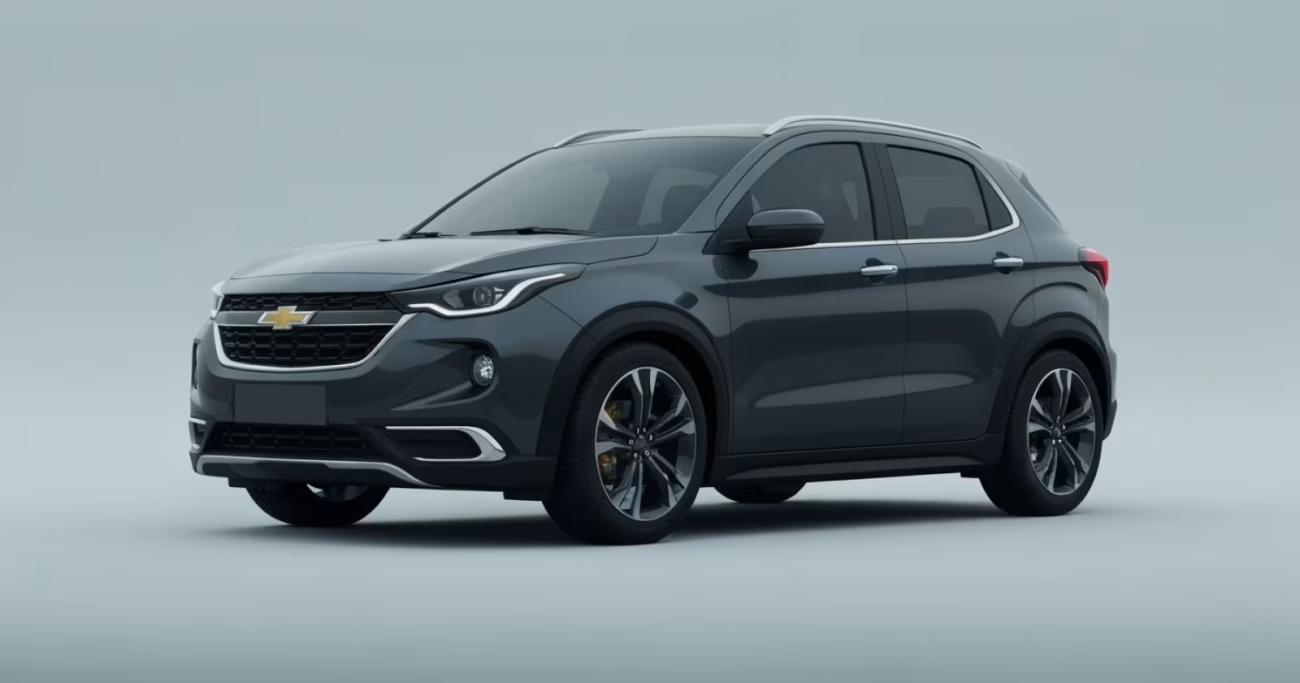
A major automaker just admitted that artificial intelligence shaped an entire production vehicle from the ground up. That automaker is Chevrolet, and the vehicle is a nameplate most people assumed was dead.
The Sonic badge is back for 2026, but not as the scrappy little sedan Americans remember. It is now a compact crossover built exclusively for South America, and its creation story reads like nothing else in the industry right now.
Why letting AI settle the engineer-designer war actually matters
Every car ever built carries the scars of an invisible fight. Designers sketch something gorgeous, then engineers walk in and explain why the pillars need to be thicker, the grille needs to be larger, and the roofline has to come up 2 inches. The final product is always a compromise, and usually the beautiful parts lose.
Chevrolet claims the 2026 Sonic sidesteps that entirely. The company says its AI-driven process “optimizes the joint work of engineers and designers from the initial stages, refining body proportions and surfaces in an integrated way.” In plain language, structural and aesthetic decisions evolved together from day one instead of clashing at the end. I find that genuinely interesting because it means the shape you see was never forced to change after the fact to meet crash or cooling requirements. It was born already satisfying them.
What Chevrolet isn’t saying about the powertrain
Here is the catch. GM has not confirmed a single powertrain number for the new Sonic. The press materials talk endlessly about design language, coupe-SUV silhouettes, and codes of belonging. They say almost nothing about what sits under the hood. That silence is loud.
The most likely candidate is the 1.2-liter turbocharged 3-cylinder engine paired with a 48-volt mild-hybrid system and flex-fuel capability that GM has been rolling out across its South American lineup. One small clue buried in the press release mentions that the “Turbo” engine badges are finished in black. That word — turbo — at least confirms forced induction, and the black treatment hints at a sportier positioning than the base Onix Activ. I would not be surprised if GM is holding back a power figure that undercuts the Fiat Pulse Turbo 200’s output just enough to spark a price war.
The coupe-SUV label is a stretch, but the design works
Chevrolet calls the Sonic an “SUV coupe.” I am not buying that label. A gently sloped rear roofline and a raked rear window do not make something a coupe. That said, the actual design language is sharp. The front end borrows from the Equinox EV, with remarkably slim headlights flanking a long, thin upper intake above the real grille. It looks wider and more planted than anything else in this price class.
The rear is where the real effort shows. Three-dimensional taillights extend outward from the body and connect through a horizontal light bar spanning the tailgate. It gives the Sonic a sense of width that compact crossovers in this segment rarely achieve. Gustavo Aguiar, GM South America’s marketing director, described the car as a “code of belonging” for buyers who see their vehicle as more than transportation. That is marketing speak, sure, but the design does back it up visually.
| Spec | Detail |
|---|---|
| Body style | Compact crossover (coupe-SUV styling) |
| Design method | Fully AI-driven virtual development |
| Expected engine | 1.2L turbo 3-cylinder, 48V mild hybrid |
| Fuel system | Flex-fuel (gasoline and ethanol) |
| Design reference | Chevrolet Equinox EV front-end language |
| Market position | Between Onix Activ and Tracker |
| Target market | Brazil and South America only |
Fiat Pulse and VW Nivus should be paying attention
Brazil’s compact crossover segment is the single most competitive space in South American automotive. The Fiat Pulse dominates with aggressive pricing and a turbo engine lineup that starts around 90,000 BRL. The Volkswagen Nivus counters with a more refined interior and strong brand loyalty. The Sonic needs to land right between them on price while offering something neither can match on design and tech perception.
Positioning the Sonic between the Onix Activ and the Tracker is a smart move. It fills a gap in Chevrolet’s own lineup without cannibalizing either model. The Onix Activ is more of a raised hatchback, and the Tracker sits higher in both size and price. The Sonic slots in as the style-conscious option for younger buyers who want crossover proportions without Tracker money. If GM prices it within 5,000 BRL of the Pulse, this segment gets a real three-way fight.
| Model | Expected engine | Hybrid tech | Segment position | Edge |
|---|---|---|---|---|
| 2026 Chevrolet Sonic | 1.2L turbo 3-cyl | 48V mild hybrid | Compact crossover | AI-optimized design, hybrid efficiency |
| Fiat Pulse Turbo 200 | 1.0L turbo 3-cyl | None | Compact crossover | Proven sales leader, aggressive pricing |
| Volkswagen Nivus | 1.0L TSI turbo | None | Compact crossover | Interior refinement, brand trust |
Why this matters
- First mass-market vehicle openly designed through AI from start to finish
- 48V mild-hybrid tech signals GM’s electrification push in emerging markets
- Compact crossover war in Brazil now has a legitimate 3-way battle
For anyone wondering about a US return, do not hold your breath. If the Sonic name ever reappears in North America, it almost certainly will not be on this vehicle. This is a South America play, purpose-built for that market’s tastes, fuel infrastructure, and price expectations.
I think the real story here is not the car itself but the process behind it. If Chevrolet’s AI-driven development actually delivered a better-resolved design in less time with fewer compromises, every automaker on the planet is going to want to know how. The Sonic might be a regional compact crossover, but the method that created it could reshape how the entire industry builds cars. Keep an eye on early reviews out of Brazil later in 2026 — the results will tell us whether AI-assisted design is the future or just a press release talking point.
