
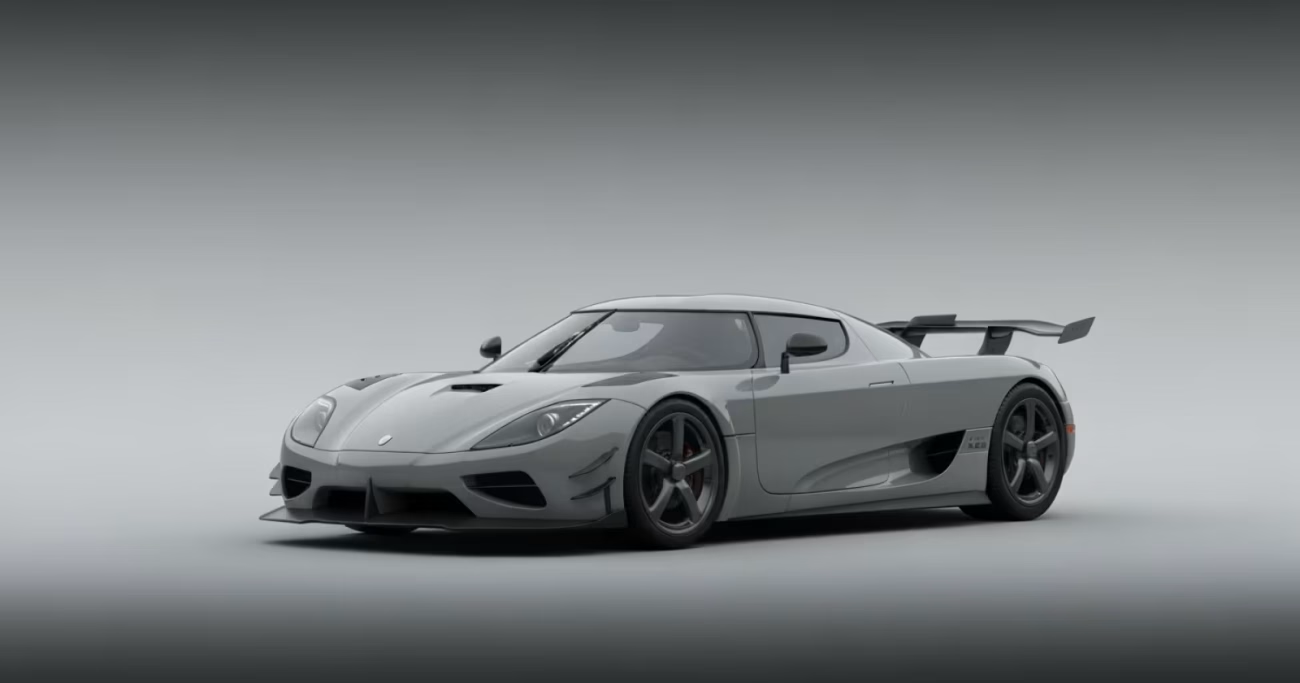
Most automakers solve engine vibration problems by throwing more cylinders at it. Christian von Koenigsegg decided to solve it by making the problem do useful work instead.
A newly surfaced patent from the Swedish hypercar maker reveals a brilliantly unconventional approach to smoothing out odd-cylinder engines. And it signals that the legendary 600-horsepower 3-cylinder that was supposed to power the Gemera is far from dead.
At a glance
| Spec | Detail |
|---|---|
| Patent name | Balancing of a Compressor-Engine Assembly |
| Inventor | Christian von Koenigsegg |
| Engine | 2.0-liter 3-cylinder (TFG) |
| Output | 600 hp from 3 cylinders |
| Key innovation | Compressor doubles as balance shaft |
| Valve tech | FreeValve camless electro-pneumatic |
| Potential use | Hypercars and VTOL aircraft |
Why a 3-cylinder engine has a physics problem nobody wants to talk about
Engines love symmetry. In a 4-cylinder, when one piston reaches the top of its stroke, another is at the bottom. The forces cancel out, and the engine runs relatively smooth. A 3-cylinder can never achieve that natural pairing. There is always an odd piston out, generating vibrations that make the whole assembly shake.
Traditional fixes involve heavy balance shafts spinning inside the block, adding weight and complexity. For a company obsessed with power-to-weight ratio, that approach is basically a non-starter. Koenigsegg needed something that would cancel the vibrations without just being dead weight bolted to the engine. The answer turned out to be hiding in plain sight.
A compressor that moonlights as a balance shaft is peak Koenigsegg
The patent describes an engine-driven air compressor that is deliberately built off-balance. Its piston is timed to hit the bottom of its stroke at the exact moment the engine’s number 1 piston reaches the top. Think of it like a second person jumping on a trampoline perfectly out of phase with the first. The bouncing cancels out.
The compressor is hard-mounted to the engine block and driven directly off the crankshaft through a belt or chain with no clutch. Both sets of pistons must point in the same direction, and the timing has to be locked. The remaining 2 engine cylinders are paired to balance each other, leaving the compressor to handle the odd one out. It is elegant math dressed up as mechanical engineering.
What Koenigsegg is not saying about why this compressor really exists
Here is the catch. The compressor is not just a balancing trick. It actually produces compressed air that the engine desperately needs. The TFG uses FreeValve technology, a camless valvetrain that replaces traditional camshafts with electro-pneumatic actuators. Those actuators need a steady supply of pressurized air to function. This single component solves 2 problems at once.
But the applications go further than cars. Christian von Koenigsegg has openly discussed adapting the TFG for aviation, specifically for VTOL aircraft where its insane power-to-weight ratio would be a massive advantage. High-altitude planes need pressurized cabins, and piston-engine aircraft use compressors exactly like this one to deliver that. The patent is not just a car part. It is a dual-purpose aerospace component hiding inside a hypercar engine.
The one detail that makes this compressor smarter than it looks
There is a problem with permanently coupling a compressor to an engine. Sometimes you do not need compressed air, but you cannot stop the compressor spinning without losing the balancing effect. Koenigsegg’s solution is a variable inlet valve with an actuator that can cycle between full compression, partial compression, and zero compression.
The compressor keeps spinning at all times, maintaining engine balance even at idle. But the inlet valve controls whether it actually compresses anything. It can effectively idle without doing work, or ramp up to full output on demand. That level of control from a mechanically driven compressor is unusual, and it shows how deeply the engineering team thought through every operating condition.
How it stacks up
| Engine | Cylinders | Displacement | Power | Balance method |
|---|---|---|---|---|
| Koenigsegg TFG | 3 | 2.0L | 600 hp | Compressor counterbalance |
| Toyota GR Corolla (G16E-GTS) | 3 | 1.6L | 300 hp | Traditional balance shaft |
| Ford EcoBoost | 3 | 1.0L | 125 hp | Balance shaft + offset crank |
| BMW B48 | 4 | 2.0L | 255 hp | Inherent inline-4 balance |
Why this matters
- Koenigsegg is still actively developing the 600-hp TFG engine.
- Dual-use patents suggest serious aerospace ambitions beyond hypercars.
- Odd-cylinder engines could become viable without heavy balance shafts.
The verdict
This patent is classic Christian von Koenigsegg. Instead of accepting the conventional tradeoffs of a 3-cylinder layout, he turned a necessary accessory into a structural solution. The fact that the compressor also feeds the FreeValve system and could pressurize an aircraft cabin makes it one of the most efficiently multi-tasked engine components I have seen in years. Patents do not always reach production, but this one tells us the TFG is not a shelved concept. Koenigsegg is still refining it, and the next time that 600-hp triple surfaces, it may be smoother than any 3-cylinder has a right to be.
If you are the kind of person who geeks out over engineering solutions that refuse to accept compromise, keep this patent on your radar. The TFG story is not over. It might just be getting started.
