
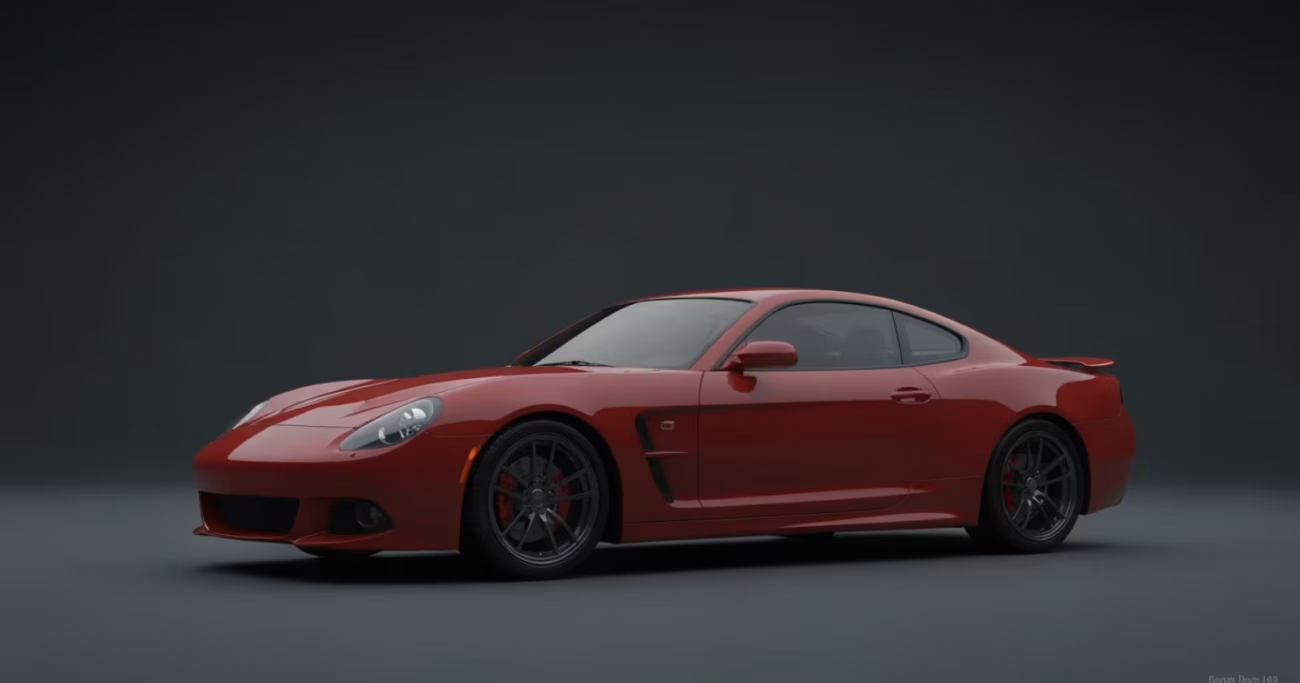
Dodge’s CEO just told the world his brand owes customers a cheap, fun performance car — then immediately left the door open to never building one. That combination of candor and corporate hedging is either brutally honest or deeply alarming, depending on how long you’ve been waiting for Dodge to get its act together.
I’ve watched this brand flirt with relevance for years, and what CEO Matt McAlear said at the New York Auto Show this year is the clearest signal yet that Dodge knows exactly what it needs — and may still be powerless to deliver it.
Dodge sells 37 cars per dealer per year — think about that
The numbers behind Dodge’s current situation are genuinely staggering. The brand moved just under 102,000 units in 2026, and roughly 81,000 of those were Durango SUVs. That left the rest of the lineup — the Charger, the dying Hornet, a handful of Daytona EVs — splitting table scraps.
With around 2,700 dealers across the United States, Dodge averaged approximately 37 vehicles sold per dealership for the entire year. A single motivated salesperson at a Toyota store can beat that number in a good month. For context, Volvo — a brand with fewer than 300 US dealers — outsold Dodge on a brand-wide basis. That’s not a speed bump. That’s a structural collapse.
| Metric | Detail |
|---|---|
| Dodge total 2026 US sales | ~102,000 units |
| Durango share of sales | ~81,000 units (79%) |
| Avg sales per US dealer | ~37 vehicles for the full year |
| Dodge cheapest model (Charger) | Starts at ~$40,000 |
| Stellantis sales decline (prior year) | Down 28% |
| Dodge Hornet GT horsepower | 268 hp, 295 lb-ft torque |
| Mitsubishi cheapest model | Under $30,000 |
What McAlear isn’t saying about the brand’s real problem
At the New York Auto Show, McAlear told The Drive that Dodge “owes” it to customers and dealers to offer affordable performance vehicles. He pointed to the original Dodge Viper as proof the brand can “turn a segment on its head” with something nobody expected. It was a bold reference — except the Viper was a $50,000 supercar with no power windows, not exactly the entry-level answer anyone is asking for.
Here’s the catch: McAlear followed that vision statement with the most deflating qualifier in automotive history. He said that wanting to build affordable fun cars “doesn’t mean we’re actually going to do it.” That’s not humility. That’s a brand leader admitting, in public, that the company’s own ambitions may be financially out of reach. Stellantis’s North American operation is bleeding. Prioritizing a low-margin niche sports car while the broader house is on fire is a very hard sell to shareholders.
The Hornet already proved Dodge can’t price a small car right
The real story here isn’t that Dodge lacks ideas — it’s that the brand already tried the affordable performance formula and got it badly wrong. The Dodge Hornet GT packed 268 horsepower and 295 pound-feet of torque, making it the quickest vehicle in its class. On paper, that sounds like a win. In showrooms, it was a slow-motion disaster.
The Hornet started at $31,000, which sounds reasonable until you realize it was built on an Alfa Romeo platform, assembled in Italy, and sized like a Chevrolet Trax or Kia Seltos — while priced $5,000 above a comparable AWD Jeep Compass. Buyers could get a Chevy Equinox or a Kia Sportage for less money and more space. It took aggressive discounting just to clear inventory. Dodge essentially built the right idea inside the wrong economic reality, and the market punished it without mercy.
Why Dodge showing up at Miata’s price point changes everything
McAlear specifically mentioned wanting to challenge the industry’s expectations for entry-level vehicles, and the brand has previously floated the idea of competing with the Mazda Miata on affordability and driver engagement. That’s a fascinating target. The Miata sells around 9,000 to 10,000 units annually in the US despite being a two-seat roadster with no trunk — because it costs around $30,000 and delivers exactly what it promises.
The real question is whether Stellantis can fund a vehicle like that when it’s simultaneously trying to rescue Chrysler and stabilize a portfolio that shrank 28% in a single year. Low-volume, low-margin sports cars are passion projects. They require corporate willpower, not just CEO enthusiasm. McAlear sounds like he wants to build something iconic. What’s less clear is whether anyone above him is willing to write the check.
How it stacks up
| Model | Starting Price | Horsepower | Body Style | Edge |
|—|—|—|—|—|
| Dodge Charger (cheapest Dodge) | ~$40,000 | 550 hp (base) | Sedan/coupe | Raw power |
| Mazda Miata MX-5 | ~$30,000 | 181 hp | Roadster | Affordability + fun factor |
| Chevrolet Trax | ~$21,000 | 137 hp | SUV | Volume pricing |
| Dodge Hornet GT (discontinued path) | ~$31,000 | 268 hp | Compact SUV | Power-to-price (failed execution) |
Why this matters
- Dodge selling 37 cars per dealer annually is unsustainable long-term
- Stellantis’s 28% sales drop forces hard choices about niche investments
- A sub-$30K Dodge performance car would reshape the entry sports car segment
The verdict
Matt McAlear is saying the right things — Dodge absolutely owes its customers and its dealers a reason to walk into a showroom that isn’t a $40,000 electric muscle car or a 20-year-old SUV platform. The Hornet experiment showed the brand understands the concept but consistently fumbles the execution. If Stellantis can find the financial footing to greenlight a genuine sub-$30,000 performance vehicle, Dodge has the brand equity to make it compelling. But right now, the CEO’s own words — “it doesn’t mean we’re actually going to do it” — are the most honest and most damning sentence anyone at Dodge has said in years. If you’re a Dodge loyalist, the best move right now is to make noise — contact your dealer, follow the brand’s announcements closely, and let the company know the demand is real, because corporate bean counters are listening whether they admit it or not.
