
Dodge’s lineup right now is just two vehicles — a muscle car and an SUV. That’s it. And the man running the brand says that’s exactly the kind of problem a raw, no-frills, sub-$30,000 sports car could fix forever.
At the New York Auto Show, Dodge CEO Matt McAlear didn’t walk back the idea of an affordable performance car. If anything, he doubled down — and the benchmark he chose to reference says everything about where this brand wants to go.
The original Viper is the blueprint, and that should excite you
McAlear pointed directly to the first-generation Dodge Viper as the spiritual model for what an affordable Dodge sports car could look like. His words: “400 horsepower and bare bones of American pure muscle” — a car “no one saw coming.” That’s the energy he wants to recreate, not just the spec sheet.
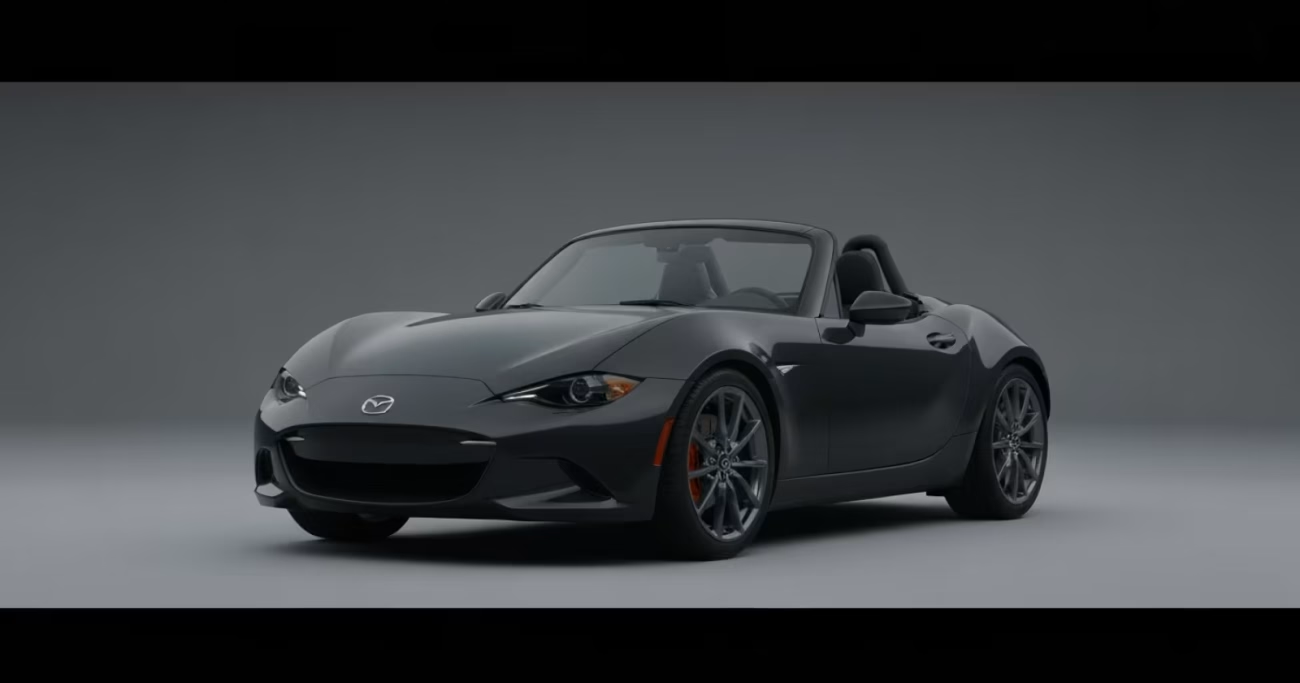
The pitch isn’t complicated. Strip the car back. Remove the heated seats. Skip the stacked driver-assist tech. Cut every cost that doesn’t make the car faster, sharper, or more fun. What you’re left with, in theory, is something that could challenge the Mazda MX-5 and the Toyota GR86 on both price and feeling — without trying to be a luxury product.
A market gap nobody in Detroit is filling right now
Here’s what makes this conversation more than just executive daydreaming. The sub-$30K sports car space is genuinely underserved in America right now. The Mazda MX-5 Miata starts around $29,000. The Toyota GR86 and Subaru BRZ hover just below and above that number. None of them come from an American brand with Dodge’s performance street credibility.
McAlear acknowledged the gap plainly: “There’s absolutely a market for affordability.” He went further, saying Dodge owes its dealers and customers vehicles that deliver “style, attitude, and performance” — not just transportation. That’s brand language with a specific direction. It’s not describing a commuter car. It’s describing something rear-wheel-drive and light.
| Model | Starting Price | Power Output | Drive Layout | Key Edge |
|---|---|---|---|---|
| Dodge (Proposed) | Under $30,000 | TBD | Likely RWD | American muscle identity |
| Mazda MX-5 Miata | ~$29,000 | 181 hp | RWD | Lightest in class |
| Toyota GR86 | ~$30,500 | 228 hp | RWD | Toyota reliability + fun |
| Subaru BRZ | ~$30,300 | 228 hp | RWD | Subaru AWD reputation nearby |
Dodge has circled this idea before — here’s why it never landed
The real story is that Dodge isn’t new to this conversation. The late-1990s Copperhead concept was pitched as a V6-powered companion to the Viper — affordable, fun, attainable. It never made production. Then came the Razor, a compact four-cylinder sports car concept that leaned hard into simplicity. After that, the Sling Shot, with a targa roof and a three-cylinder engine the size of a large coffee maker.
The most tantalizing near-miss was the Dodge Demon concept — not the 840-horsepower drag monster, but an earlier roadster designed specifically to go toe-to-toe with the Mazda MX-5. It was sharp, credible, and compelling. It also never made it past the auto show circuit. That pattern is exactly why McAlear’s careful language — “I would love to see something happen, but it doesn’t mean we’re actually going to do it” — is both honest and a little deflating.
Stellantis is pushing every brand toward a sharper identity — and Dodge needs this
What’s different in 2026 is context. Stellantis under its current direction is actively pushing each brand to build around a clearer core identity. For Dodge, that identity is performance. Scott Kruger, who oversees design across Chrysler, Dodge, Jeep, and Ram, has said the goal is to create vehicles that are “affordable while maintaining the attributes that make them desirable.” For Dodge, that attribute is speed — full stop.
The Charger, for all its success, never reached buyers who couldn’t spend forty, fifty, sixty thousand dollars. That’s a real problem for a brand trying to build a performance culture, not just sell to people who already have money. An entry-level sports car under $30,000 would introduce Dodge to an entirely new generation of buyers — the kind who tune their own cars, track them on weekends, and become lifelong brand loyalists.
Why this matters
- Dodge has no affordable product — a $30K sports car fixes that instantly.
- The MX-5 and BRZ dominate a market with zero American competition right now.
- Stellantis’s brand-clarity push gives this idea its best shot at becoming real.
The verdict
A sub-$30K Dodge sports car is not confirmed, not in production, and not guaranteed to happen. But for the first time in a long while, the people making decisions at Dodge are talking about it in public, repeatedly, with a coherent philosophy behind it. That’s not nothing.
Enthusiasts who grew up watching Dodge concepts get shelved should stay cautiously optimistic — the brand has a complicated relationship with follow-through. But the competitive case is undeniable. If Dodge can deliver a raw, rear-wheel-drive performance car under $30,000, it doesn’t just fill a gap in its own lineup. It rewrites what American buyers expect from an entry-level sports car. The market is waiting. The only question is whether Dodge finally shows up to claim it.
If you’ve been sitting on the sidelines waiting for an American sports car that won’t drain your savings account, now is the time to make some noise — let Dodge know the demand is real, because automakers listen when buyers are loud.
