
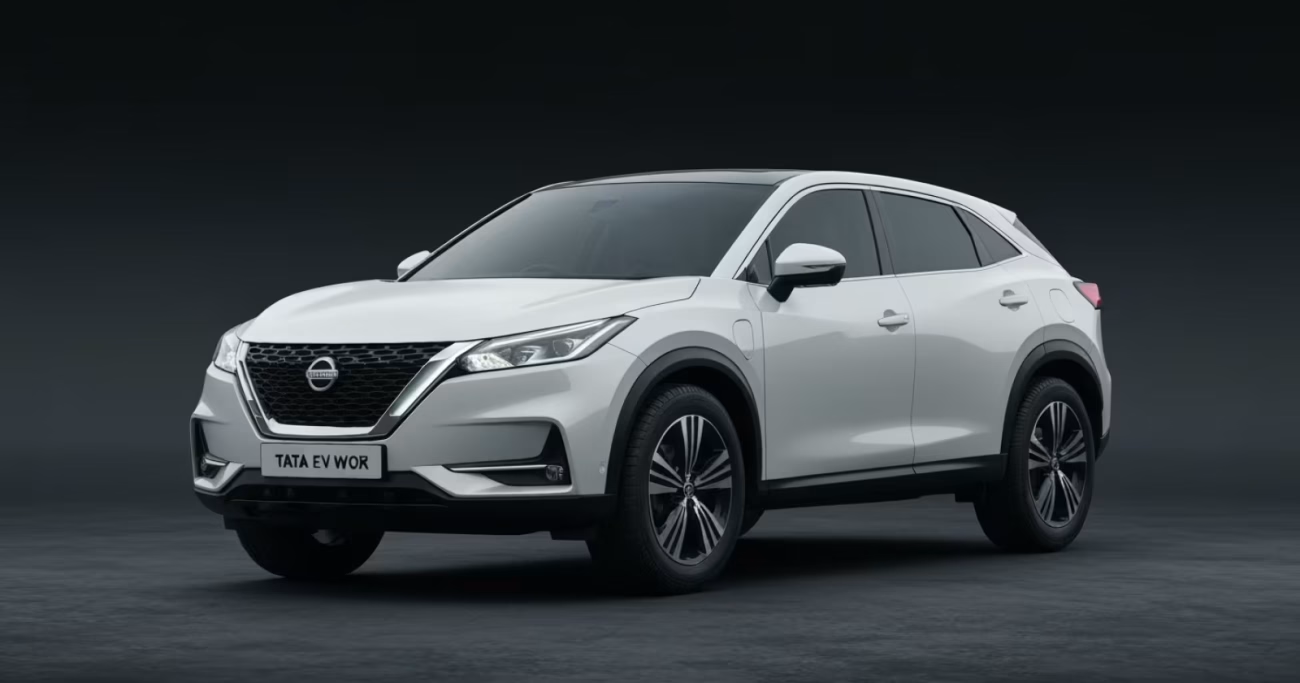
An electric SUV that charges from 10% to 80% in just 12 minutes and claims a combined range of 1,450 km on a single tank-plus-battery cycle — that is not a concept car promise, that is what Nissan just put on sale. And the starting price? Roughly ₹21 lakh. I had to read that twice myself.
What Exactly Is The Nissan NX8?
Dongfeng Nissan has officially revealed the NX8 for the Chinese market in 2026, slotting it between the familiar Rogue (X-Trail) and the larger Pathfinder. It becomes the third model in Nissan’s growing N Series lineup, joining the N6 and N7. This is not a mild refresh or a badge-engineered crossover — it is a ground-up product built to fight in China’s brutally competitive EV SUV space.
The NX8 comes in two powertrain flavours: a fully electric BEV version and an Extended Range EV (EREV) variant that pairs a petrol engine with an electric motor. Deliveries for the BEV have already started, and the EREV is expected to follow shortly. The early market response has been nothing short of explosive — over 8,000 bookings landed within 30 minutes of order books opening.
Size And Design That Means Business
I find the proportions genuinely impressive for this price bracket. The NX8 stretches 4,870 mm in length, 1,920 mm in width, and stands 1,680 mm tall, riding on a generous 2,917 mm wheelbase. That makes it longer than the Rogue while staying slightly shorter than the Pathfinder — a sweet spot that should translate into a roomy cabin without the bulk of a full-size SUV.
Nissan’s latest V-Motion design language is in full effect here. The front fascia is clean and closed off, as you would expect from an EV-first platform, with full-width DRLs and a split headlamp setup giving it a sharp, modern face. Around the back, sleek OLED tail lamps add a premium touch. Flush door handles and smooth body panels are not just for looks — they genuinely help with aerodynamic efficiency, which directly feeds into those range numbers.
A Cabin That Punches Way Above Its Price
This is where the NX8 gets genuinely hard to ignore. The interior is anchored by dual 15.6-inch infotainment screens paired with a 10.25-inch digital instrument cluster, all running on a Qualcomm Snapdragon 8295P chipset. That is the same chip powering cabins in vehicles costing two or three times as much globally. Higher variants are also expected to offer a large augmented reality head-up display.
Comfort features read like a luxury sedan spec sheet. Zero gravity seats come with massage, heating, and ventilation functions. The front seats can recline into what Nissan calls a lounge-like setup — perfect for those charging stops or long highway breaks. There is a 25-speaker audio system, AI-based voice interaction across four zones, an onboard refrigerator, and even a small heating and cooling compartment. The BEV version adds a frunk and underfloor boot storage, which is a practical bonus I always appreciate.
Powertrain: Two Choices, Both Compelling
The BEV version offers two single-motor options — a 215 kW (288 hp) variant and a more powerful 250 kW (335 hp) unit. Both are paired with an 81 kWh battery pack sourced with CATL’s battery monitoring system. Claimed CLTC range tops out at 650 km, which is competitive by any global standard.
But the charging speed is the real headline. The NX8 supports ultra-fast charging at up to 463 kW. That means a 10% to 80% charge takes roughly 12 minutes. To put that in perspective, you could grab a coffee at a highway stop and come back to a nearly full battery. That single number changes the entire ownership equation for anyone with range anxiety.
The EREV variant takes a different approach. It combines a 1.5-litre petrol engine with a 250 kW (335 hp) electric motor. Pure electric range sits at 310 km, while the total combined range stretches to a claimed 1,450 km. For buyers who want electric driving daily but need the safety net of petrol for longer trips, this is a compelling package.
| Specification | BEV Version | EREV Version |
|---|---|---|
| Length x Width x Height | 4,870 x 1,920 x 1,680 mm | 4,870 x 1,920 x 1,680 mm |
| Wheelbase | 2,917 mm | 2,917 mm |
| Motor Output | 215 kW / 250 kW | 250 kW |
| Battery Capacity | 81 kWh | Not confirmed |
| Pure Electric Range (CLTC) | Up to 650 km | 310 km |
| Combined Range | 650 km | 1,450 km |
| Fast Charging Speed | 463 kW (10-80% in 12 min) | Not confirmed |
| Engine | None | 1.5L Petrol |
| Price (China) | From Yuan 149,900 (~₹20.5 lakh) | Expected similar range |
Safety And Driver Assistance
Nissan has partnered with Momenta for the NX8’s advanced driver assistance system. The hardware suite includes up to 29 sensors, headlined by a roof-mounted LiDAR unit. That is serious kit for a vehicle in this price range. CATL’s battery monitoring system adds another layer of safety on the energy storage side. While I have not seen independent crash test results yet, the sensor count and technology partnership suggest Nissan is not cutting corners here.
What This Means For Indian Buyers
Now, the honest part — the NX8 is a China-market product as of now, and Nissan has not confirmed any India launch plans. But the pricing and positioning make it impossible to ignore from an Indian perspective. At roughly ₹20.5 lakh to ₹28.7 lakh (converted from Yuan 149,900 to Yuan 209,900), the NX8 would undercut nearly every electric SUV currently on sale in India if it ever arrived at similar pricing.
For context, the Tata Harrier EV and Mahindra XEV 9e are shaping up to be the key players in India’s electric SUV space in 2026. The NX8’s spec sheet — 650 km BEV range, 463 kW charging, dual screens, LiDAR-based ADAS — would make it a formidable competitor against both. The EREV option with 1,450 km combined range would be particularly attractive in a market where charging infrastructure is still developing outside metro cities.
Nissan India has been relatively quiet on the EV front compared to its aggressive China strategy. Whether the N Series lineup eventually makes it to Indian shores depends on how Nissan restructures its India operations and whether the platform can be adapted for local manufacturing. The demand signal from China — 8,000 bookings in half an hour — certainly makes a business case.
The Bigger Picture
What strikes me most about the NX8 is not any single number, but the overall package at this price. A near-5-metre SUV with premium cabin tech, genuine fast-charging capability, and a choice between pure electric and extended range — all starting under the equivalent of ₹21 lakh. Chinese automakers like BYD and Li Auto have been doing this for a while, but seeing a legacy Japanese brand match them on value is a significant shift.
The 463 kW charging support is particularly noteworthy. Most EVs in the Indian market today top out at 150-200 kW. Even globally, 400 kW-plus charging is still rare outside of premium segments. If this technology trickles down to Nissan’s future global products, it could reshape expectations for mid-range EVs everywhere.
If you have been waiting for electric SUVs to hit that sweet spot of range, features, and affordability, the NX8 is proof that we are getting there faster than most predicted. Keep an eye on Nissan India’s moves over the coming months — and if you are in the market for an electric SUV, it might be worth holding off just a little longer to see how the competitive landscape shifts. The game is changing quickly, and vehicles like the NX8 are the reason why.
