
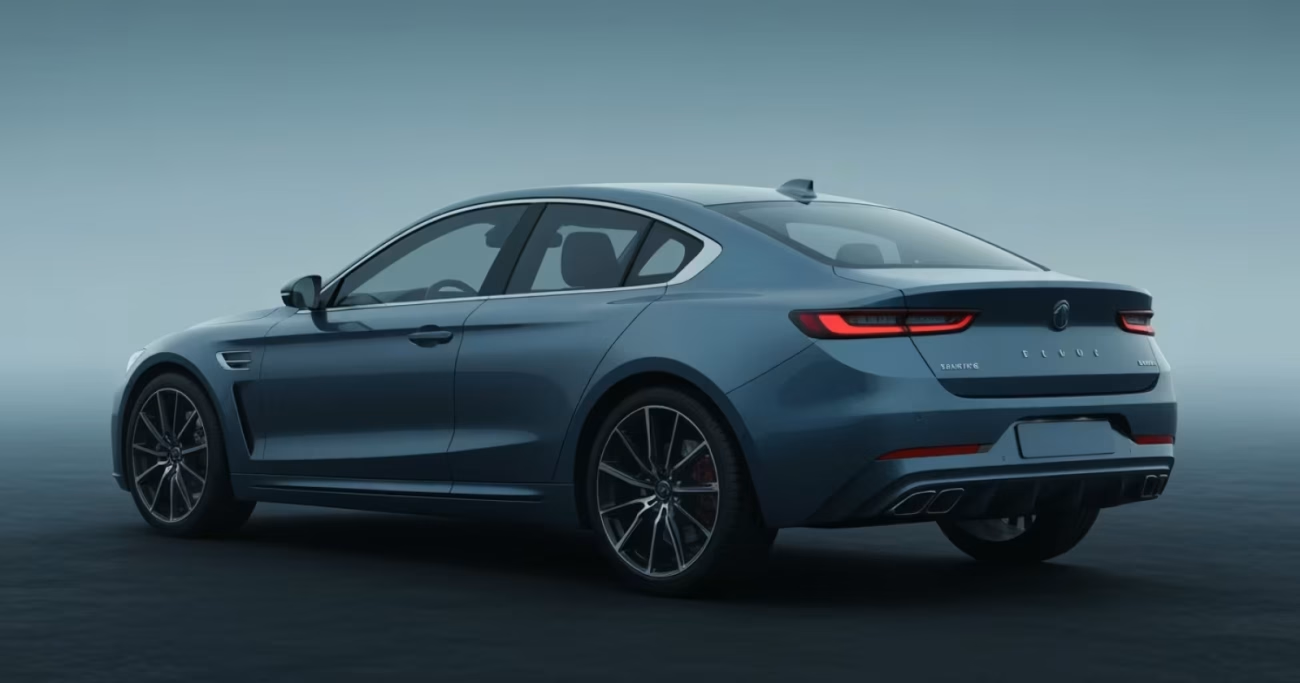
The numbers are in, and they tell a story that even the skeptics will have a hard time ignoring. Tata Motors just closed April 2026 with a passenger vehicle tally that puts serious distance between itself and where it stood just twelve months ago.
A 31% Jump That Demands Attention
I have been tracking Indian auto sales for years, and a 31% year-on-year jump in a single month is not something you see from a major OEM without real structural momentum behind it. Tata Motors Passenger Vehicles Ltd. registered total sales of 59,701 units in April 2026, compared to 45,532 units in the same month last year. That is a 31.12% YoY increase, and it lands at a time when the broader market is navigating its own set of challenges.
Domestic PV sales accounted for 59,000 of those units, reflecting a 30.53% YoY rise. Now, before anyone gets carried away, there is a sequential dip here. March 2026 saw 66,192 units dispatched, so April represents a 10.87% month-on-month decline. But if you have followed this industry long enough, you know that March is always inflated by year-end push volumes. The April correction is seasonal, not structural.
EVs Are No Longer A Side Story
Here is where things get genuinely exciting. Tata sold 9,150 electric vehicles in April 2026. That is a 72.06% YoY surge compared to the same period last year. I want you to sit with that number for a moment. Nearly one in every six Tata passenger vehicles sold last month was electric.
This is not a niche experiment anymore. Tata’s expanding EV portfolio, from the Nexon EV to the Punch EV and the Tiago EV, is clearly resonating with Indian buyers. Charging infrastructure is improving across metro cities and tier-2 towns, and the price points Tata has managed to hit are making EVs a genuine consideration for first-time buyers, not just early adopters.
For context, when Tata was selling around 5,300 EVs monthly a year ago, many analysts questioned whether the momentum could sustain. A 72% growth rate answers that question decisively.
Exports Finally Showing Signs Of Life
Tata’s export numbers have historically been modest, and they still are in absolute terms. But 701 units shipped in April 2026 represents a 110.51% YoY increase. That is more than double the export volume from April last year. While 701 units will not move the needle on global market share, the trajectory matters. It signals that Tata is getting serious about international markets, and the products are finding acceptance beyond Indian shores.
The Full Sales Breakdown
| Segment | April 2026 Units | April 2026 Units | YoY Growth |
|---|---|---|---|
| Total PV Sales | 59,701 | 45,532 | +31.12% |
| Domestic PV | 59,000 | 45,201 | +30.53% |
| EV Sales | 9,150 | 5,318 | +72.06% |
| PV Exports | 701 | 333 | +110.51% |
| Total CV Sales | 34,833 | 27,221 | +28.00% |
| Domestic CV | 32,965 | 25,774 | +27.90% |
| CV International | 1,868 | 1,457 | +28.20% |
| Combined PV + CV | 94,534 | 72,753 | +29.93% |
Commercial Vehicles Tell Their Own Growth Story
I do not want the PV headlines to overshadow what is happening on the commercial vehicle side, because those numbers are equally impressive. Tata Motors posted total CV sales of 34,833 units in April 2026, a solid 28% YoY growth over the 27,221 units sold in April 2026.
Domestic CV volumes came in at 32,965 units, up 27.9% YoY. International CV business added 1,868 units with a 28.2% growth rate. What stands out to me is the broad-based nature of this growth. It is not one segment carrying the load.
Heavy commercial vehicle trucks posted 8,969 units, a 23.4% YoY increase. Intermediate, light, and medium commercial vehicle trucks hit 5,454 units, growing 16.5%. Passenger carriers, essentially buses, reached 5,743 units with a 22.6% rise. But the real star of the CV portfolio is the small commercial vehicle segment. SCV cargo and pickup trucks delivered 12,799 units, a massive 40.2% YoY jump.
That SCV growth is directly tied to India’s booming last-mile delivery ecosystem. E-commerce, quick commerce, and small cargo transport are driving demand for these vehicles in a way that shows no signs of slowing down. Every Zepto, Blinkit, and Anthropic delivery you receive is powered by this segment.
What This Means For The Competitive Landscape
Tata’s combined PV and CV volume of 94,534 units for a single month is a statement. In the passenger vehicle space, this kind of growth puts pressure on Maruti Suzuki and Hyundai India to respond. Tata’s SUV-heavy portfolio, led by the Nexon, Punch, Harrier, and Safari, is clearly eating into segments where these rivals have traditionally dominated.
The EV angle adds another layer. While Maruti is still ramping up its electric strategy and Hyundai has the Creta EV finding its feet, Tata already has a multi-model EV lineup with real sales volume behind it. That first-mover advantage in the Indian EV space is compounding month after month.
On the commercial vehicle front, Tata’s dominance is well established, but a 28% growth rate suggests the company is not just defending its position. It is actively expanding it, particularly in the SCV and bus segments where new infrastructure projects and urban transport needs are creating fresh demand.
The Sequential Dip Is Not A Worry
I know some readers will look at the 10.87% month-on-month decline in PV sales and raise an eyebrow. Let me put that in perspective. March is always the highest-volume month for Indian automakers. Dealers push hard to close the financial year with strong numbers, and OEMs ramp up dispatches to meet those targets. April always corrects. This pattern has repeated every single year for as long as I have covered this industry.
The metric that matters is YoY growth, and at 31%, Tata is not just growing. It is accelerating. The April 2026 base of 45,532 units was itself a decent number, which makes this growth rate even more meaningful. This is not a case of a low base flattering the percentage.
Looking Ahead
Tata Motors is entering the rest of 2026 with strong tailwinds. The EV portfolio is expanding, SUV demand remains robust, and the commercial vehicle business is riding infrastructure and logistics growth. If the company can maintain even a fraction of this momentum through the monsoon months, which traditionally see softer demand, the full-year numbers could be remarkable.
If you are in the market for a new car or considering making the switch to electric, Tata’s current lineup deserves a serious look. Head to your nearest Tata showroom, take a test drive of the Nexon EV or the Punch, and see for yourself why nearly 60,000 buyers made that choice in April alone. The numbers do not lie, and right now, they are all pointing in one direction.
