
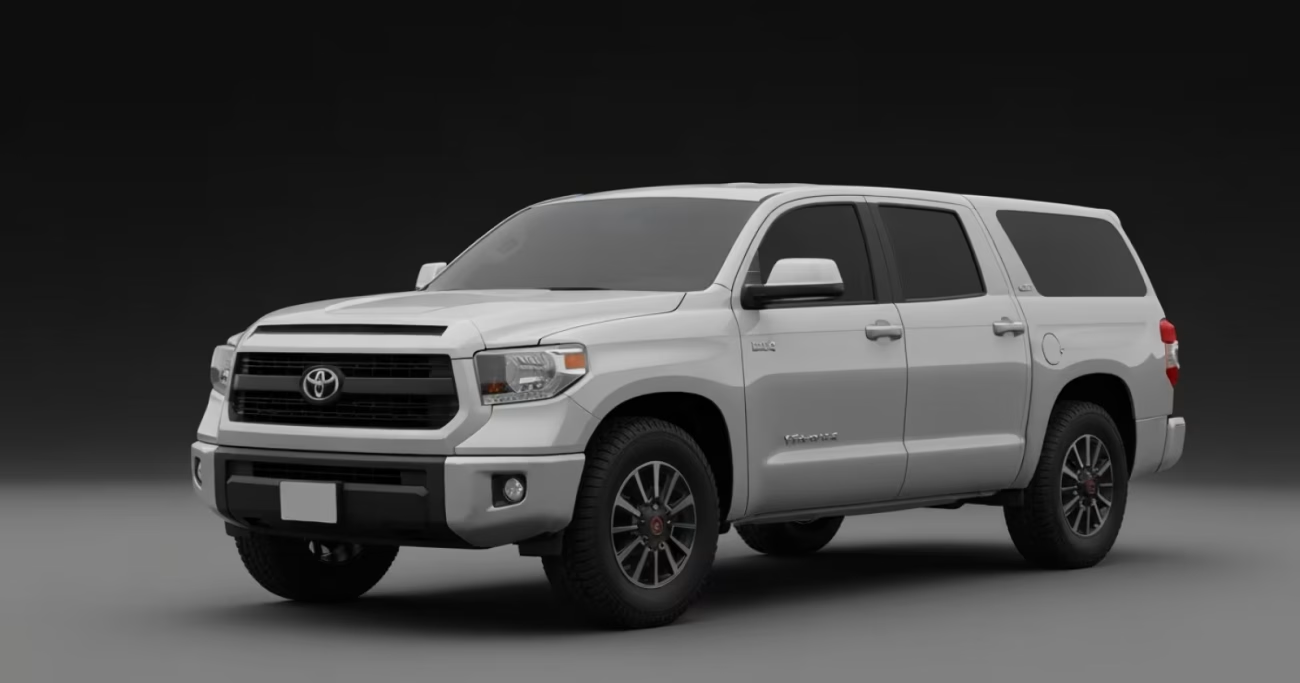
A full-size American pickup truck — built in San Antonio, Texas, priced at $75,000 — is now sitting inside a Toyota showroom in Tokyo. That single fact tells you more about the current state of US-Japan trade relations than almost any press release could.
I’ve been tracking this story since last December when Toyota first hinted at reimporting US-built models, and the official April 2026 launch confirmed what many in the industry quietly suspected: this is as much a diplomatic maneuver as it is a product launch. Here’s exactly what’s happening, why it matters, and what it signals for the road ahead.
Why Toyota shipping American trucks to Japan changes the trade conversation
Toyota officially began selling US-produced Tundra pickups and Highlander SUVs at its Tokyo showrooms on April 2, 2026. Nationwide sales across Japan are set to roll out this summer, enabled by a regulatory change that took effect on February 26. That rule change allows US-built vehicles to enter Japan with only minor domestic modifications rather than full retesting — a significant shift that opens a door that had previously been nearly shut.
Those modifications are surprisingly minimal. Toyota is swapping the turn signal bulbs for orange alternatives and adjusting headlamp angles to meet Japanese anti-glare standards. That’s it. Everything else — the 3.4-liter twin-turbo V6, the 10-speed automatic gearbox, the full TNGA-F ladder frame chassis — arrives exactly as assembled in Texas. The real story is how little had to change, and what that signals about how the certification rules were quietly engineered to make this possible.
The $75,000 price tag no one in Japan was actually asking for
The 1794 Edition Tundra will start at 12,000,000 yen in Japan — just over $75,000 USD. The Highlander Limited ZR Hybrid comes in at 8,600,000 yen, around $53,800. Both figures sit well above their US retail equivalents, largely because options like the 14-inch multimedia touchscreen, the 12.3-inch TFT color display, and leather seating are bundled as standard in the Japanese lineup.
Here’s the catch: Toyota is targeting just 80 Tundra units per month in Japan, which adds up to roughly 960 vehicles per year. The Highlander target is even more restrained at 40 units monthly, or 480 annually. For comparison, 12,949 Tundras were sold in the United States in a single month last year. What Toyota isn’t saying directly is that this initiative was never designed to move metal — it was designed to move a conversation.
The real reason Toyota is doing this has everything to do with tariffs
Toyota’s own press release explicitly states the decision was made to “help further strengthen Japan-US relations.” That’s a remarkably candid acknowledgment of the political dimension here. The move lands squarely in the context of the current US administration’s fluctuating tariff situation, which has created sustained pressure on Japanese automakers to demonstrate visible, measurable market access for American-made goods.
I think this is one of the more compelling examples of corporate diplomacy I’ve seen from any automaker in years. Japan’s cities favor compact, fuel-efficient vehicles. Full-size American pickups are not a cultural fit for Osaka or Kyoto. The Tundra will slot above the Hilux in Toyota’s domestic lineup — a truck reintroduced to Japan in 2017 after a 13-year absence, and one that is never sold in North America. The Tundra’s arrival is a gesture as much as it is a product strategy, and both governments appear to benefit from that framing.
One catch nobody is talking about that limits Tundra’s appeal in Japan
The Tundra sold in Japan will not be offered with a hybrid powertrain. In a market where Toyota has built its domestic reputation on hybrid technology — Prius, Corolla Hybrid, the hybrid Hilux — that omission is a real limitation. What Japanese buyers will find instead is a 389-horsepower twin-turbo V6 producing 479 lb-ft of torque paired with a 10-speed automatic. Impressive by any global standard, but not the specification that typically resonates with Tokyo commuters.
All imported models will also remain left-hand drive, which creates genuine friction in a right-hand-drive country. There is a dedicated community in Japan for imported American vehicles, and a $75,000 Texas-built Tundra has real appeal as a statement piece in that niche. The Highlander, meanwhile, does bring the hybrid powertrain Japanese buyers expect — a 2.5-liter four-cylinder hybrid producing 243 hp — and stands a better chance of building steady, if modest, momentum.
| Model | Engine | Power Output | Japan Price (USD est.) | Monthly Japan Target |
|---|---|---|---|---|
| Toyota Tundra 1794 Edition | 3.4L Twin-Turbo V6 | 389 hp / 479 lb-ft | ~$75,000 | 80 units |
| Toyota Highlander Limited ZR Hybrid | 2.5L 4-cyl Hybrid | 243 hp / 175 lb-ft | ~$53,800 | 40 units |
| Toyota Hilux (Japan-spec) | 2.8L Diesel | ~204 hp | ~$40,000 est. | Established baseline |
| Toyota Camry US-built (upcoming) | TBC | TBC | TBC | TBC — “when ready” |
What this means for American auto workers and the Texas plant
From a manufacturing standpoint, Toyota’s San Antonio facility now has a direct export role in Japan — however small in scale. That’s a narrative win for US domestic production at a moment when trade balance and factory employment are under intense political scrutiny. Even 120 combined units per month adds incremental production value and, more importantly, gives both governments a concrete data point to reference in ongoing trade discussions.
The symbolism here runs deeper than the numbers justify. A full-size, twin-turbo, ladder-frame pickup that represents American truck culture — sitting on a Tokyo showroom floor in 2026 — is genuinely striking. Toyota has also confirmed that US-built Camrys will follow the Tundra and Highlander into Japan, though the timeline remains open at “as soon as preparations are complete.” That Camry announcement is the one I’m watching most closely, because its volume potential in Japan is considerably higher than either model currently on sale, and its launch timing will tell us everything about how the broader trade negotiation is actually progressing.
If you’re following the global auto industry for signals about where trade policy is headed, bookmark this story and watch the Camry timeline carefully. The Tundra may be the headline, but the Camry will be the real indicator of how far this US-Japan automotive bridge actually extends. Follow the production numbers — not the press releases — and you’ll see the real story emerge.
