
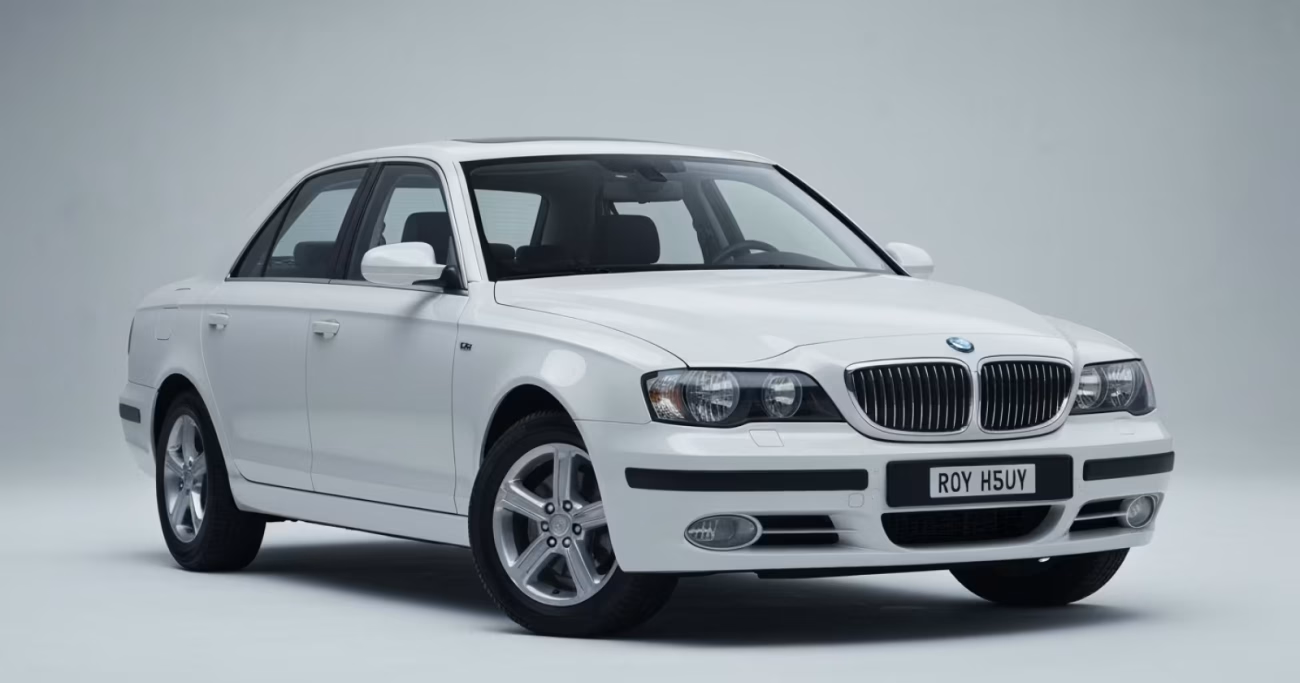
One of the Soviet Union’s most recognizable car names just drove back into existence — wearing a Chinese suit, assembled in a factory that used to stamp out Volkswagens. The Volga is back, and the story behind its return is more geopolitically tangled than any badge swap has a right to be.
For decades, Volga sedans were the unofficial symbol of Soviet authority. Government officials rode in them. Taxis ran on them. Every Russian over a certain age knows the nameplate by heart. Then the brand went quiet — and what’s replacing that silence in 2026 is something entirely unexpected.
A Soviet legend rebuilt with Chinese bones
The revived Volga lineup arrives with two models: the K50 SUV and the C50 sedan. Neither one is an original design. The K50 is built directly on the Geely Monjaro platform, and calling it a close relative would be generous — it is, by almost every visible measure, a Monjaro wearing a new grille badge.
The front fascia, chrome trim, headlight clusters, and body proportions all carry over from the Chinese original. Volga’s contribution appears to be largely cosmetic — a revised grille insert and a new emblem. Russian media reporting on the K50 suggests it runs a 2.0-liter turbocharged petrol engine producing 238 hp, paired with an eight-speed automatic and all-wheel drive.
The sedan tells the same story, just in a different body style
The C50 sedan follows the same template. It’s based on the Geely Preface, and the design changes are equally minimal — a new grille, a new badge, and almost nothing else. The interior, according to available details, carries over the Preface’s four-spoke steering wheel, digital instrument cluster, and portrait-format infotainment screen without significant modification.
That’s not automatically a condemnation. The Preface is a genuinely clean design — it draws comparisons to the Volkswagen Passat and, from certain angles, the American-market Honda Accord. The C50 is offered in two states of tune: 150 hp and 200 hp, both from a 2.0-liter turbocharged four-cylinder, routed through a seven-speed dual-clutch transmission.
| Spec | Volga K50 (SUV) | Volga C50 (Sedan) |
|---|---|---|
| Base platform | Geely Monjaro | Geely Preface |
| Engine | 2.0L turbocharged petrol | 2.0L turbocharged petrol |
| Power output | 238 hp | 150 hp / 200 hp |
| Transmission | 8-speed automatic | 7-speed dual-clutch |
| Drive system | All-wheel drive | Not yet confirmed |
| Production site | Former VW Group plant, Nizhny Novgorod | Former VW Group plant, Nizhny Novgorod |
| Pricing | Not announced | Not announced |
The factory where these cars are made says everything
Both models will roll out of the VW Group’s former manufacturing facility in Nizhny Novgorod — a plant that previously built Skoda and Volkswagen models for the Russian domestic market before Western brands exited following Russia’s invasion of Ukraine. That exit left a significant production gap, and the Volga revival is, at least in part, an attempt to fill it.
This isn’t the first time a Volga comeback was floated. A 2024 revival plan built around Changan-based platforms was previewed with three model concepts and then quietly abandoned. This second attempt has the advantage of timing — with Western marques gone and domestic demand still present, there’s a real window. Whether a rebadged Geely can carry the emotional weight of the Volga name is a separate question entirely.
What this revival actually reveals about Russia’s car market
The real story here isn’t nostalgia — it’s industrial improvisation at scale. Russia lost its access to European automotive technology and manufacturing partnerships almost overnight. What’s filling that void is Chinese product, Chinese platforms, and Chinese supply chains, dressed up in familiar local branding.
Volga is far from alone in this pattern. Multiple Russian nameplates have been revived or repositioned using Chinese underpinnings since 2022. The difference here is the factory — repurposing a facility that VW Group built to European standards and pointing it at Chinese-derived product for Russian consumers is a genuinely unusual industrial pivot. Pricing hasn’t been announced for either model, which will ultimately determine whether this revival gains traction or becomes another false start.
I find the positioning fascinating — Volga carries decades of cultural weight in Russia, and pairing that with Geely’s increasingly competitive hardware isn’t a terrible strategy on paper. The Monjaro, in particular, is a well-regarded product in markets where it’s sold under its own name. Whether Russian buyers accept it wearing Soviet-era badges is the gamble Volga’s backers are making.
If you grew up knowing the Volga name — or if you follow how geopolitics reshapes automotive markets in real time — these two models are worth tracking closely. Pricing announcements will be the real signal. When those numbers land, they’ll tell you exactly how seriously this revival is meant to be taken.
