
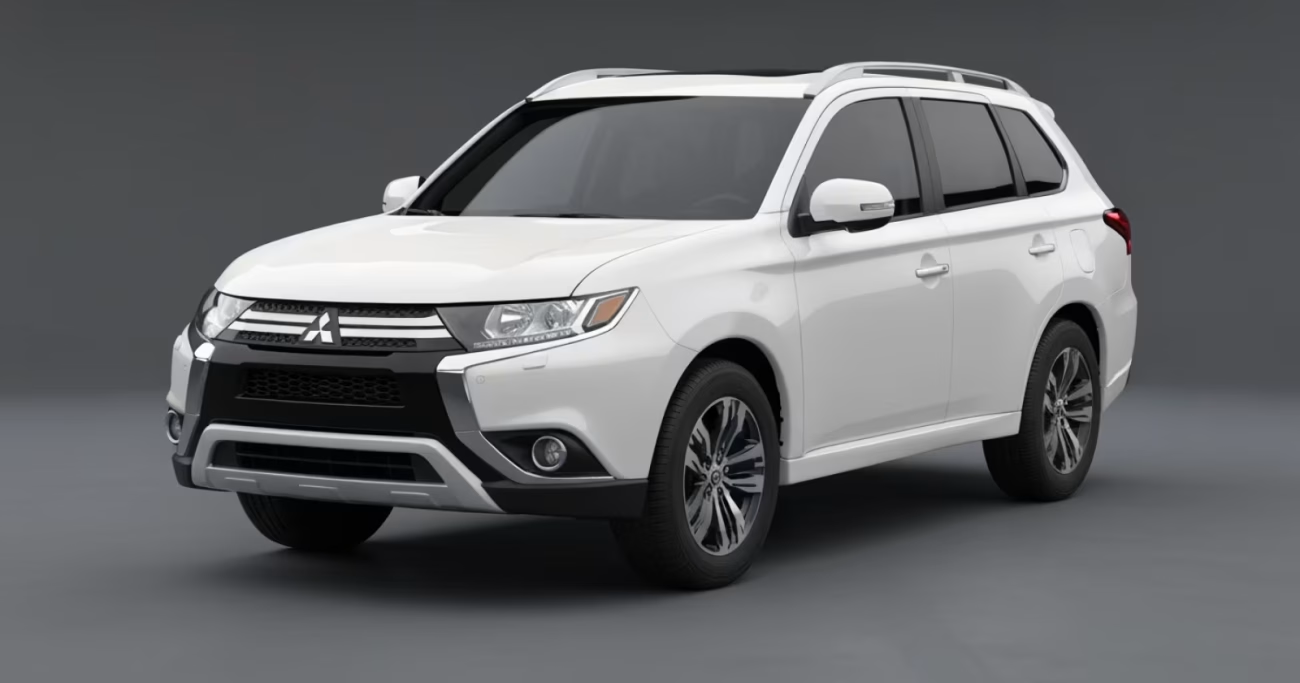
A smaller engine with less horsepower somehow making an SUV better sounds like marketing spin. But Mitsubishi just pulled it off with the 2026 Outlander, and the math actually checks out.
The refreshed 3-row crossover swaps its old 2.5-liter naturally aspirated 4-cylinder for a 1.5-liter turbocharged unit paired with 48-volt mild-hybrid assist. On paper, horsepower drops from 181 to 174. In practice, the torque jump from 181 lb-ft to 206 lb-ft changes the entire driving character of this SUV. And it all starts at $31,740 including destination.
At a glance
| Spec | Detail |
|---|---|
| Engine | 1.5L turbo I4 + 48V mild hybrid |
| Horsepower | 174 hp @ 6,000 rpm |
| Torque | 206 lb-ft @ 3,000–4,000 rpm |
| Starting price (incl. dest.) | $31,740 |
| Fuel economy (FWD) | 26 city / 31 highway mpg |
| Seating | 3 rows standard |
| AWD premium | $1,800 (includes heated seats) |
Why less horsepower actually means more muscle
I know it sounds counterintuitive. Losing 7 horsepower doesn’t scream “upgrade.” But the old 2.5-liter engine had a well-documented weakness — it felt sluggish off the line, especially with the CVT hunting for ratios. That 181 lb-ft of torque simply wasn’t enough to move a 3-row SUV with any confidence in real-world driving.
The new 1.5-liter turbo fixes this with 206 lb-ft available across a broad 3,000 to 4,000 rpm band. Add the 48-volt mild-hybrid assist providing extra shove from a standstill, and the Outlander should finally feel adequate in highway merges and passing situations. It still won’t win any drag races, but that was never the point. The point was making daily driving less frustrating, and Mitsubishi nailed that.
Toyota charges more for less — think about that
Here is where things get interesting for anyone cross-shopping. A 2026 Toyota RAV4 starts around $32,525 with destination, offers just 203 horsepower, and gives you exactly zero third-row seats. The Hyundai Tucson starts in a similar range with 187 hp and also no third row. The Outlander undercuts both while seating up to 7 passengers.
Even the base ES trim comes loaded. I’m talking a 12.3-inch center display with navigation, wireless Apple CarPlay and Android Auto, SiriusXM 360L, an 8-speaker Yamaha audio system, and a full safety suite including forward collision mitigation, blind spot monitoring, and rear cross-traffic braking. That is a lot of standard equipment for a vehicle under $32,000.
What Mitsubishi isn’t saying about the price increases
The headline number looks clean. The ES base model is only $350 more than last year’s version. But the destination fee jumped $250 to $1,745, so the real increase is $600. That is manageable. The real story is further up the trim ladder.
The SE grade costs $1,950 more than before, and it doesn’t really add any new features to justify that jump. The old top-line Platinum Edition is gone entirely, and the SEL now tops out at $42,095 — or $43,895 with all-wheel drive. That is a $2,050 increase over last year’s equivalent. Mitsubishi is clearly pushing margins on the upper trims while keeping the entry point competitive. If you are budget-conscious, the new LE trim sitting in the middle of the lineup is probably the sweet spot.
The one catch nobody is talking about
Fuel economy. You would expect a mild-hybrid turbo to deliver a meaningful efficiency gain over the old naturally aspirated engine. It doesn’t. The 2026 Outlander gets 26 city and 31 highway with front-wheel drive, compared to 24 city and 31 highway last year. That is a 2 mpg improvement in the city and nothing on the highway. With AWD, it is 26/30 versus 24/30 — the same story.
Mitsubishi isn’t advertising this as an efficiency play, and I respect that honesty. The mild-hybrid system here is about driveability, not saving fuel. If you want real hybrid efficiency from Mitsubishi, the Outlander PHEV sits right next to this one in the showroom. But for buyers who just want a better-driving gas SUV, the tradeoff makes sense.
How it stacks up
| Model | Starting MSRP | Torque | Rows | Edge |
|---|---|---|---|---|
| 2026 Mitsubishi Outlander | $31,740 | 206 lb-ft | 3 | Best value, only 3-row |
| 2026 Toyota RAV4 | ~$32,525 | 184 lb-ft | 2 | Resale value |
| 2026 Hyundai Tucson | ~$32,250 | 195 lb-ft | 2 | Tech and warranty |
| 2026 Nissan Rogue | ~$33,200 | 184 lb-ft | 2 | Interior refinement |
Why this matters
- Mild-hybrid tech is now reaching sub-$32,000 compact SUVs
- 3-row seating at this price point has almost no competition
- Mitsubishi is proving smaller displacement turbos can replace larger engines
The verdict
The 2026 Outlander is the strongest case Mitsubishi has made for itself in years. It addresses the single biggest complaint — weak low-end power — without blowing up the price or sacrificing practicality. Family buyers who need a third row under $32,000 essentially have one choice, and it just got noticeably better. If Toyota and Hyundai aren’t paying attention to what Mitsubishi is doing at this price point, they should be.
If you are shopping for a compact SUV right now, I would seriously recommend getting to a Mitsubishi dealer and driving this one back to back with a RAV4 or Tucson. The Outlander should be arriving at dealerships very soon, and that torque difference is something you will feel immediately. Do not sleep on this one.
